.png)


Dr Arvind Mayaram is a former Finance Secretary to the Government of India, a senior policy advisor, and teaches public policy. He is also Chairman of the Institute of Development Studies, Jaipur.
September 2, 2026 at 4:27 AM IST
India's economy grew 7.8% last quarter. It is worth asking why so few of the stakeholders in that economy actually believe the number. Youth unemployment has been climbing through the year. Private corporate investment, as a share of GDP, sits near a decade low, and intentions data suggests it is worsening. Net FDI has turned negative twice this year, against gross inflows the government celebrates. Imports are growing faster than exports, widening the trade deficit even as export headlines look strong. And the rupee has been Asia's worst-performing currency in 2026, past ₹96 to the dollar despite $700 billion in reserves and repeated RBI intervention. A headline figure that coexists comfortably with all five of these is not describing the economy households and investors are actually living in.
This is not a statistical dispute. It is a policy dispute. The gap between print and reality happens when growth is managed quarter to quarter rather than directed toward a coherent set of outcomes.
Youth Unemployment: PLFS data shows unemployment among 15–29-year-olds rising from 13.8% in April 2025 to 16.2% by June 2026, even as overall unemployment held near 5.5% — the burden is falling on the young and worsening in real time. Azim Premji University's surveys find close to 40% of graduates under 25 without work; even PLFS's own figures put unemployment among those with secondary education and above at 6.5–7%, well above the national rate.
Private Investment: Realised private corporate capital formation fell to about 10.1% of GDP in 2023-24, from 11.2% the year before, and stayed below 11% through 2024-25 by India Ratings' estimate. The private share of Gross Fixed Capital Formation slid to a decadal low near 33%. Most tellingly, the NSO's own survey of private capex intentions fell from ₹6.56 trillion in 2024-25 to ₹4.89 trillion in 2025-26 — even as corporate profit margins sat near a fifteen-year high. Companies have never had more cash to invest. They are choosing not to.
Net FDI: Gross FDI touched roughly $94.6 billion in 2025-26. Net FDI — after repatriation, disinvestment and outward investment — came in at just $7.6 billion, barely 8% of gross, and turned outright negative in December 2025 and again in May 2026. Attracting capital and retaining it have become two different challenges, and only one is being met.
Net Exports: This connects directly to the GDP arithmetic itself. July's merchandise exports hit a record $44.24 billion, up nearly 20% year-on-year. But imports rose faster, up 17.5% to $76.22 billion, pushing the merchandise trade deficit to a six-month high near $32 billion. Over April–July, exports grew 17% while imports grew 19.3%, and the cumulative trade deficit jumped nearly 53% to $49.43 billion. Net exports are not contributing to this year's growth story; they are a widening drag, driven largely by costlier energy imports.
The Rupee: Priced continuously by people with money at stake, it is the most immediate of the five. Down roughly 7% against the dollar since January, breaching ₹96, and Asia's worst performer this year — despite reserves near $700 billion and sustained RBI intervention.
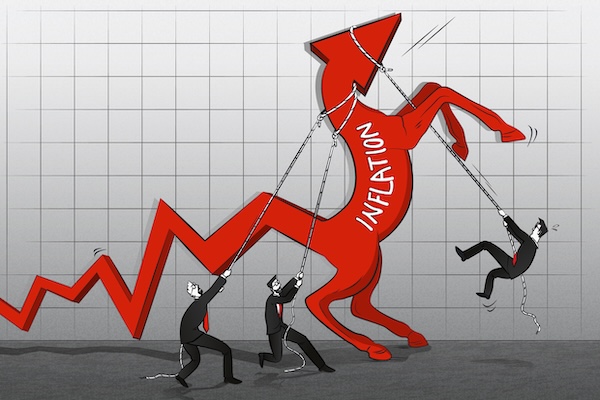
Inflation: CPI inflation climbed from a record low of 0.25% in October 2025 to 4.45% by July 2026, crossing the RBI's 4% target for the first time in over a year, by the central bank's own account. The mechanism tying all five together runs through here: a weaker rupee raises the cost of every imported barrel and tonne of fertiliser, which widens the trade deficit, which pressures the currency further, which feeds inflation and discourages the private capex needed to absorb the young workforce entering the job market each year. There is a quieter warning too: Crisil's economists note core inflation looks benign only because near-double-digit wholesale inflation hasn't fully passed through yet. Much of this quarter's strong real-growth print rested on a GDP deflator flattered by low wholesale prices. If that wholesale inflation now works through to retail prices, the same arithmetic that inflated this quarter's number will compress the next one.
This is not only the critics' reading. Much of what drove 7.8% was not durable — GST cuts and income-tax relief lifted vehicle sales sharply, cash transfers now running in seventeen states added to consumption, and government and oil companies absorbed most of the crude price shock rather than passing it on. Crisil's own forecast for the year ahead — 7% growth, 5.1% inflation, a current account deficit widening to 1.5% of GDP, and the RBI's risk balance tilting from rate cuts toward possible hikes — describes the growth-inflation mix turning "less forgiving" as reversing tailwinds bite. When a mainstream, non-adversarial forecaster describes the same pattern I have been noticing, that is no longer a fringe reading.
None of this reflects a lack of policy capacity. What is missing is a clearly signalled hierarchy among competing objectives — growth, inflation control, external stability, employment — pursued simultaneously without sequencing. Fuel taxes are adjusted rather than passed through; FX intervention holds the rupee within bounds rather than addressing what drives its decline. These choices cushion shocks; they do not compound into a trajectory.
The instructive contrast remains 2012–14, a sharper crisis by every metric — current account deficit near 4.8% of GDP, fiscal deficit above 5.5%, near double-digit inflation, rupee near ₹69. What changed the trajectory then was a clearly sequenced set of priorities and coordination between fiscal, monetary and external policy that gave markets something to price in. Growth recovered from 5.2% to 6.9% within a year, and the rupee strengthened to ₹59. India today is structurally stronger than it was then. Yet policy is proving less effective at shaping expectations, precisely because that sense of hierarchy and sequencing is missing.
The growth number is not the problem to be solved. It is the symptom pointing at the problem. Until youth employment, private investment, net FDI, net exports and the rupee start moving with the headline print, that number will keep being defended rather than believed.
More From BasisPoint