.png)

Week in Numbers: Tracking India’s Economic Pulse
Early high-frequency data suggest that weakness in economic activity, particularly in the manufacturing sector, may have deepened in August.

Datametricx is a veteran journalist tallying the macro game, keeping score of the numbers that shape India’s economy and policy.
August 22, 2026 at 7:14 AM IST
Private-sector activity, particularly in manufacturing, remained subdued. The HSBC Flash PMI showed a marginal improvement in private-sector output in August after growth slowed to its weakest pace since early 2022 in July. Growth in the services sector improved, more than offsetting the slowdown in manufacturing output, where growth fell to its weakest pace in five years.
The HSBC Flash India PMI Composite Output Index rose to 54.6 in August from July’s 54.3, a 52-month low. Although the latest reading signalled a faster expansion of private-sector activity, it was still the second-weakest since March 2022.
Indian companies reported a slightly stronger increase in new orders in August, although the pace of growth remained subdued compared with the trend observed in recent years. Anecdotal evidence suggested that challenging market conditions, competitive pressures and lower customer requirements constrained growth.
The improvement in August was driven by the services sector, which, after recording its weakest increases in business activity and new work in 53 months in July, staged a modest reacceleration as growth rates strengthened. By contrast, the manufacturing sector lost momentum, posting the weakest increases in production and new orders in five years.
Manufacturing-only data showed greater purchasing activity in August, broadly reflecting an increase in new orders. However, the pace of expansion in input purchases eased to its slowest in more than five years, contributing to softer rates of accumulation of both pre- and post-production inventories. The Flash India Manufacturing PMI fell for the third consecutive month to 52.9 in August, signalling only a modest improvement in overall factory conditions. The Flash India Services PMI Business Activity Index rose to 54.5 in August from 53.3 in July. At 54.5, the index was the second-lowest in 46 months.
Flash PMI readings have tended to overstate the final readings. Over the past 15 months, the flash composite index has, on average, been 0.4 points higher than the final reading.
Growth in the Index of Core Industries slowed to 5.4% in July from 6.0% a month earlier. The moderation was mainly due to a sharp slowdown in iron ore output growth, which fell to 29.5% from 44.5% a month earlier.
The Office of the Economic Adviser, which compiles the Index of Core Industries, recently introduced the new index adding iron ore to the existing eight core industries – coal, crude oil, natural gas, refinery products, fertilisers, steel, cement, and electricity. Despite the moderation, strong growth in iron ore output continued to keep overall core industries growth elevated. Excluding iron ore, core industries growth would have been 4.5% in July, compared with 4.2% a month earlier.
Among the other eight sectors, cement was the only one to grow in double digits, at 13.1% in July. Output of crude oil contracted for the 19th consecutive month, natural gas for the 25th straight month, and fertilisers for the fifth consecutive month in July.
Annual growth in e-way bill generation moderated to a 45-month low of 6.0% in July from 14.5% a month earlier, pointing to a slowdown in trading activity. Notwithstanding the moderation, e-way bill generation in July was the second-highest on record at 139.79 million. An e-way bill, a GST document required for transporting goods worth more than ₹50,000, is a leading indicator of economic activity. The Services PMI fell to a four-and-a-half-year low in July.
India’s overall unemployment rate fell to a four-month low of 5.1% in July from 5.5% a month earlier, driven primarily by sharp decline in unemployment among young rural women. The unemployment rate among rural population fell to 4.5% in July from 5.0% a month earlier, while it rose to 6.7% from 6.6% among the urban population.
The youth unemployment rate fell to 15.6% in July from 16.2% a month earlier, as unemployment among rural youth fell to 14.1% from 15.1%. However, unemployment among urban youth increased to a six-month high of 18.6% from 18.2% during the same period. The unemployment rate among young rural women fell to 16.0% from 18.6%, even as the rate among young urban women increased to 27.2% from 25.3% during the same period.
Meanwhile, the overall labour force participation rate — the share of working-age population that is employed or actively seeking work — increased to a four-month high of 55.4% in July from 54.4% a month earlier.
Domestic air passenger traffic contracted for the fourth time in five months, as disruptions caused by the war in West Asia and higher airfares resulting from a sharp increase in crude oil prices continued to weigh on demand. Passenger traffic fell 4.8% year-on-year to 12.00 million in July. This was the sharpest fall since January 2022 and the lowest domestic air passenger traffic in absolute terms in 44 months. Passenger traffic of IndiGo, the largest domestic airline, declined 1.6% to 8.08 million in July. Passenger traffic for the Air India Group declined 13.1% year-on-year to 2.88 million.
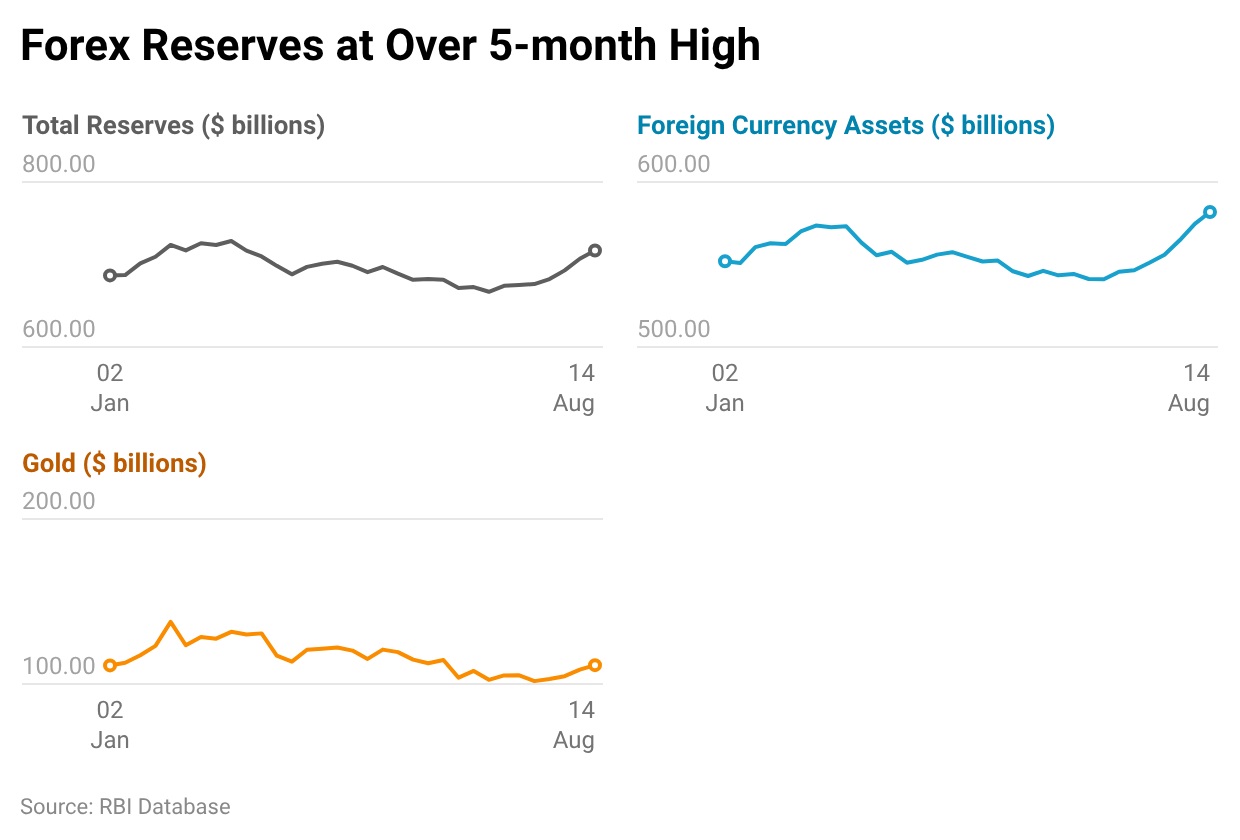
India’s foreign exchange reserves rose to a 24-week high, aided by strong inflows under schemes announced by the Reserve Bank of India to attract foreign currency and rise in gold prices. Total foreign exchange reserves increased by $9.91 billion to $716.91 billion in the week ended August 14. Foreign currency assets rose by $7.23 billion to $581.85 billion, while gold reserves increased by $2.68 billion to $111.42 billion. The RBI’s reserves have risen by about $35 billion since the central bank announced the schemes in the first week of June.
Reservoir storage increased but remained below historical averages. As of August 20, live storage in 166 reservoirs stood at 117.77 billion cubic metres, up 8.66 billion cubic metres from a week earlier. Live storage was at 64% of total reservoir capacity. However, storage was 17% below last year’s level and 3% lower than the 10-year average. Reservoirs are replenished during the southwest monsoon.
Southwest monsoon rainfall remained deficient, particularly in eastern and southern parts of the country. As of August 21, cumulative rainfall over the country was 544.3 millimetres, or 87% of the long-period average. Among the four regions, rainfall was 74% of the long-period average over east and northeast India, 77% in the south peninsula, 89% in northwest India, and 98% in central India. Rainfall was 63% of the long-period average in June, 101% in July, and 85% through August 21.
As the sowing season neared its end, the area under kharif crops remained below last year’s level amid deficient monsoon rainfall. The total area sown under kharif crops fell 1.5% year-on-year to 105.67 million hectares as of August 21. Rice acreage declined 3.2% to 40.51 million hectares. The area under pulses rose 1.3% to 11.36 million hectares, but oilseed acreage declined 0.2% to 18.84 million hectares. Sugarcane sowing declined 0.7% to 5.84 million hectares, while the area under cotton fell 0.3% to 10.85 million hectares. The area sown so far accounted for 96% of the normal kharif area of 110.45 million hectares.
Coming up
- August 28: Index of Industrial Production for July
- August 31: Quarterly Estimates of GDP for April-June
- September 1: HSBC India Manufacturing PMI for August
Tailpiece
The number of establishments that are not incorporated or registered under the Companies Act rose 9.2% year-on-year to 86.7 million units in April–June. Employment in these establishments was estimated at 137.0 million during the quarter, up 6.6%.
More From BasisPoint