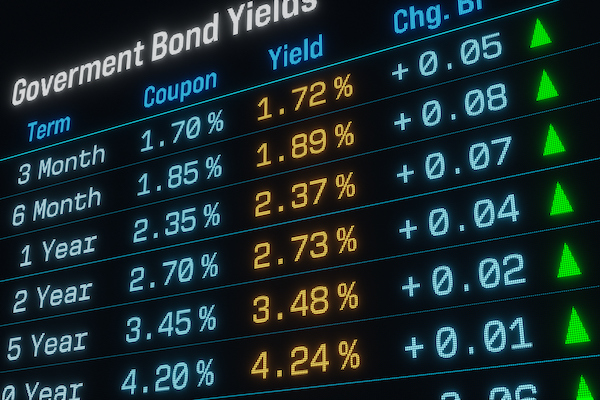
The surge in domestic bond yields should not be mistaken for the market doing the Reserve Bank of India’s work. Higher yields are tightening financial conditions, but the speed and scale of the move point to market dislocation, compounded by uncertainty over the central bank’s liquidity management.
System liquidity has swung from a surplus of ₹11.6 trillion in early September to almost no surplus now, with occasional deficits. Over the same period, three-month certificate of deposit yields have jumped to 7.65% from 6.30%, an increase of 135 basis points. One-year CD yields have climbed to 8.10% from 7.15%.
The strain extends across maturities.
The 10-year government bond yield has risen to 7.45% from 6.95% in September, and the five-year yield to 7.20% from 6.60%. Yields on two- to three-year AAA-rated public sector bonds have increased to 8.25% from 7.60%. Across these instruments, yields have moved up by 50–135 basis points in roughly 45 days.
One-year dollar/rupee forward premiums have meanwhile risen to 4.35% from 3.10% in early September. Global factors explain part of this repricing, but the reversal in domestic liquidity has added to the uncertainty.
That reversal is particularly striking after the mobilisation of $133 billion in foreign currency non-resident (FCNR) deposits. The RBI’s measures eased medium-term foreign exchange funding concerns but created a large liquidity surplus. In absorbing that surplus, the central bank appears to have gone to the other extreme, leaving markets to adjust abruptly from abundant liquidity to scarce funds.
Since mid-October, the RBI has shifted from variable rate reverse repo auctions, which absorb liquidity, to variable rate repo auctions, which inject it.
An earlier column had anticipated that transition only in January–March 2027. Its arrival much sooner underscores the difficulty of judging how the central bank will respond to the effects of its own measures.
Also Read:
The RBI Buys Time, but Can It Turn the Rupee Around?
Traders demand a higher premium for that uncertainty. Crediting the resulting rise in yields as effective monetary tightening would overlook the disruption behind it. A sustained decline in yields will require greater confidence in the predictability of the RBI’s response, rather than merely another round of liquidity operations.
Investor Market
These conditions make bonds an ‘investor’s market’ rather than a trader’s one. Corporate treasuries and insurance companies willing to hold for several months may find value at specific yields. For traders like primary dealers and banks operating over weeks, an attractive entry yield offers little comfort if another liquidity shift or a wave of supply pushes prices lower.
The funding outlook reinforces that distinction.
With one-year dollar/rupee forward premiums at 4.35–4.50%, hedging costs could sharply reduce corporate demand for external commercial borrowings. More borrowers would then turn to rupee loans and domestic bond markets, adding to funding pressures even as yields appear increasingly attractive.
Those additional borrowing needs would arrive ahead of January–March 2027, a period traditionally marked by heavy supply. Gross issuance of state development loans could exceed ₹5.5 trillion during the quarter, increasing competition for domestic funds.
Public financial institutions, whose dollar borrowing plans have been put on hold, are also adding to issuance in the one-year CD segment, where yields are near 8.20%. That funding pressure is likely to keep two- to three-year corporate bond yields elevated. Spreads may therefore have further to widen.
Nor is there an obvious source of sustained buying from trading portfolios. Foreign banks approaching their December year-end may be reluctant to add risk after much of the year has been marked by rising yields. Public sector banks, carrying significant mark-to-market losses, may use relief rallies to reduce exposure.
For traders in the 10-year benchmark, the immediate choice may be between covering short positions at 7.45% and cutting long positions after any rally towards 7.30%. Selective demand from investors can coexist with that defensive trading behaviour. It need not produce a durable rally.
External Constraints
A terminal repo rate of 6% now looks likely, with the daily weighted average call rate fluctuating between the repo rate and the marginal standing facility rate. Yet greater clarity on the eventual policy rate would not, by itself, resolve uncertainty over liquidity management or the measures used to support the rupee.
With ₹97 to the dollar appearing to be the RBI’s line of defence, and equities retaining support from systematic investment plans, the bond market may continue to absorb the consequences of those policy choices. The 10-year yield could hover in a 7.25-7.75% range in the remainder of 2026-27.
Geopolitical risks add to the difficulty of trading a sustained recovery.
The period after the November 3 US midterm elections carries the risk of renewed escalation in West Asia. A major US military operation against Iran, alongside Israel, could trigger a fresh flight from risk and push Brent crude above $120 a barrel.
The latest decline in 10-year US Treasury yields, following a sell-off in artificial intelligence stocks, appears to reflect a flight to safety. It offers limited reassurance about the domestic funding pressures keeping Indian yields elevated.
January–March 2027, particularly the period after the Union Budget, may offer a better opportunity to add duration and shorter-maturity corporate bonds if more of the supply and policy risks are reflected in prices. For now, higher yields may attract selective investors, while traders continue to use sharp rallies to reduce exposure. A more durable recovery will require greater stability in liquidity management and a return of capital flows.
.png)