.png)


Kirti Tarang Pande is a psychologist, researcher, and brand strategist specialising in the intersection of mental health, societal resilience, and organisational behaviour.
July 26, 2026 at 5:35 AM IST
Someone left a Google review of Jantar Mantar, "Terrible customer service by Delhi Police. Would not recommend."
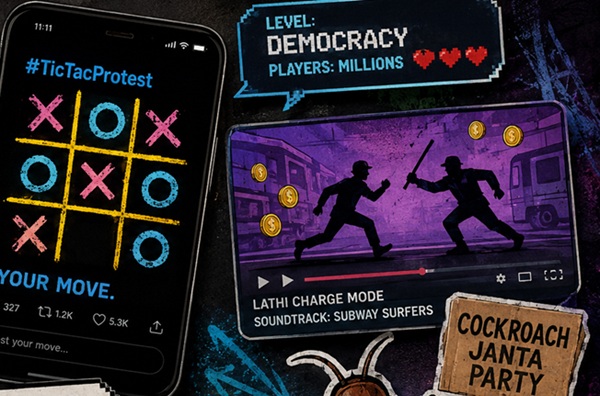
On X, a user drew a tic-tac-toe grid on the Prime Minister's face.
More precisely, someone took Narendra Modi's video addressing protesting students, superimposed a hashtag-shaped game board over his forehead, posted it on X, and citizens began playing. Replies flooded in with X's and O's, victory claims, creative doodles and invitations for Grok to make the next move. Nobody organised the crowd. Nobody summoned them. People simply spotted a format they knew by heart and jumped in and gamified political dissent.
Protest videos of police lathi charges appeared with the soundtrack of Subway Surfers. When a judicial figure described protesters as "cockroaches", they arrived wearing cockroach costumes and formed the "Cockroach Janta Party".
Commentary is treating it as disconnected moments of internet humour. Did institutions realise what actually happened? Did they understand the fundamental redesign of political participation behind those views? And it is a design by the people for the people.
Previous generations largely relied on demonstrations, speeches, slogans, hunger strikes and petitions. Digital-native citizens have inherited those objectives but rebuilt the user interface around the interaction models they use every day: games, memes, remix culture, avatars, comments and collaborative participation.
The designer Donald Norman called these affordances. It means the actions that a design naturally invites. A door handle invites pulling. A button invites pressing. A touchscreen invites tapping, swiping and pinching. Gen Z grew up inside interfaces designed around participation rather than observation. When they turned towards politics, they were not simply protesting on streets and posting onto digital platforms, but made the protest native to the internet by making it a game you can play, a meme you can remix, an identity you can wear, and a running joke you can join with one tap. And it is far more powerful because it lowers the barrier to entry dramatically and creates deeper psychological engagement. It changes the nature of protest, not just the reach.
The result is not one new protest tactic. It is an entirely new Protest OS. Like every operating system, it consists of multiple applications performing different functions while running on the same architecture. Each recruit participates differently and produces a distinct behavioural effect.
For example, the tic-tac-toe meme borrows from mobile gaming's core design principle: collective play with immediate feedback and zero barrier to entry. You do not need to understand NEET or the Education Ministry to place an X on a grid. Behavioural research has long established that reducing the effort required to participate increases the likelihood of participation. This a principle BJ Fogg formalised as the behaviour model and Thaler applied to choice architecture. When the cost of dissent falls to the effort of a single tap, the population of dissenters expands accordingly. Social proof does the rest: each new move signals to the next person that participation is already underway, safe, and expected.
The remix layer operates differently. Placards reading "We asked for Make in India. You gave us Leak in India." required no lengthy explanation because they borrowed the government's own language. Instead of inventing a new slogan, protesters inverted an existing one. Familiarity did most of the persuasive work as the source material itself became the criticism.
When protesters take scary videos of lathi charges by police and edit them with the Subway Surfers game soundtrack, they are turning a moment of powerlessness and fear into something the protester has control over and just like that they become the player, not the victim. Goffman has shown us that how you present an event changes how people feel about it and react to it. By reframing "I’m getting chased by police" as "I’m playing an endless runner game with cop chaser," the protesters can reduce distress and make the experience psychologically easier to process.
Psychologists call this cognitive reappraisal. It is one of the most effective ways humans have to manage difficult emotions. It lowers stress and makes the memory easier to live with and share. In the protest it serves multiple strategic and psychological functions at once: It bypasses censorship of graphic content and protects the message. It protects the protester emotionally by reducing fear and increases the reach by making it more shareable and entertaining.
This reframing is not just limited to events. Gen Z is reframing themselves too. When a judge called the protesters “cockroaches,” most people would expect anger or denial. Instead, the protesters said, “Okay, we’re cockroaches” and then showed up in cockroach costumes and created the Cockroach Janta Party. They took the insult and proudly made it their brand. By owning the slur, Gen Z flipped the power dynamic. The word that was meant to degrade and dehumanise them became something they chose to wear with pride. The insult stopped being a weapon used against them and became a flag they waved themselves.
Research on social identity shows that when people see their actions as “This is who I am” rather than “I’m taking a risky stand,” they become much more committed and consistent. It’s no longer just a protest they’re attending, it is group they belong, it’s an expression of their identity. They turned passivity— “Power called me this”—into agency —“We call ourselves this”. Power named them. So, they renamed themselves and agency replaced stigma.
Even the Google reviews reveal the same operating system at work. It borrowed the interface of consumer feedback and applied it to democratic accountability. Rather than filing a formal complaint, students used a rating system they trusted, understood and interacted with every day.
Economist Albert Hirschman had long predicted it. He argued that when people are unhappy with an organisation or government, when their “voice” — complaining, protesting, voting, petitioning, stops working, they basically have two options: either exit or find new creative alternatives to express their dissatisfaction.
However, Hirschman could never have imagined what the internet would enable. Digital platforms didn’t just give people more ways to speak. They gave them an entire new vocabulary for designing protest. This is where the institutional consequence becomes structurally significant because rules of engagement have changed.
Institutions—governments, political parties, universities, police, media, etc, which were built for one-way communication, where they speak and the public just listens, are now facing citizens who expect to actively participate and interact. This creates a serious mismatch. Citizens expect to co-create, respond in real time, remix, play with, and shape the conversation.
Behavioural research consistently finds that people invest more deeply in ideas they help create than those they merely consume. Governments celebrated the reach of official videos. Protesters celebrated redesigning what those videos could become. One side still believes communication ends when the message is broadcast. The other assumes it begins when the audience starts editing it. Citizens are no longer simply receiving political messages. They are playing, rating and remixing them. The audience has become the author.
When someone left a one-star review of Jantar Mantar. They weren't reviewing a monument. They were reviewing democracy's customer service.
More From BasisPoint