.png)

India's $16 Billion Travel Bill Is Not What It Seems
Travel now accounts for 56.7% of India's outward remittances under the LRS, but the category also includes overseas education. Distinguishing between the two is essential to understanding remittance trends and designing policies to conserve foreign exchange.


Rajesh Kumar teaches economics. His interests include monetary policy, international trade, and macroeconomic frameworks.
November 14, 2026 at 7:03 AM IST
Travel’s share of India’s outward remittances under the Reserve Bank of India’s Liberalised Remittance Scheme has risen from 31% to 57% in a decade. New RBI data show that this category comprises two very different expenses: one for tourism and another for education.
On May 10, 2026, Prime Minister Narendra Modi appealed to citizens in Hyderabad to conserve foreign exchange amid the West Asia crisis. Among other measures, he reportedly asked them to postpone foreign travel for at least a year. Early data show no clear decline. Travel remittances under the Liberalised Remittance Scheme between May and August 2026 were 1.0% higher than in the corresponding period a year earlier.
Within this period, remittances for holidays fell from $853.1 million in June to $713.8 million in August, while those for education rose from $488.3 million to $855.5 million. Without a comparable year-ago breakdown, however, it is difficult to establish how much of these movements can be attributed to the appeal and how much reflects seasonal factors.
The appeal comes against the backdrop of a sharp increase in travel-related remittances. In 2016-17, Indians sent $2.57 billion abroad for travel under the scheme. By 2025-26, the figure had risen to $16.44 billion, more than six times the earlier amount and equivalent to 56.7% of all LRS outflows. The figure might appear to represent a bill for foreign holidays. The Reserve Bank of India's latest data show that the reality is more complicated.
Travel has driven almost all the growth in the scheme. Since 2019-20, it has accounted for 92.8% of the increase in LRS remittances. Over the same period, remittances under the Studies Abroad category fell 53.7%, while those for the maintenance of close relatives increased just 2.9%.
Figure 1: Travel Now Takes 56.7% of Outward Remittances, Up From 31.4% in 2016-17
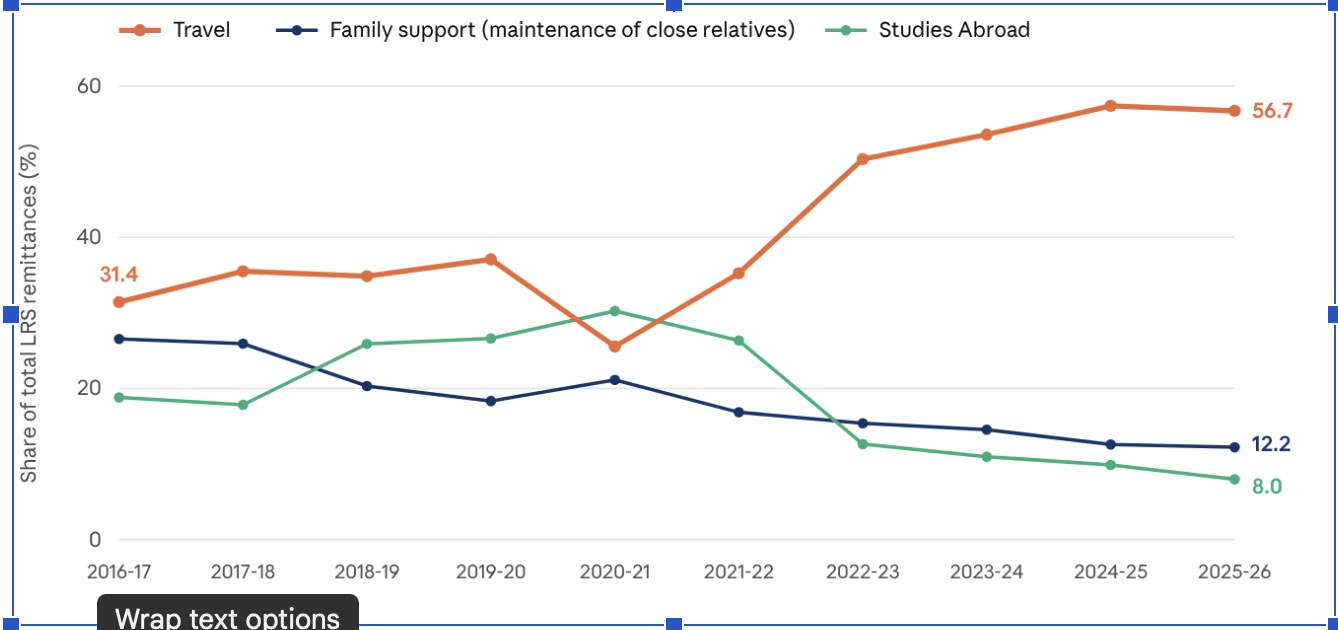
Source: RBI, LRS yearly and monthly tables. Shares and the 2025-26 total are the author's calculations.
The dollar figures suggest that travel remittances have plateaued. They peaked at $17.01 billion in 2023-24 before slipping to $16.44 billion in 2025-26. In rupees, the bill continued to rise. At the average RBI reference rate for each year, it increased from ₹1.41 trillion to ₹1.45 trillion.
Two Bills
The RBI began separately reporting travel-related remittances by purpose in March 2026, making a full-year comparison of the components impossible for now. However, the April-August 2026 breakdown shows why the aggregate travel figure can be misleading.
Other travel, which covers "holiday trips and payments for settling international credit card transactions", accounted for 55.9% of travel remittances. Travel for education, which includes “fees, hostel expenses etc.", accounted for another 41.6%. Business, pilgrimage and medical travel together made up just 2.5%. In other words, about 42 cents of every dollar remitted under the travel category went towards education.
Tourism Bill
The outbound travel boom itself is real. Indian departures reached 32.83 million in 2025, up 6.3% from 2024 and about 22% above the 26.92 million recorded in 2019. Leisure accounted for 43.4% of departures in 2025, while visits by the Indian diaspora accounted for 34.1%. Yet the 22% rise in departures contrasts with a 136% increase in LRS travel remittances since 2019-20. More expensive holidays may explain part of the gap, but they may not account for all of it.
Policy has also pulled in two directions. The Union Budget reduced tax collected at source on overseas tour packages to a flat 2% from April 1, 2026. Less than six weeks later, the Prime Minister appealed to citizens to defer foreign travel.
Education Bill
Education carries a weight far beyond its share of outbound travellers. India Tourism Statistics 2026 shows that education accounted for just 1.9% of departures in 2025, yet it represented 41.6% of LRS travel remittances in April-August 2026. Although the periods and measures differ, the same report offers a clue: the average education-related trip lasted 133.91 days, compared with 24.06 days for leisure travel.
This also changes how the decline in the Studies Abroad category should be interpreted. Remittances under this category fell from $5.17 billion in 2021-22 to $2.31 billion in 2025-26. However, an RBI footnote clarifies that the category covers education availed remotely, without travelling abroad. Students travelling overseas for education are classified under travel. Combining the two categories puts education-related remittances at 28.2% of LRS outflows in April-August 2026, rather than the 5.3% represented by studies abroad alone.
The annual data hint at the same classification shift. In 2022-23, travel remittances nearly doubled to $13.66 billion, while Studies Abroad remittances fell by a third to $3.43 billion, even as student departures increased. Tourism was also reopening that year, so the published data cannot establish whether some student-related payments shifted between categories. Nevertheless, the divergence between the two trends is noteworthy.
The number of students going abroad for higher education is falling. The Ministry of Education told the Rajya Sabha that the number of students leaving India for higher education declined from more than 908,000 in 2023 to 626,000 in 2025. Whether education-related remittances have fallen alongside student departures remains unclear, as the RBI has not published a historical breakdown of travel remittances for education.
Two Maps
The RBI data do not reveal where the money goes. The Ministry of Tourism, however, tracks departures by destination and purpose rather than remittance values. Its data offer a glimpse into two distinct patterns.
The destination data reveal distinct patterns in leisure and education travel. The UAE recorded about 3.06 million Indian departures in 2025, of which 52.5% were visits by the diaspora. Thailand recorded 2.07 million departures, with 93.0% for leisure. The US recorded 948,000 departures. Student destinations look quite different. The US led as a destination for education-related departures, with about 130,000, followed by the UK with 121,000 and Australia with 67,000. The Ministry of External Affairs’ count of Indian students already abroad as of January 1, 2025, shows that 427,085 of the 1.25 million Indian students enrolled in universities overseas were in Canada. This difference arises because annual departures capture the movement of students during a year, whereas enrolment figures reflect the stock of students studying abroad at a given point.
One Account, Two Purposes
The balance of payments shows how much depends on this distinction. Total travel payments rose 62.5% from 2019-20 to 2025-26, to $35.77 billion, according to preliminary estimates. LRS travel remittances grew much faster, with their share of total travel payments increasing from 31.6% to 46.0%. This suggests that part of the increase may reflect a shift in the channel through which payments are made, rather than an equivalent rise in overall spending.
Receipts from foreign visitors grew just 6.3% to $31.88 billion over the same period. As a result, India’s travel account moved from a surplus of $7.99 billion to a deficit of $3.89 billion.
Economic theory also suggests that the two bills should not be treated alike. Gary Becker (1964) described spending on education as an investment in human capital that can raise future earnings. A holiday, by contrast, is consumption. In India’s foreign exchange accounts, however, both are classified under travel. The distinction has its limitations: graduates who remain abroad may take much of the economic return on that investment with them. Nevertheless, it matters when assessing appeals to conserve foreign exchange. A family can postpone a holiday far more easily than it can defer a semester of study, so the same call for restraint has very different implications for the two categories.
Reading the Bill
A decade ago, travel accounted for less than a third of the money Indians sent abroad under the LRS. Today, it accounts for more than half. But the category encompasses considerably more than foreign holidays. Some of that money pays for a week in Phuket. Some pays for a hostel stay in Toronto. India will understand its outbound remittance trends better only when it can distinguish between the two.
The policy lesson is straightforward. Measures intended to conserve foreign exchange should distinguish between tourism and education rather than treat all travel as a single category. A holiday can wait. A semester is far harder to postpone.
More From BasisPoint