.png)

India-China Détente and Blumenthal’s Sanctions
India’s pushback against US sanctions over Russian oil comes as New Delhi and Beijing seek to turn a fragile thaw into a broader reset in ties. The development points to a more assertive Indian foreign policy.
Rajesh Ramachandran is a former Editor-in-Chief of The Tribune group of newspapers and Outlook magazine.
September 18, 2026 at 10:32 AM IST
Finally, the relentless neo-colonial attack on Indian sovereignty by the bipartisan US legislature has resulted in a crack in the edifice of bilateral relations built over the last three decades. India responded to the crass language and condescending dictates of US Senator Richard Blumenthal by pointing to the “potential implications” of his sanctions bill for the “bilateral relationship” between India and the US. This is the strongest statement yet by the Indian government against the US, and for good reason.
Blumenthal is a Democrat, a classmate of the Clintons and a friend of the Obamas and the Bidens. His role in advancing legislation that would sanction India for buying Russian crude by imposing tariffs of up to 100% on Indian goods is the latest sign of the US establishment dropping its fig leaf of MAGA unreasonableness and Trumpian eccentricities. This is the US establishment attempting to interfere in India’s decision-making and hijack its energy security.
Blumenthal elaborated on how this lethal trade and diplomatic weapon against India came about, explaining that the “idea for sanctions combined with tariffs was hatched on one of those overnight train rides and we developed it over a couple of years…” Blumenthal was obviously referring to the late US Senator Lindsey Graham, a prime advocate of the measure, and to the overnight train journeys they undertook to Kyiv, the Ukrainian capital. This suggests that the idea for the sanctions bill predates the Trump administration.
The timing of the bill’s passage is interesting. It is as if the US establishment was waiting for the BRICS leaders’ summit to conclude before slamming Prime Minister Narendra Modi with legislation dictating where India should source its energy. Only the list of Anglo-American oil companies that would benefit from India’s energy needs remained unstated. However, the brazen US attempt to threaten and interfere in India’s affairs was, for a change, met with unprecedented pushback.
India has issued a statement refusing to kowtow to the US colonial decree. “The Indian side has also made clear its determination to take all necessary measures to protect its trade and economic interests. Government will work closely with Indian trade and industry bodies to deal with the implications of these developments.” This is not diplomatic gobbledegook, but a sure-footed move to clearly define the red lines of sovereignty that the empire tried to erase.
This pushback is in line with Prime Minister Modi warmly greeting Iranian President Masoud Pezeshkian and leading him hand in hand to the BRICS venue. The India-Iran bonhomie was a diplomatic correction to an earlier ill-advised and ill-timed visit to Tel Aviv on the eve of the US-Israel attack on the Persian regime and people. India’s correction paid big dividends, though the pro-Western commentariat in the country refused to appreciate the gains of the diplomatic initiative. India could get the heads of Iran and the UAE into the same room and speak to each other without a Western interlocutor.
Then there were the four paragraphs of the BRICS New Delhi Declaration that unequivocally supported the Palestinian cause and the people of Gaza. This reference to the crisis in Gaza can also be read as a clean rupture with India’s blind alliance with Israel.
While condemning Israel’s human rights violations, naming the country and underscoring its legal obligation to ensure humanitarian aid in Gaza in the strongest possible terms, the Declaration includes a reaffirmation of “support for Palestine’s full UN membership as part of an unwavering commitment to the two-state solution, in accordance with international law, relevant UN resolutions, and the Arab Peace Initiative. This includes a sovereign, independent and viable State of Palestine within the internationally recognised 1967 borders (Gaza Strip and West Bank), with East Jerusalem as its capital, so that two states can live side by side in peace and security.”
All this is new for a government that has long viewed West Asia, particularly the Israel-Palestine conflict, through the prism of domestic communal polarisation. Religious separatism in Jammu & Kashmir, to a great extent, shaped domestic political opinion against the genuine aspirations of the Palestinian people, and this too is being corrected by a hardline Hindutva government. Interestingly, separatist leader and Kashmir’s Mirwaiz, Umar Farooq, met President Pezeshkian at an event held on the sidelines of the BRICS summit at the Iranian embassy. This amounted to New Delhi displaying confidence in people across the political spectrum in the Kashmir Valley.
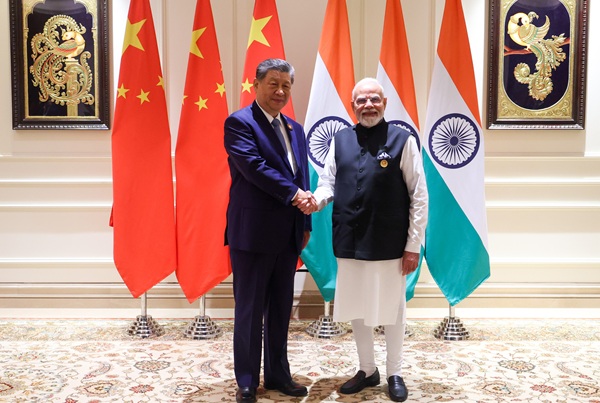
But all this remained just a sideshow compared with the bilateral summit meeting between India and China. Blumenthal’s reference to India and China together, while speaking about his sanctions legislation, was notable. He addressed India and China together, condescendingly telling two of the world’s biggest and oldest nations: “To China and India: You better clean up your act. Buy your oil and gas somewhere else.” This came too soon after the India-China bilateral to be overlooked.
The thaw in India-China relations was being made official, with a new chapter in the bilateral relationship announced through Chinese President Xi Jinping’s visit to India after seven long years. These were years of painful deadlock over border disputes, a military standoff, the suspension of direct flights and grave mutual suspicion. Russian intervention at Kazan in October 2024 helped de-escalate border tensions, while the second Modi-Xi meeting at Tianjin in China in September 2025 normalised the ties.
The bilateral meeting in Delhi has taken the relationship substantially forward, with the Chinese side declaring that India and China are partners, not rivals; that their relationship offers opportunities, not threats; that both should help each other succeed; and that irritants should be removed with political wisdom. The Indian Blumenthals have already seized on a China-Pakistan boundary agreement to delegitimise the Himalayan strides that the two giant neighbours made towards peace and mutual understanding earlier this week.
This is the opening of a new era, with the potential for the centre of global economic and strategic power to tilt further towards Asia.
More From BasisPoint