.png)

Amir Shaikh is Associate Director at CareEdge Advisory
October 29, 2026 at 7:16 AM IST
El Niño is a natural weather cycle in which parts of the Pacific Ocean become warmer than usual. The intensifying El Niño conditions in 2026 are rapidly shaping the agricultural outlook, commodity prices and global temperatures for 2027.
In the latest monetary policy statement dated October 7, 2026, the Reserve Bank of India (RBI) explicitly identified the deficient southwest monsoon and strong El Niño conditions as risks to the agricultural outlook and rural demand. The assessment marks a strengthening of the RBI’s earlier caution, with the central bank now referring to “strong El Niño conditions” rather than merely the emergence of El Niño-related risks. Nevertheless, healthy foodgrain buffers and proactive government interventions are expected to provide a degree of protection against the adverse impact.
The regional averages mask wide internal disparities, from Odisha’s 29% surplus to Marathwada’s 39% deficit, and from West Uttar Pradesh’s 17% surplus to Punjab’s 41% deficit. This polarised rainfall pattern is more consequential than the headline deficit, as simultaneous shortfalls across major agricultural belts could increase irrigation dependence, weaken reservoir recharge and create uneven pressure on crop output and rural incomes.
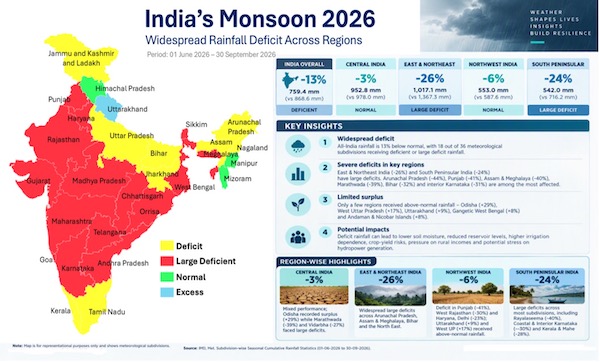
In major crop-producing states, the production effect depends on both the size of the rainfall gap and its timing. Uttar Pradesh and Maharashtra, which are central to sugarcane output, face heightened yield and recovery risks when rainfall and irrigation availability weaken because sugarcane is water-intensive. Deficits in rice-growing areas can constrain transplantation and grain formation, while shortfalls in pulse- and oilseed-producing regions can reduce yields where irrigation coverage is limited. Intense rainfall may still cause local flooding without fully restoring soil moisture, groundwater or reservoir storage.
Water, Energy Remain Key Concerns
El Niño can affect water availability, agricultural productivity and marine ecosystems. The Central Water Commission’s latest available weekly bulletin, dated October 1, 2026, covered 178 reservoirs with combined live-storage capacity of 184.762 billion cubic metres (BCM), including 20 hydroelectric-project reservoirs with 35.299 BCM of capacity. This provides the appropriate current benchmark for reading the rainfall deficit alongside irrigation, drinking-water and hydropower risks.
The second source of pressure emerges when weather-related risks coincide with elevated energy, fertiliser and transportation costs arising from geopolitical uncertainty. Fuel is critical across the agricultural and food value chain, including fertiliser production, irrigation, farm machinery, transportation, processing and refrigeration.
The RBI has indicated that an uncertain global economic environment, elevated energy prices and supply-chain pressures could have some bearing on domestic economic activity. El Niño-related rainfall volatility could amplify these pressures by affecting agricultural production and food availability. Nevertheless, adequate foodgrain stocks, proactive supply management and government initiatives relating to crop diversification, short-duration crops, climate-resilient varieties, water harvesting and conservation could partially mitigate the impact.
Sustained momentum in services, the continuing impact of GST rationalisation and broadly stable employment conditions may continue to support urban demand. However, the outlook for rural consumption is likely to remain more closely linked to rainfall distribution, crop realisations, input costs and the effectiveness of policy support.
Food Inflation
CFPI inflation rose sharply from 2.13% in January 2026 to 5.95% in August 2026, signalling renewed food-price pressures. The sustained increase highlights growing inflationary risks amid evolving El Niño conditions, particularly through their potential impact on rainfall, crop yields and food supplies.
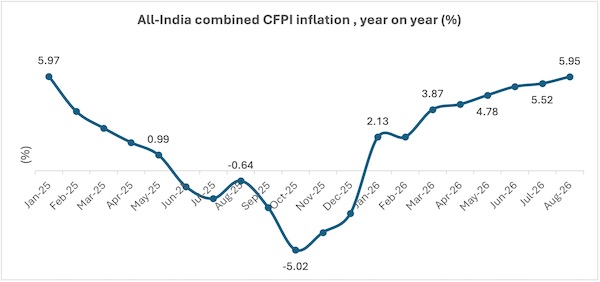
Source: Ministry of Statistics and Programme Implementation, monthly CPI/CFPI releases.
Conclusion
India’s 2026 rainfall experience shows that a 13% all-India deficit can coexist with substantial variation across states and districts. The result is a broad but uneven risk landscape for agriculture, reservoir replenishment, rural incomes and food inflation, with the sharpest exposure in rain-fed areas and water-intensive crop belts.
The economic consequences of El Niño will ultimately depend less on the national rainfall number and more on the location, timing and intensity of rainfall relative to crop cycles and water requirements. Regions facing sustained rainfall deficits remain vulnerable to crop stress and lower water availability, while concentrated rainfall events can generate flood-related damage without adequately addressing underlying moisture deficits.
Looking ahead, the policy response should prioritise weekly monitoring of rainfall and reservoir storage, crop-specific contingency planning, efficient irrigation, timely input support and calibrated food-supply management. The central analytical task is to connect state-level rainfall and water availability with major crop calendars so that emerging production and price pressures are identified early and addressed with practical interventions.
(This article is published by arrangement with CARE Analytics and Advisory Private Limited)
More From BasisPoint