.png)

Why the RBI Cannot Leave the Rupee to Market Forces
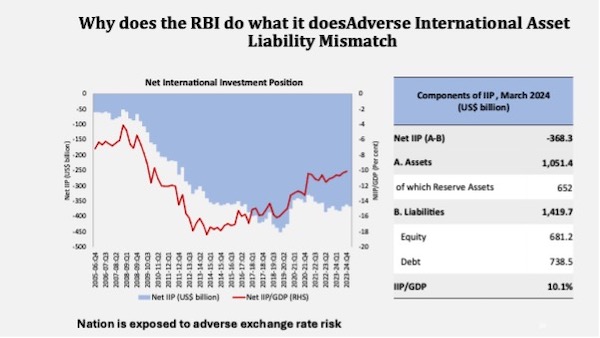
Why does the RBI intervene at all? Despite being the world’s fifth-largest reserve holder, its gross foreign liabilities exceed its reserves quite substantially, by over 10% of GDP. And then there is this growth angle too

Michael Patra is an economist, a career central banker, and a former RBI Deputy Governor who led monetary policy and helped shape India’s inflation targeting framework.
November 9, 2026 at 2:06 AM IST
Why does the Reserve Bank of India intervene at all, instead of allowing the rupee to float freely? Wouldn’t that work towards securing the independence of monetary policy?
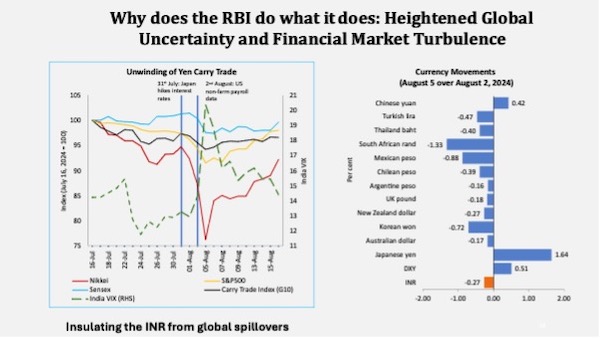
To take an example, frenzy rose to a flash point on August 5, 2024, following the first rate hike by the Bank of Japan on July 31 after the pandemic.
In a couple of days, the release of weaker-than-expected US non-farm payrolls data on August 2 sparked immediate concerns on Wall Street about an economic slowdown. It raised expectations that the Federal Reserve would soon cut interest rates.
A bloodbath reminiscent of Black Monday of 1987 was unleashed across financial markets worldwide as the yen carry trade unwound. The fear gauge – the Volatility Index or VIX – jumped more than 50%, to its highest level since 2020.
Once again, on a single data release on September 3 of the same year – the US Institute of Supply Management (US ISM) manufacturing index – recessionary fears resurfaced, setting off a rout in US equity markets that quickly spread to Asia and Europe.
Thus, markets are always recalibrating, albeit in a disorderly fashion. Every incoming data point seems to be sparking fears of a jarring end to the prevailing stance of monetary policy.
Markets have also demonstrated substantial resilience. The speed of recovery from the shocks I described has been remarkable. Leveraged positions have been rebuilt. Risk-taking resumed, although the widening of the conflict in West Asia from October 2024 depressed equity market sentiment and pushed up volatility in commodity prices, especially of gold and crude oil.
Why the RBI Does What it Does
The Trump tariff announcements in early 2025 had a similar effect of churning the cauldron. Buffering up with reserves to hedge against uncertainty is the way angels would want to tread. This is the principal reason why the exchange rate’s stability matters for the RBI.
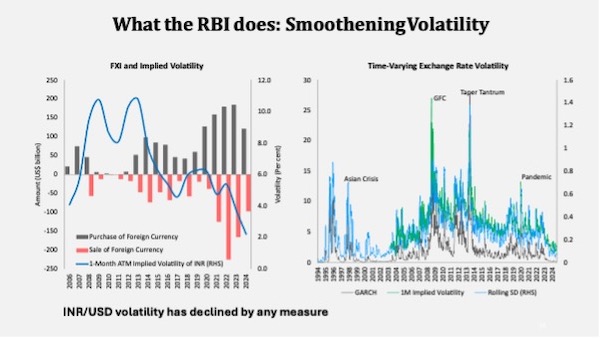
In fact, net capital flows generally exceed the current account deficit, leading to an accumulation of reserves. Consistent with running a current account deficit, the Indian rupee tends to depreciate modestly every year by about 2-4%, which, by making foreign earnings competitive, is to the advantage of India.
In recent years, however, capital flows have dominated exchange rate dynamics. The high volatility and turbulence associated with capital flows are another reason why the RBI has to be on guard to curb excessive volatility in the rupee’s exchange rate.
Technical work done in the RBI to quantify the tail risks associated with capital flow volatility and fashion appropriate responses shows that there is a 5% chance of portfolio outflows of 3.2% of GDP or a little over $125 billion in response to a COVID-type contraction in real GDP growth or a global financial crisis (GFC)-type decline in interest rate differentials vis-à-vis the US or a GFC-type surge in the VIX.
In a black swan event in which all these shocks hit together in a perfect storm, there is a 5% chance of portfolio outflows of 7.7% of GDP and short-term credit cutback of 3.9% of GDP.
Accordingly, the country as a whole is exposed to exchange rate risk. Someone will have to pay for exchange rate volatility. If bouts of volatility are large and prolonged, illiquidity can easily mutate into insolvency. In a crisis, all capital flows are callable, and the responsibility for remaining afloat on the burning deck eventually devolves on the sovereign.
There is also the issue of exchange rate changes and their pass-through into export prices. This tracks the old orthodoxy that exchange rate depreciation renders exports cheaper to the foreign buyer and, other things remaining the same, increases sales in overseas markets. For most of India’s exports, however, competitive conditions prevail in markets abroad. Prices are set by the buyer or in tight competition with numerous sellers. Accordingly, market share is preserved and expanded only by quality improvements in a price-taking environment. As a consequence, it is empirically observed in the data that real exchange rate elasticity of exports has been declining over time. Competitive depreciation by maintaining an undervalued exchange rate just does not work any more.
This is Part 15 of the Masterclass with Michael Patra.
Masterclass with Michael Patra: Previous Sessions
Part 1
Origins, Ideas and Institutions
Michael Patra begins the masterclass by tracing how central banks evolved from fragile monetary experiments into institutions entrusted with preserving trust, stability and confidence.
Part 2
RBI and the Safeguarding of Confidence
The series then turns to the RBI’s evolution, its expanding institutional role, and the balance between autonomy, growth and price stability.
Part 3
The Rise and Fall of Monetary Policy Regimes
From Bretton Woods to monetary targeting, the masterclass examines how central banks repeatedly reinvented monetary policy frameworks when old anchors collapsed.
Part 4
When Monetary Anchors Collapse
As monetary targeting broke down globally, central banks were pushed again into uncertainty, instability and regime change.
Part 5
Central Banking and Monetary Policy Regimes: The Indian Experience
How India’s trysts with crises, policy responses and changing gears in the development strategy imposed monetary policy regime shifts upon the RBI.
Part 6
Inflation Targeting and the Contract of Trust
From time inconsistency to flexible mandates, Michael Patra explains how inflation targeting became the world’s most durable monetary policy regime.
Part 7
India: Survival of the FITtest
From the Urjit Patel committee to the first MPC, Michael Patra traces how India designed, legislated and launched flexible inflation targeting.
Part 8
Lessons From India’s Inflation Targeting Decade
After a decade tested by a pandemic and war, Michael Patra distils four lessons from India’s flexible inflation-targeting framework.
Part 9
The Plumbing in the Monetary Policy Architecture
Patra explains the plumbing of monetary policy, tracing how RBI liquidity management transmits the MPC’s repo rate through banks and money markets.
Part 10
How the RBI Manages Liquidity, From the LAF Corridor to Sterilisation and Beyond
Michael Patra explains how the RBI manages liquidity, from sterilisation and CRR operations to forecasting and the LAF corridor’s role in transmission.
Part 11
The Pipes: Monetary Policy Transmission
Setting the repo rate is only the start. Michael Patra explains how monetary policy reaches the economy and what gets lost along the way.
Part 12
Operational Realities in Monetary Policy Transmission
Monetary policy transmission begins instantly in money markets, but frictions across rates, bonds and bank credit weaken its speed and strength.
Part 13
International Dimensions of Monetary Policy
How exchange rate regimes shape monetary policy independence and why global forces constrain domestic policy choices.
Part 14
The Forces That Set Exchange Rates and the Regimes of the Rupee
Patra explains the underlying principles of exchange rates, how they shape the economy, and how the rupee has undergone regime shifts.
More From BasisPoint