.png)

Central Banking 101: Origins, Ideas and Institutions
After four decades at the RBI, Michael Patra enters classroom and traces how central banks evolved to safeguard trust, stability and confidence in this new Masterclass series.
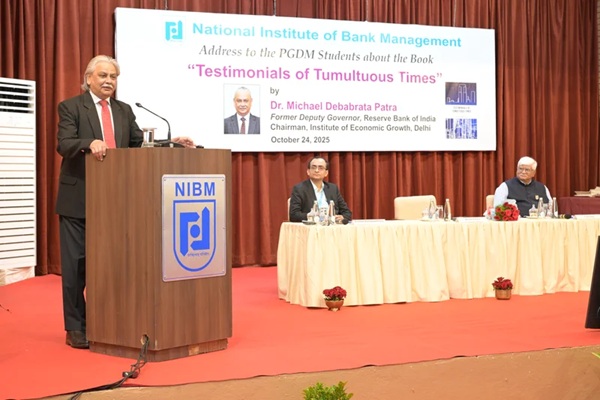

Michael Patra is an economist, a career central banker, and a former RBI Deputy Governor who led monetary policy and helped shape India’s inflation targeting framework.
May 25, 2026 at 7:41 AM IST
There is a certain verdant hue to academia. Leafy boughs, off-beat trails stamped through lush, manicured foliage, fecund shadows at once soporific and stimulating the intellect, it is the environs where the quest for knowledge can stretch tirelessly towards perfection.
After I left the Reserve Bank of India, my home, hearth and household for four decades, I became footloose and fancy free, willing to tick boxes of new experiences that had tantalisingly eluded me, fascinating me from afar. Teaching was one of them.
One day, however, I took a long look in the mirror and promptly decided: nah! There is not a semblance of the teacher in me. That is when along came Dr Partha Ray, Director of the National Institute of Bank Management (NIBM) in Pune and comrade-in-arms at the executive board of the International Monetary Fund. Together, we had had a ring-side view of the global financial crisis of 2008, watching every day, first, venerable financial institutions and then, countries failing like a danse macabre, that immortal 1874 symphonic poem by French composer Camille Saint-Saens that depicted death with a solo violin, a xylophone representing rattling bones, and 12 tolls of a harp. Some were rescued, and some bit the dust. We lived to tell the tale and co-authored a book about that great denouement.
Of course, you can do it, he told me, loftily dismissive of the butterflies in my stomach. With great panache, he handed me over to Professor Jiji Mathew, the gentle shepherd of students enrolled under its flagship post-graduate diploma course in management (banking & financial services).
This year, NIBM has introduced a new elective course on “Central banking and Monetary Policy in India”, and I was to be the fatted slaughter at its altar. To rub salt into my wounds of diffidence, Dr Ray and Professor Mathew ordained that I would deliver not one or two but a series of lectures. This course would aim to provide students of this apex institution for research, training, education and consultancy in bank management with a comprehensive understanding of India's monetary policy, liquidity management, and other related central banking functions so as to empower them to make informed decisions as future managers in the banking industry.
Tremulous and completely overawed, I stepped across the threshold into the groves of academe.
Ice Breaker
If, however, one were to attempt a non-functional definition of a central bank today, I posited, it is a public institution that takes people’s trust and gives them confidence, security and stability. Every function of a central bank imbues this transactional faith. It is no coincidence, therefore, that the word ‘reserve’, which means to hold, to retain, to conserve, to preserve, according to the Merriam-Webster dictionary, is found in the names of at least 12 central banks at the last count.
More on this when we get to monetary policy regimes, but first, I suggested, it is interesting to see how central banks evolved and the various forms they took as they assumed their numerous responsibilities.
In 1624, the first copper coins were minted by Sweden because of a shortage of silver and gold due to prolonged wars, and a desire to maintain the price of copper, which was Sweden's most important export product. The large plate coins made of copper weighed 19.7 kg, the largest coins in the world. In 1661, Johan Palmstruch, a Swedish national who had lived in the Netherlands, launched the idea that it would facilitate the management of money if banknotes known as credit notes were issued against deposits of copper coins. He set up a bank that guaranteed the value of the banknotes and undertook to replace the banknotes with coins on demand. The banknotes were initially a success, as they were easier to handle than the heavy old coins. During the following years, the bank printed more and more notes. In 1663, both the Crown and the Lord High Chancellor of Sweden, the leader of the Privy Council, also took large loans given in credit notes. The rapid increase in the number of banknotes led to them losing value. The general public started to become suspicious, and an increasing number demanded to redeem their banknotes for coins. It all ended in the bank’s failure because of too many banknotes in relation to the value of coins that were deposited in the bank. Eventually, in 1668, in the Riksdag of the Estates, which was Sweden’s parliament, the nobles pushed through a proposal to establish a new bank from the ruins of the failed one. The Bank of the Estates of the Realm – today’s Sveriges Riksbank – was established, and the world's oldest central bank was born.
It is situated in Stockholm. I visited it in 1993 and watched with fascination its dogged defence of the krona against speculative attacks during Europe’s Exchange Rate Mechanism (ERM) crisis, with the AAA-rated Swedish National Debt Office or Riksgaltkontiryet borrowing in the international financial markets and filling up the central bank’s reserves. Eventually, the defence failed, and the krona had to drop out of the ERM grid.
I turned to the evolution of another central bank, the Bank of England, the world’s second-oldest central bank. It was established in 1694 as the government’s banker and debt manager to raise money to rebuild the Royal Navy, which had been defeated by the French Navy. Like the Riksbank, it was a privately-held joint stock company until its nationalisation in 1946. It has become the model on which most central banks are based. It is associated with the evolution of the primary function for which a central bank exists — the lender of the last resort, from which derives the financial stability objective of a central bank. The Bank of England was relocated to London’s Threadneedle Street in 1734, and since then it has been known as the old lady of Threadneedle Street.
The Bank of England became famous because of a book by the journalist, businessman, and essayist, Walter Bagehot, who wrote extensively about government, economics and literature. The book was called Lombard Street: A Description of the Money Market. It remains a cornerstone of monetary economics, providing timeless lessons on financial stability that inform modern central banking practices.
The book was a reaction to the financial collapse of Overend, Gurney and Company, a wholesale discount bank located at 65 Lombard Street, London, the historic centre of the London banking industry from medieval times to the 1980s. When Overend, Gurney and Company suspended payments on 10 May 1866, panic spread across London, Liverpool, Manchester, Norwich, Derby and Bristol. Bagehot described financial panic as ‘a species of neuralgia’ which is a sudden, intense, and often burning or stabbing pain that follows the path of a damaged, irritated, or compressed nerve. Bagehot pointed out that the key function of a central bank is to avert panic: “you must not starve it,” he wrote. His prescription has been deftly summarised by Charles Goodhart, a famous British economist: a central bank has to stop panic by lending freely at a penal rate of interest against all good collateral. This remains relevant and in practice even today. This function predates the modern central bank’s function of price stability and inflation targeting.
The Federal Reserve
The Fed considers itself to be "an independent central bank” because its monetary policy decisions do not have to be approved by the president or by anyone else in the executive or legislative branches of government. It also does not receive funding appropriated by Congress. More recently, however, with the Chairman of the Fed being subjected to criminal investigation by the US Department of Justice for renovating the Fed’s headquarters, that independence and its dual mandate of price stability and full employment are under scrutiny. In this context, the Chairman’s statement is sobering: “The threat of criminal charges is a consequence of the Federal Reserve setting interest rates based on our best assessment of what will serve the public, rather than following the preferences of the President. This is about whether the Fed will be able to continue to set interest rates based on evidence and economic conditions—or whether instead monetary policy will be directed by political pressure or intimidation.”
The Fed can best be described as a federation of national central banks.
Another example of a different structure is the European Central Bank. The European Central Bank (ECB) is the central component of the Eurosystem and the European System of Central Banks. The ECB was established in May 1999 with the purpose of guaranteeing and maintaining price stability. When the ECB was created, it covered a Eurozone of eleven members. Today, the European System of Central Banks (ESCB) comprises the European Central Bank (ECB) and the national central banks (NCBs) of all 27 member states of the European Union.
It can be regarded as a confederation of national central banks with a common currency and a common monetary policy, although not being backed by a fiscal or banking union is widely considered a fatal design flaw.
Thus began my sojourn in academia.
(The masterclass continues in Part 2, which turns to the evolution of monetary policy regimes in India.)
More From BasisPoint