.png)

Why the Freedom Movement's Favourite Photograph Refuses to Die
Why do Indian protests still end with leaders being carried to police vans? A wry look at colonial symbolism in the age of social media.

Krishnadevan is Editorial Director at BasisPoint Insight. He has worked in the equity markets, and been a journalist at ET, AFX News, Reuters TV and Cogencis.
July 25, 2026 at 6:11 AM IST
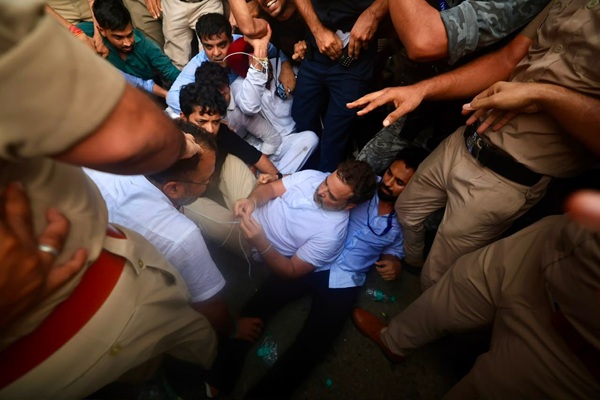
Watch almost any political protest in India and, sooner or later, the same scene unfolds. The slogans are loud, the cameras are already in position, and police personnel begin leading protesters away. Yet someone almost invariably ends up being carried to the waiting vehicle while photographers capture the moment from every possible angle. Whether the protester refuses to walk or the police choose the quickest way to clear the road, the resulting image is instantly recognisable.
The picture is so familiar that hardly anyone stops to ask why it has survived for so long.
The picture acquired its moral force during the freedom movement. When Mahatma Gandhi and thousands of satyagrahis courted arrest, they were confronting a government that ruled without the consent of the governed. Many offered passive resistance rather than active resistance, forcing the colonial state to carry them away. Every arrest exposed the insecurity of an empire that feared peaceful dissent. The image became powerful because it revealed something about the nature of colonial rule.
Independent India kept the image even after the empire disappeared.
That is the curious part. Governments now derive their authority from elections rather than conquest. Political parties alternate between power and opposition with predictable regularity. The same politicians who criticise police action from the opposition benches often defend it once in office. Yet almost every major party still reaches instinctively for the visual language of the freedom movement, as though democratic politics requires the props of colonial resistance.
The explanation today has less to do with history than with incentives.
In the age of newspapers, an arrest produced tomorrow morning's front page. In the age of social media, it produces a thumbnail, a reel and a day's worth of online engagement. The protest is no longer directed only at the government. It is also directed at millions of smartphone screens. Images of protesters being carried away tend to travel farther online than those of protesters quietly boarding a police vehicle. Whether by design or by instinct, political movements have adapted to that reality.
The act itself has changed remarkably little. What has changed is the audience. During the freedom struggle, the image challenged the moral authority of an empire. Today, it competes for attention in a crowded media market where every political event vies with cricket highlights, celebrity gossip, food and diet blogs, and viral videos. The symbolism survives because it still communicates sacrifice in a language that cameras understand instantly.
There is an irony here nonetheless. Gandhi transformed arrest into a moral weapon against an unaccountable colonial state. Modern politics often treats the image of arrest as a communication strategy in a fiercely competitive media environment. The symbolism is familiar, even if the context is entirely different.
None of this is an argument against protest. Democracies need dissent, and governments should be challenged when they overreach. Nor is it an argument for rough policing. It is simply a question worth asking. If the moral authority of the freedom movement came from the cause it served, why has so much of modern politics become preoccupied with reproducing the photograph?
These photographs have become a form of political currency. The image of being carried away still conveys sacrifice, even if everyone involved knows that the real contest is no longer against an empire but for attention.
India won freedom on August 15, 1947. Yet one of the freedom movement's most enduring political images continues to shape public life. The empire disappeared, elections replaced colonial rule, and newspapers have mostly given way to social media, but the photograph of a protester being carried to a police vehicle still carries more political weight than it probably should.
More From BasisPoint