.png)

Phynix is a seasoned journalist who revels in playful, unconventional narration, blending quirky storytelling with measured, precise editing. Her work embodies a dual mastery of creative flair and steadfast rigor.
July 27, 2026 at 3:15 AM IST
Dear Insighter,
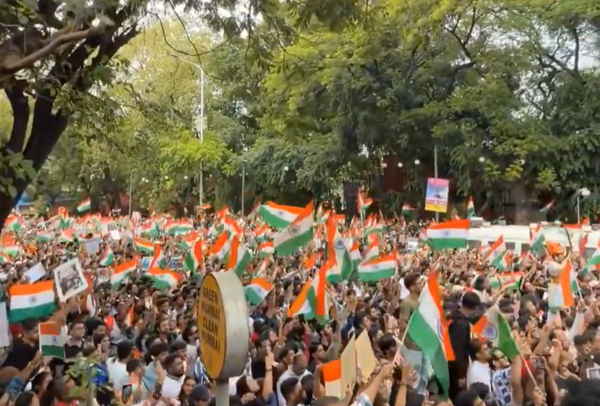
Some weeks feel like history unfolding in real time. Last week was one of them. My Instagram and X screen time suggested there were more than 24 hours in a day as every refresh brought another image, another update, another debate. The streets and social media became part of the same conversation, each amplifying the other until it was difficult to tell where one ended and the other began. It felt like one of those moments that future historians will return to, searching for the point at which something fundamental shifted.
There was an energy that made you believe institutions could still bend when enough people pushed together. Hope and anxiety coexisted. People across class, religion and geography came together with a rare sense of shared purpose. There were stories of strangers ordering food from thousands of kilometres away to feed protesters, police in the North Eastern states protecting rather than suppressing dissent, and the National Anthem ringing out in unison. Whatever your politics, it was difficult not to recognise the significance of the moment.
The movement made headlines around the world and exposed a crack in the government's armour. One minister has been replaced. But that is where the more important question begins, not where it ends.
Did the protests change anything, or did they merely change the headlines? As with most things in this glorious, confounding country, the answer is more complicated than either side would like to admit.
As Kalyan Ram and Minari Shah both point out, the gap between what the government offered and what protesters demanded reveals something far deeper than one failed exam. The government's response focused on fast-track courts for paper leak cases. The movement demanded something far more fundamental: accountability, with those at the top accepting responsibility when institutions fail. Those are not the same thing.
The protests may have begun with NEET, but they quickly evolved into a broader debate about whether hard work is rewarded fairly, whether institutions acknowledge their failures, and whether those in power are ever held accountable. At its core, the movement is no longer about competitive examinations. It is about trust in public institutions and, ultimately, whether the democratic system can still command that trust.
Take the rupee. Dhiraj Nim argues that its weakness reflects a world where dollar funding has become more expensive, investors have more attractive alternatives, and geopolitical uncertainty has made India's external position increasingly vulnerable. Sachchidanand Shukla echoes this, noting that the RBI's overseas-funding window may buy temporary stability but also creates future claims on liquidity and reserves. It eases immediate pressure, but it is a bridge rather than a lasting solution.
Deba Prasad Rath and Rewanth Raichooti highlight that India's latest easing cycle has exposed a gap in monetary policy transmission. Between February and December 2025, the repo rate fell from 6.5% to 5.25%, while the yield on the 10-year government security dropped only marginally. Even as India's public debt trajectory improves, global uncertainty continues to blunt the effectiveness of domestic monetary policy.
Then there's what we're actually building with all this money. Sagari Gupta asks whether India's record ₹12.2 trillion capital expenditure programme is creating lasting public wealth or simply adding to future liabilities. Without a consolidated public sector balance sheet, there is no definitive way to answer that question. Until such an accounting exists, capex led growth will continue to produce impressive headline numbers while leaving a far more important measure of public wealth unanswered.
The reform paradox doesn't stop there. Utsav Saksena warns that India excels at headline reforms, but crucial financial sector overhauls keep stalling. The Financial Data Management Centre, the Public Credit Registry, and the Financial Resolution and Deposit Insurance Bill were never vanity projects. They were intended to become essential safeguards against future financial instability. None of them have been implemented.
Vivek Kaul points to another uncomfortable truth: the government earned ₹1.29 trillion from long-term capital gains tax on stocks and equity mutual funds in 2024-25. Those demanding zero tax on stock market gains rarely acknowledge the trade-off. Every rupee not collected from equity investors has to be collected from someone else.
The governance of technology presents another layer of risk. Srinath Sridharan and Anand Venkatanarayanan examine the RBI's technology governance, which relies on institutional proximity: the maker also does the checking. But as AI makes vulnerability discovery cheaper and faster, that arrangement becomes fragile. The fundamental question is stark: who independently verifies the maker? And who verifies them?
Even the brighter spots in the economy deserve a closer look. Sharmila Kantha notes that while India's FDI rebounded to $39 billion in 2025, ranking 11th globally, it remains below the 2022 peak of $49 billion. This volatility underscores India's sensitivity to global shocks and domestic policy uncertainty.
Rajesh Kumar's analysis of GST data reveals a fiscal geography that has grown more unequal. Domestic collections have more than tripled since 2018-19, rising to ₹16.70 trillion in 2024-25. But behind the aggregate, state-wise data reveal a tax base increasingly concentrated in a few industrialised regions. India may have one nation and one tax, but it does not yet have one revenue geography.
Trade agreements tell a similar story. Surendar Singh observes that India is signing free trade agreements at an unprecedented pace, yet export competitiveness remains weak. India's share of ASEAN's imports has halved since 2012. Lower tariffs, by themselves, have not been enough to improve India's export competitiveness.
Vijay Chauhan and Satish Kumar Reddy examine the India-UK Comprehensive Economic and Trade Agreement, noting that while tariff cuts open opportunities, implementation will determine the gains. India is offering immediate reductions on 99% of products, while the UK is offering reductions on about 65%.
Even the aviation sector, as Sharmila Chavaly reports, is contemplating reforms that could create new problems rather than solving existing ones. The Ministry of Civil Aviation is considering allowing airport operators to own airlines and vice versa. Vertical integration between infrastructure gatekeepers and dependent carriers may fail to fix broken parts but actually add new breakage points.
R. Gurumurthy offers a cautionary tale: a GraniteShares ETF in the United States collapsed after its net asset value turned negative. The failure lay not in the company but in the architecture of the financial product itself. In an age of increasingly engineered financial products, investors must understand not only what they own but how they own it, because the container itself can break.
Dev Chandrasekhar's analysis of HDFC Bank shows that the bank is still paying for a merger it closed three years ago. Net interest margin came in at 3.26% for the quarter, down 24 basis points from 3.5%. The gap is the cost of HDFC Ltd debt, most of which matures later this year. The bank is not underperforming. It is carrying a weight.
Krishnadevan V reports that gold loans have overtaken personal loans and now sit behind mortgages in outstanding balances, with roughly ₹16.8 trillion lent against family jewellery. Tata Capital has stepped into this market. Gold loans now look less like emergency borrowing and more like a secured credit line that households tap repeatedly. We've moved from emergency borrowing to structural reliance on collateral.
K. Srinivasa Rao argues that India has expanded formal banking access at scale, but the next phase must deepen customer engagement. The share of adults with a formal bank account rose from 35% in 2011 to 89% in 2025. But dormant accounts, limited usage, and weak financial literacy show that access doesn't equal engagement.
Ashima Goyal and Anas Khan offer rare good news: dense agricultural market networks can sharply reduce the impact of extreme rainfall on inflation. Denser and better-connected agricultural markets cannot stop extreme rainfall, but they can make it less inflationary. We know the solution, but we're not implementing it systematically.
Michael Patra's masterclass on India's flexible inflation-targeting framework reminds us that the journey has been long and contested. Inflation targeting is about stabilising the economy's growth around its potential path. By symmetrically addressing symptoms, it creates the environment for strong, sustained growth.
So where does that leave us? The students showed up. They organised, persisted and forced the government to respond. Education Minister has been replaced. But if the past few weeks have shown us anything, it is that changing one individual is far easier than repairing the institutions that allowed the crisis to emerge in the first place.
Whether it is the rupee, financial regulation, GST, trade policy, banking or technology governance, the challenge is ultimately the same: institutions that inspire confidence rather than merely demand it.
The real test is not whether this movement succeeded, but whether it sparks a broader demand for accountability across the systems we rely on every day—from public services and financial regulation to the routine interactions that too often require a bribe or a favour to get things done.
Also Read:
- India's MSMEs Need Ecosystems, Not Just Incentives by Nilanjan Banik: India's 63 million MSMEs could become key engines for jobs and exports if policy shifts from isolated firms to specialised industrial ecosystems.
- Climate Policy Needs Carbon Pricing, Not Just Green Subsidies by Amitrajeet A. Batabyal: New research finds modest global carbon taxes outperform green subsidies, while uneven climate policies impose significant economic costs.
- India's Healthcare Crisis: Why Insurance Coverage Fails the Insured by D. Tripati Rao & Rishu Kumar: Insurance covers 46% but reimburses just 4.3%; for the poor, lost wages from illness prove deadlier than medical bills.
- Why the Freedom Movement's Favourite Photograph Refuses to Die by Krishnadevan V: A wry look at why Indian protests still end with leaders being carried to police vans, and why that colonial-era image endures in the age of social media.
- Sarci Sense: Why We Forgot How to Be Unreachable by Srinath Sridharan: Constant connectivity has quietly changed what freedom, trust and even courtesy now mean; this is a meditation on the lost art of being unreachable.
- The West Asian Conflict and the Changing Face of the Principles of War by Lt Gen Syed Ata Hasnain: From AI-enabled warfare to strategic endurance, the West Asian conflict is forcing militaries to rethink how wars are fought without abandoning timeless principles.
- Don't Overestimate America and China's Importance by Jim O'Neill: A former UK Treasury minister argues that problems like climate change, AI governance and antimicrobial resistance cannot be tackled by the US and China alone.
Beyond this Newsletter
The BasisPoint app brings you our latest insights, analysis and updates as soon as they are published.
Download the BasisPoint app from Google Play or Apple’s App Store and stay connected to the ideas shaping India’s economy, policy and markets.
Until next time, may your questions be sharper than the answers you are given.
Phynix
More From BasisPoint