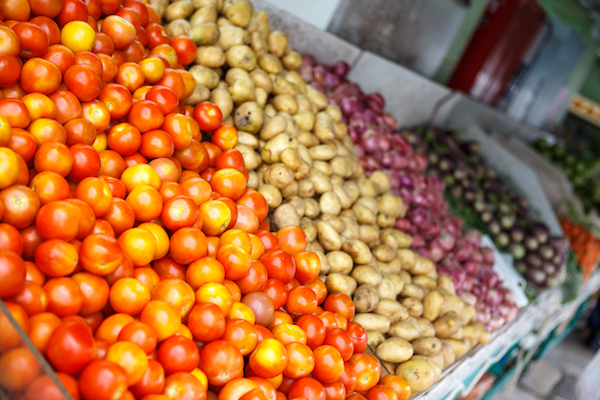
Tomato, onion and potato, or TOP, prices are among the most visible sources of food inflation in India. A sharp rise in any one of them quickly enters household budgets, political debate and the inflation outlook.
The usual explanation is bad weather.
Heavy rain damages crops, delays harvesting, disrupts transport and increases spoilage. For highly perishable vegetables, even a temporary interruption in supply can produce a large price movement. Climate change is likely to make such triggers more frequent.
But weather is only part of the story. Similar rainfall shocks can produce a large price spike in one district and a modest response in another.
TOP crops are highly perishable, grown in concentrated belts and cannot be smoothed through storage in the way cereals can. When rainfall is far above normal, harvest losses, spoilage and transport disruption can convert a local shock into a sharp month-on-month price movement.
There are two competing views. One attributes perishable-food inflation primarily to weather-induced supply disruptions, implying that once production is damaged, price spikes are largely unavoidable. The other argues that dense trading networks allow produce to move across regions, so the same shock has less impact where markets are deeper.
Which view holds is an empirical question, and the two point to very different policy responses. The first requires a narrow focus on climate resilience; the second calls for a broader set of mitigants.
A dense market network does not prevent crop damage. It changes what happens after the damage occurs. Traders can source from more locations, farmers have access to more buyers, and local shortages can be partly offset by moving produce across markets. The same weather shock can then produce a smaller local price response.
What the Data Show
We test these hypotheses by combining monthly wholesale prices from Agmarknet with district-level rainfall data from the India Meteorological Department for 253 districts in 19 states between 2018 and 2025.
Each district-month’s rainfall is classified as deficient, normal or excess relative to that district’s own 1991–2020 average for the same calendar month. Market depth is measured by the number of mandis in a district integrated with eNAM, the national electronic agricultural market.
We then examine whether the inflation response to rainfall shocks weakens as mandi density rises. We also test two further channels: state-level marketing reform, measured by NITI Aayog’s Agricultural Marketing and Farmer Friendly Reforms Index, and the cumulative growth of agricultural start-ups.
We find that unusual rainfall is inflationary for perishables. Excess rainfall raises TOP inflation by about 1.1 percentage points in the same month, with a further increase of roughly 1 percentage point in the following month as the disruption works through the supply chain.
Our central finding is that this price effect falls sharply as the local mandi network becomes denser. In a district with a single eNAM-linked mandi, excess rainfall adds about 0.8 percentage points to monthly TOP inflation. At four mandis, the effect is less than half as large. By around nine mandis, it is essentially zero.
Among the three TOP crops, onions show the clearest pattern. The main result survives alternative specifications, including measuring rainfall continuously, restricting the sample to extreme-rainfall years and counting only mandis that actually trade these crops. This suggests that the result is not an artefact of a particular definition of weather or market depth.
We also examine state-level channels. The evidence is weaker than the mandi result, partly because district-level variation is not captured. Better marketing reform and greater agricultural start-up activity are associated with smaller pass-through, but the evidence does not survive our strictest tests. We therefore treat these channels as suggestive rather than established.
The interpretation of the mandi result also requires caution. Our prices are wholesale mandi prices, not retail prices. Retail margins, transport costs and local distribution determine how much of the wholesale movement reaches consumers.
Mandi density is based on the current audited eNAM list and is treated as fixed, although integration expanded between 2018 and 2025. It therefore captures persistent cross-district differences in market depth rather than the effect of a particular mandi joining eNAM at a particular time.
More importantly, mandi networks were not randomly assigned. Districts with more connected markets may also have better roads, storage, administration or commercial activity. The estimates show that rainfall shocks are less inflationary where market networks are denser, but they do not prove that adding a mandi will mechanically produce the estimated reduction.
The sample is also limited to districts with sufficiently continuous price reporting for all three crops and may therefore represent better-functioning markets than the country as a whole. A placebo exercise using storable cereals, which would sharpen the evidence for a perishability mechanism, remains to be completed.
Policy Implications
These caveats narrow the claim, but they do not erase the main pattern in the data.
The conclusion we can defend is precise and useful: weather shocks pass through to perishable-crop prices far more weakly where mandi networks are dense.
Food-inflation policy often begins after prices have already risen, through export restrictions, stock limits, subsidised sales or emergency imports. The paper identifies a preventive margin.
Climate adaptation is not only about seeds, irrigation and crop resilience. It is also about the capacity of markets to move food when production is disrupted.
Denser and better-connected agricultural markets cannot stop extreme rainfall. They can make it less inflationary.
The practical priority is not merely to count electronic registrations, but to strengthen functioning links among mandis, logistics providers, buyers and producing regions. Our results suggest that this is already happening in many districts and may be reducing the impact of weather shocks on inflation. It can and should be extended to others.
.png)