The results of the recent Legislative Council (MLC) elections are being read as a verdict on everything - from the mood of GenZ, to discontent among the upper caste, to poor opposition strategy.
Some of that is overreach.
Still, the results carry strong signals for the parties, and for the state elections ahead, especially Uttar Pradesh in 2027.
The Numbers
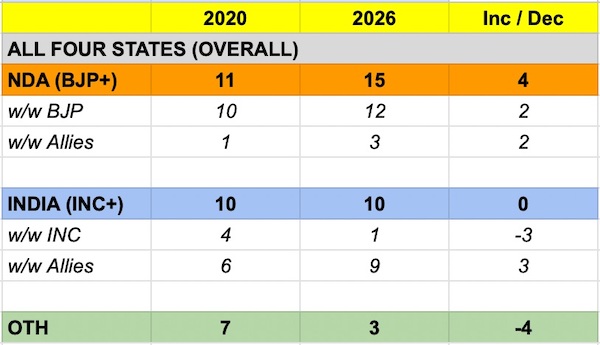
The BJP-led NDA won 15 of the 28 seats across four states: Uttar Pradesh, Bihar, Karnataka and Maharashtra. Together, these states send close to 200 MPs to the Lok Sabha, so they matter well beyond the council seats.
State by state:
- Uttar Pradesh: BJP 6 of 11, with the Samajwadi Party (SP) taking 5.
- Bihar: NDA 3 of 8, RJD 2, Jan Suraj 1, others 2.
- Karnataka: NDA (BJP and JD(S)) won all 4 seats.
- Maharashtra: Maha Vikas Aghadi (MVA) retained 3 of 5 seats with ruling Mahayuti taking only 2
Compared with 2020, UP is almost the same (BJP won 5 of 11 seats then), and Bihar is identical for the NDA at 3 out of 8. Karnataka improved the tally count for the NDA from 3 to a clean sweep with 4 seats. Maharashtra stayed with the MVA at 3 of 5.
Why These Polls are Different
The current polls were for graduate and teacher constituencies, whose voters are educated, often young, and generally considered less ideological than the wider electorate. They respond to issues like jobs, exam integrity and institutional functioning more than to caste arithmetic or a leader’s popularity.
Another unusual feature is that incumbents usually do well in these contests, because they control resources and organisation. This time that rule was broken. The ruling Mahayuti in Maharashtra and the Congress government in Karnataka both lost ground, while the incumbent-led camps held up in Bihar and UP.
Takeaway 1: A Real, But Narrow NDA Gain
The NDA’s performance deserves credit. It came after roughly three months of protests and opposition pressure, and the BJP has come out with a majority of the seats. But the win has layers. Karnataka was a clean sweep, and only UP gave the BJP a clear lead. Bihar and Maharashtra were setbacks. This was an incremental win rather than a mandate.
Takeaway 2: Not All is Well in The BJP
The BJP lost two seats in Varanasi and one in Nagpur, the home of the RSS headquarters. Both are symbolically awkward. In fairness, the party lost these seats in 2020 as well, so this is not entirely new.
Several problems seem to have compounded each other:
- Infighting. In UP, an apparent tussle between central and state leadership affected the poll outcome. In Maharashtra, the BJP says the Shinde Sena did not back its candidates, and there are signs of friction between the RSS and the BJP.
- Youth discontent. Unemployment, a shortage of jobs, and paper leaks seem to have found expression in the ballot box. The message from young, educated voters is hard to ignore.
- Upper-caste unease. Discontent over the UGC rules, and SC/ST and reservation issues seems to have hurt in Varanasi.
- Poor poll management. Weak canvassing and voter registration let down a party that otherwise had the resources.
Takeaway 3: UP 2027 Looks Like a Cliffhanger
The 6–5 scoreline in UP matters more than any other number here. The BJP kept its lead, but the SP gained two seats, and it is building on its 2024 Lok Sabha showing, when it led in 225 of the 403 assembly segments. The momentum has held, and the contest looks too close to call. Anyone treating UP-2027 as a foregone conclusion is not reading these results carefully.
Takeaway 4: The INDIA Bloc Held Up, Mostly Because of Allies
The opposition’s overall performance was stable, but the credit goes to regional parties. The SP and RJD won 5 and 2 seats respectively, and the RJD has made a partial recovery after its heavy loss in 2020. Within the INDIA bloc, regional allies grew from 5 seats to 9.
Takeaway 5: The Congress is the Weak Link
The Congress fell from 4 seats to 1 while its allies grew. Its campaign on the Chief Election Commissioner and its protest politics do not appear to be translating into votes on the ground. This also follows its loss in the DUSU polls, which is worrying for a party trying to reconnect with young voters.
These polls were held on ballot papers, so the argument that electronic machines are to blame does not apply. The party needs to ask whether it is losing because of the alleged cheating it has campaigned on, which has not been established, or because of its own organisational weaknesses. The second explanation is more likely to lead to a fix.
Takeaway 6: Chief Ministers Under Pressure
Several leaders came out of these polls weaker:
- D.K. Shivakumar - won 0 of 4 in Karnataka and faces internal challenges from the Siddaramaiah camp.
- Devendra Fadnavis - won only 2 of 5 in Maharashtra and faces pressure from Eknath Shinde, who wants to return as CM.
- Samrat Choudhary - won only 3 of 8 in Bihar, and has yet to step out of Nitish Kumar’s shadow while new players like Jan Suraj emerge.
Takeaway 7: Bipolarity is Squeezing Out The Rest
Independents and smaller parties were squeezed in UP and Maharashtra, which account for the entire four-seat fall in the “others” category. The long-run trend is the same. The combined vote share of the BJP and Congress in general elections has risen from about 51% across 1952–2019 to 58% in 2024, while others fell from 49% to 42%. The Indian political space is becoming a two-pole contest.
Takeaway 8: Incumbency is No Guarantee, and Resources Aren’t Everything
Incumbency usually brings resources, and resources usually win these polls. That did not happen in Maharashtra and Karnataka, which should worry both the BJP and the Congress. Both parties need to ask what went wrong, who sabotaged candidates, and why, and then act on the answers.
Takeaway 9: Mahaul Versus Management
A favourable mood, or mahaul, is essential for building a narrative and shaping vote preferences. But elections are also about management. In low-turnout, registration-driven contests like these, organisation, voter enrolment and door-to-door canvassing count for more than the headlines. Parties that spend months on narrative and weeks on booth management will keep being surprised.
So, Will it Affect 2027?
Directly, the MLC results do not predict assembly outcomes. The electorate is narrow and unrepresentative, and the voting patterns differ from those in general elections. However, they do act as an early warning on three fronts.
First, UP will be fiercely contested. A one-seat margin in a graduate constituency is no forecast, but the SP’s continued momentum means the BJP cannot afford complacency or internal feuds. Second, youth and jobs issues are real, and they need an answer beyond slogans. Third, organisations will decide close contests, and parties that fix their booth-level machinery and internal discipline will have the edge.
The NDA can take comfort in the count, and the opposition can take comfort in the cracks. Neither side should read too much into either.
.png)