.png)

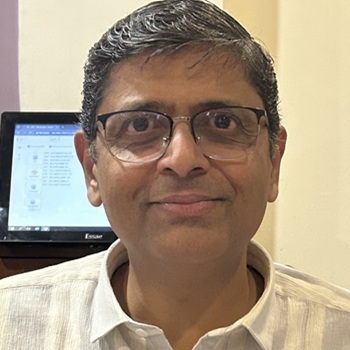
Rajesh Ramachandran is a former Editor-in-Chief of The Tribune group of newspapers and Outlook magazine.
July 24, 2026 at 9:19 AM IST
Prime Minister Narendra Modi issued a video message at midnight reassuring the youth about fast-track courts and his government’s attempts to tackle question paper leaks. Activist Sonam Wangchuk has ended his fast in the presence of Union ministers JP Nadda and Jitendra Singh at a private hospital. Education Secretary Vineet Joshi, who was the founding director-general of the National Testing Agency, has been replaced, and two other secretaries have been appointed in his place. Yet, there is no word on Education Minister Dharmendra Pradhan, whose resignation remains the protesters’ primary demand.
The government is finally acting, about three months after the National Eligibility-cum-Entrance Test, conducted on May 3, was cancelled and two and a half months after the Cockroach Janata Party was created by Abhijeet Dipke as an online response to remarks of Chief Justice of India Surya Kant. In its 12-year tenure, the BJP-led NDA government has rarely appeared so wobbly or as out of control as it does now in the face of the relentless anger of the country’s frustrated youth. The trigger — the paper leak — is genuine, while the government’s response has been tardy, if not an outright dismissal of the protests as a legitimate form of seeking redress.
The government’s biggest blunder was assuming that this protest would fizzle out and eventually be forgotten. It dismissed the protests as yet another foreign-funded attempt at regime change, similar to movements in Pakistan, Sri Lanka, Bangladesh, and Nepal. What it failed to recognise was that the protests were driven by a genuine grievance, one that struck at the heart of the BJP-RSS’s core constituency — the middle class. The government did not anticipate that the very middle class it had long courted would turn against it over the erosion of the educational system that had long promised upward mobility through STEM (Science, Technology, Engineering, and Mathematics) education.
Indian governments have offered little to the tax-paying middle class, whose members send their children to expensive private schools, rely on costly private healthcare, buy increasingly unaffordable housing, and continue to struggle with an inefficient bureaucracy and inadequate public infrastructure. For many families, professional education, particularly medicine and engineering, has remained the only reliable route to economic security. The NDA government centralised admissions to medical colleges through a single entrance examination. However, that unified system has repeatedly come under scrutiny over allegations of paper leaks and irregularities. Paper leaks had occurred before previous examinations as well.
This episode has only reinforced the perception that the new system has failed students. It is unpardonable for a government to tinker with a proven mechanism, to replace it with a broken one and then not accept political accountability for the mess. Had Dharmendra Pradhan accepted responsibility by stepping down from the education portfolio, or from the government altogether, the middle-class anger may not have spilled onto the streets. It is still early to conclude the government has reached a political inflection point, but by all accounts it appears to be the NDA’s equivalent of the UPA’s 2011 moment.
The Opposition has seized the moment effectively, with images of Leader of the Opposition Rahul Gandhi being dragged away from the prime minister’s residence, making headlines across world capitals. The sharp reaction from Aam Aadmi Party leaders Atishi and Sanjay Singh appeared to vindicate Rahul Gandhi’s political instincts. The AAP did not expect Rahul Gandhi to return from vacation and hijack the political narrative around NEET. The late-night march on Thursday to Gandhi Smriti, where Mahatma Gandhi was gunned down by Nathuram Godse in 1948, added another twist to the political drama.
With the Opposition, the middle class and students arrayed against the government, the government had no option but to offer concessions. But those measures are still not enough to quell the disquiet, ease the disappointment, or restore the middle class’s faith in the Modi government. Allegations surrounding the Ram temple donations and the alleged theft of medical seats, put together, have dealt a debilitating blow to the BJP’s image. The party with a difference has failed its core constituency.
In its search for beneficiaries for welfare schemes in the poorer regions of Bihar, Madhya Pradesh, Rajasthan and Uttar Pradesh, the BJP seems to have forgotten the middle class that helped propel it from two Lok Sabha seats in 1984 to 85 in 1989 to 120 in 1991. Governments can do little for this opinion-making class when all it wants is less officialdom and more of freedom for enterprise. But the new BJP seems to have more bureaucratic red tape coupled with greater freedom for the traditional business classes, while neglecting the middle class.
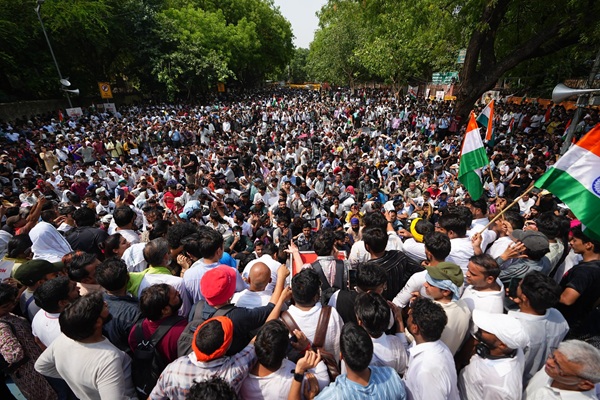
It was just a year ago that the middle class in Delhi, after a long hiatus of 27 years, voted the BJP into power. And now the very same state has become the epicentre of public anger. Tens of thousands of youngsters have gathered at the protest site even without a call to action from political parties. The dam of disaffection had burst.
The key difference between this moment and 2011, however, lies in the Opposition’s ability, or the lack of it, to turn this into a nationwide mass upsurge capable of defeating the incumbent government three years down the line. Just as the BJP in its political journey used the Muslim community as the perceived “other”, the Congress has recently been turning the Hindu middle class into its political and cultural enemy.
Rahul Gandhi has been assiduously cultivating the PDA ––– pichhda (backward classes), Dalit and alpasankhyak (minorities) ––– offering no space to the rest of the Hindus, who are the most vocal critics of any government.
So, just as a ministerial reshuffle with a relook at priorities is imperative for the government, the Congress too needs to recalibrate its choice of the “other”. The Congress loses its credibility and raison d'être when it ceases to be an umbrella party that represents all and even contradictory voices. Rahul Gandhi’s march to Gandhi Smriti is a good start. He should stop disliking and start embracing the middle class.
More From BasisPoint