.png)

The Trap India Faces Isn’t Just Geopolitical Anymore
Xi invoked Thucydides in Beijing. India, meanwhile, is discovering that the real trap isn’t geopolitical. It’s structural, and it’s already sprung.
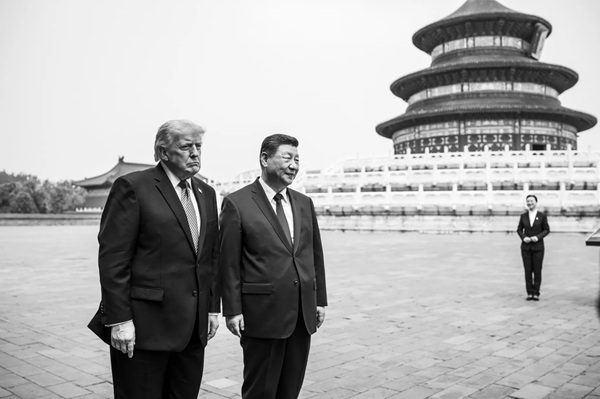
Phynix is a seasoned journalist who revels in playful, unconventional narration, blending quirky storytelling with measured, precise editing. Her work embodies a dual mastery of creative flair and steadfast rigor.
May 18, 2026 at 3:36 AM IST
Dear Insighter,
There is a particular kind of warning that lands differently when it comes dressed as a question. During his high-stakes meeting with Donald Trump in Beijing this week, Xi Jinping did exactly that, invoking the concept of the Thucydides Trap not as a threat but as an inquiry: can China and the US overcome the so-called trap and create a new paradigm of major-power relations? It was, depending on where you were standing in the room, either a sincere philosophical appeal or an elegant geopolitical gut-punch.
The Thucydides Trap, popularised by Harvard scholar Graham Allison, traces back to ancient historian Thucydides’ explanation for the Peloponnesian War: the rise of Athens and the fear this inspired in Sparta made conflict inevitable. Of the sixteen historical cases Allison examined, twelve ended in war. The four that did not required extraordinary restraint, institutional maturity and painful compromise. In the modern retelling, China is Athens, the US is Sparta, and the question being asked is whether either side still possesses the patience required to avoid becoming another historical statistic.
Trump, by most accounts, absorbed this with roughly the same depth of engagement people reserve for airline safety demonstrations. But Xi’s question lingered because the real insight behind the Thucydides Trap is about structural pressure. Systems break not because people are foolish, but because they assume warning signs remain manageable until suddenly they are not.
India, right now, is beginning to discover how many of its own assumptions rested on stability that no longer exists.
The week’s most consequential domestic moment came not from markets, but from candour. As BasisPoint Groupthink notes, Chief Economic Adviser V. Anantha Nageswaran publicly acknowledged that India’s balance-of-payments vulnerabilities are no longer merely cyclical pressures linked to oil or temporary geopolitical disruptions. His remark that managing the current account credibly, financing it and preventing excessive rupee depreciation are now central macro imperatives was remarkable precisely because policymakers rarely speak that plainly.
Dhananjay Sinha points out that April’s WPI inflation has surged to a 42-month high of 8.3%, with fuel and power inflation soaring to nearly 25%, and this is before fuel-price hikes have fully filtered through the system, before El Nino meaningfully damages food supply chains, and before fertiliser shortages feed into agricultural costs. Even more revealing is the growing gap between official projections. The finance ministry’s revised inflation assessment is now said to exceed the RBI’s own estimate.
That disconnect is becoming harder to maintain because inflation does not remain theoretical for long. It eventually arrives in grocery bills, freight costs, restaurant menus and EMI anxiety. Smita Roy Trivedi and Abhiman Das trace how quickly sentiment shifted. The rupee weakened past 96 to the dollar, markets fell sharply, and suddenly Prime Minister Modi’s call for austerity, reduce fuel use, avoid unnecessary imports, buy less gold, travel less, landed as confirmation that policymakers were more worried than they previously sounded.
Trivedi and Das also ask the question most austerity discussions politely sidestep: who actually bears the burden? Work-from-home fuel savings are meaningful if you are a consultant with dual monitors and imported coffee beans. Less so if your livelihood depends on physically transporting goods through India’s vast informal economy.
And energy, increasingly, sits underneath everything.
Arvind Mayaram’s comparison with the 2012-14 taper-tantrum period feels particularly sobering. Then too, India faced a widening current-account deficit, a collapsing rupee and rising oil imports. But today’s pressures run deeper because oil now bleeds into everything simultaneously: freight, aviation, fertilisers, manufacturing, food inflation and logistics. The ripple effects travel faster through a far more interconnected economy.
Vivek Kaul captures this brilliantly through the “fallacy of composition.” One cricket spectator stands for a better view, forcing everyone else to stand too until the collective experience worsens. Individually, Indian households buying gold are behaving rationally. Gold protects savings, stores wealth, hedges inflation, survives institutional distrust and carries enormous cultural meaning. But collectively, India’s gold obsession becomes a macroe burden precisely when dollars are scarce.
India now holds over 35,000 tonnes of gold. Somewhere between jewellery store lighting and wedding-season optimism, an entire civilisation effectively turned bullion into emotional infrastructure.
And yet, as Dev Chandrasekhar notes, the latest import-duty hikes have not reduced gold’s importance. They have simply redistributed who profits from it. The policy acts less as consumption control and more as a transfer mechanism from jewellers to gold-loan financiers. The same household buying wedding jewellery in August may later pledge part of it at a pawn counter during financial stress.
There is also an irony here that feels uniquely Indian: attempts to formalise the gold ecosystem may now partially reverse themselves. Higher duties revive incentives for grey-market imports, reopening arbitrage opportunities for the informal trade. BasisPoint Groupthink further notes that the duty architecture disproportionately benefits the Centre through cesses that bypass state revenue sharing.
Sugar policy, meanwhile, is no longer just about sugar. As G. Chandrashekhar observes, India’s latest sugar-export ban increasingly appears linked to ethanol strategy and energy security. Higher crude prices encourage diversion of sugar feedstock toward biofuels. In effect, India is now managing parts of its energy problem through its sugar bowl. The policy may make short-term sense, but it also reflects how deeply energy dependence has begun infiltrating seemingly unrelated sectors.
The same logic underpins India’s massive coal-gasification push. Sharmila Chavaly’s analysis of the ₹375 billion scheme is sobering: economically logical, geopolitically understandable, environmentally compromised. Coal gasification may buy India a decade or two of reduced import dependence, but potentially at the cost of water stress, stranded assets and future climate liabilities.
R. Gurumurthy revisits Japan’s response to the 1973 oil shock and arrives at the uncomfortable conclusion that austerity succeeds only when accompanied by institutional coherence. Japan dimmed lights, rationed consumption and redesigned its industrial structure because its bureaucracy, corporations and citizens shared a common understanding that the world had fundamentally changed.
India’s challenge is more complicated because modern India is simultaneously a consumption story, a welfare state, a developing economy and an aspirational society addicted to visible upward mobility. Asking Indians to conserve fuel while luxury SUVs queue outside brunch restaurants creates the kind of cognitive dissonance economists rarely include in models.
Still, Gurumurthy’s core point matters: resilience requires redesign, not symbolism. Anshuman Gupta reaches a similar conclusion from the energy-security angle: efficiency alone no longer guarantees stability. Countries optimised for cheap supply chains during peacetime and discovered, during crises, that resilience has its own premium. Srinath Sridharan reinforces this from a governance angle: the PM's austerity advisory matters less for its optics than for what it reveals about the evolving relationship between geopolitics and economic management.
Michael Debabrata Patra’s essay on water may actually be the most frightening piece of the week precisely because it arrives without market drama. Water scarcity lacks the theatricality of crashing currencies or exploding oil prices. Yet India’s groundwater is collapsing, urban reserves are depleting, and climate volatility is destabilising the hydrological cycle itself. By 2050, over five billion people globally could face water shortages.
Human civilisation has reached the extraordinary stage where we discuss Mars colonisation while struggling to provide clean drinking water reliably on Earth. Somewhere, future archaeologists are going to have a field day with us.
The bond market, unsurprisingly, is beginning to reflect these structural tensions too. Venkatakrishnan Srinivasan notes that oil marketing companies may soon become some of India’s largest borrowers as rising crude prices and delayed fuel-price adjustments strain working capital. He also argues that India’s municipal bond market may finally approach maturity as cities increasingly require independent financing for transport, flood resilience, water systems and sewage infrastructure. Urban India’s next phase cannot rely indefinitely on state transfers and optimism disguised as master plans.
At the same time, corporate bond mobilisation has slowed amid volatile yields and geopolitical uncertainty. Markets, Srinivasan notes, do not necessarily need lower rates as much as they need predictability. Investors can tolerate bad news better than erratic news.
Then there is GIFT City. Chandrika Soyantar’s writes India has spent years making GIFT cheap to operate in without adequately answering why serious capital should gather there organically. Tax incentives alone do not create financial ecosystems. Markets emerge through participation, liquidity and trust. GIFT, Soyantar argues, is not capital-starved, but capital-ignored.
And yet, amid all this fragility, Nilanjan Banik offers one genuinely hopeful structural story: India’s Global Capability Centres. GCCs already employ nearly 1.9 million professionals and generate $64 billion in export revenue. Unlike volatile portfolio flows or geopolitically exposed trade, GCC revenues are anchored in embedded talent and long-term operational integration. In a world increasingly defined by fragmentation, India’s talent ecosystem may become one of its most durable external-sector stabilisers.
Xi’s question to Trump was never really about ancient Greece. It was about whether great powers can recognise structural traps before they become inevitable. The uncomfortable feeling is not that India lacks warnings. It is that the warnings are finally becoming impossible to ignore.
The CEA spoke honestly. Markets listened nervously. Households quietly bought more gold anyway.
Until next week, hoping the forecasts improve,
Phynix
Also Read:
Has Quick Commerce Changed What Counts as an FMCG Moat? by Krishnadevan V: The Henkel-Pril situation is a proxy for a larger structural question — in urban categories where consumers discover products on Blinkit before they ever see a shelf, the distribution network that took decades to build may no longer be the moat it once was.
India-UAE Embrace is a Security Handshake by Rajesh Ramachandran: Modi's UAE visit and a new strategic defence framework signal India's deeper, and more exposed, role in West Asia's active minefield.
India Must Resist EU, US Pressure on Data Exclusivity in Farm-Chemicals by Ajay Srivastava: TRIPS-plus provisions in ongoing trade negotiations could quietly dismantle the generic manufacturing edge that built India's $4.4 billion agrochemical export industry.
Bribes, Bureaucracy and the Case for a Universal Basic Income by Amitrajeet A. Batabyal: New research argues a UBI may outperform targeted welfare in India — not despite reaching the non-poor, but precisely because it removes the bureaucratic chokepoints where money disappears.
Sarci-Sense: Why Indian Goodbyes Take Longer Than Parties by Srinath Sridharan: In a world optimising every human interaction into a notification, middle-aged Indians stubbornly retain one deeply uneconomical instinct: they refuse to feel finished with each other.
Turmoil at the Fed Won't End Anytime Soon by Nicolas Jabko: Trump's assault on Fed independence is less a personal vendetta against Jerome Powell and more a symptom of the global right's deepening hostility toward independent institutions of any kind.
The War on Billionaires Is Dangerous Nonsense by Michael R. Strain: The populist case — left and right — that billionaire wealth is inherently unearned misreads how value is created, and sends precisely the wrong signal to anyone still trying to build something.
More From BasisPoint