.png)


Vivek Kaul is a writer and an economic commentator.
May 14, 2026 at 11:13 AM IST
As a kid growing up in Ranchi, in the pre-MS Dhoni era when the city didn’t have proper cricketing infrastructure, I always wanted to watch a cricket match in a big stadium.
That wish was eventually fulfilled. But it took one visit to a stadium for me to realise that the best place to watch cricket is in the comfort of what we Indians call our drawing room.
It wasn’t the heat and the humidity that put me off. Nor the stinking loos – I had seen worse. The fact that the cricket ball was barely visible was something that I could put up with. Indeed, the expensive food and water inside the stadium was a bit of a bother, as was sitting uncomfortably close to so many people I did not know.
But something else ensured that I stopped going to cricket stadiums altogether. In fact, the economists have a term for what I am about to discuss – the fallacy of composition.
What happened was this: I was sitting somewhere in the middle of the stand, comfortably enjoying the game. Then, for some reason, a person in the front row stood up to get a clearer view. That forced the person behind him to stand up as well.
One after another, more people followed, until eventually I too had to stand up just to see the game properly. And then I had to watch more or less the entire cricket match standing up: something I didn’t like at all.
Everyone who had originally been sitting comfortably had to stand simply to maintain the same view as earlier. In trying to gain a small individual advantage, the crowd ended up making the collective experience worse.
This was a perfect illustration of how what makes sense for one person in isolation can, when copied by everyone else, leave the entire group worse off. This is the fallacy of composition.
Dear reader, you’re probably wondering why I have spent so much time describing one random stadium experience in a column whose headline features the word “GOLD”.
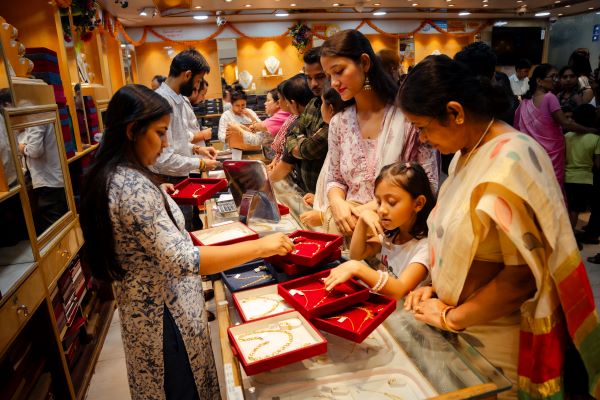
India’s obsession with buying gold is a great example of the fallacy of composition at work. When Indians buy gold at an individual household level they are being perfectly rational. But when these purchases add up at the national level, the whole thing ends up looking irrational. This is something that led to Prime Minister Narendra Modi recently saying: “For a year… we shouldn’t buy gold jewellery.”
An estimate made by Morgan Stanley put the gold owned by Indians at 34,600 tonnes as of June 2025. In 2025-26, India imported 721 tonnes of gold. Given this, and the fact that we are one and a half months into 2026-27, the current gold ownership should be greater than 35,000 tonnes.
So, why do Indians buy gold?
First, it is a very important part of our culture. Most gold is bought in the form of jewellery. The World Gold Council estimates that Indians bought gold jewellery worth $49 billion in 2025. This, despite gold prices going up.
Second, gold helps show off that one has arrived in life. It has a huge social signalling value. After all, you cannot wear your mutual fund certificates and demat account holdings of stocks to weddings and other public events.
In a very weird way, it also tends to explain why so many Indian fast bowlers wear gold chains which dangle beautifully as they run in to bowl.
Third, gold remains a very easy way to store black wealth. It can also be easily moved around. It works very well for intergenerational wealth transfer as well.
Fourth, as a country we have been taught that gold acts as a hedge against inflation. In fact, in January, a chart which showed that gold had beaten stocks in the 21st century had gone viral on WhatsApp University, leading to many people seriously asking what was the point of investing in stocks when a metal that simply needs to be dug up from the earth can give higher returns. Such arguments create investment demand for gold.
Fifth, there exists a huge informal network which is ready to lend against gold and buy it. So, gold can be quickly turned into cash.
Over the last few years bank lending, against gold jewellery has grown big time. The outstanding loans of banks against gold jewellery have exploded from ₹747.38 billion as of the end of 2021-22 to ₹4.60 trillion as of the end of 2025-26.
In fact, the outstanding gold jewellery loans between the end of 2024-25 and the end of 2025-26, grew more than outstanding personal loans and credit card outstanding put together.
Sixth, despite the rise of India’s formal financial system, some distrust remains. Ponzi schemes continue to be in the news. In this environment, many households tend to trust their local jeweller across generations. (Of course, as some of my relatives have found out, local jewellers can also take you for a ride, but then that’s another story for another day.)
So, buying gold remains a rational decision at the individual level. But India produces almost no gold. In fact, as a recent Tanishq ad featuring Sachin Tendulkar told us, India imports 99% of its gold. And this has to be paid for in dollars. In 2025-26, gold imports amounted to $72 billion.
Further, India imports close to 90% of the crude oil it consumes, alongside huge volumes of natural gas, edible oils, fertilisers, electronics and key industrial components. Nearly all of these imports have to be settled in dollars. Add to that India’s more than $112 billion trade deficit with China, which also has to be financed in foreign currency.
Now imagine this against the backdrop of a prolonged conflict in West Asia: the Strait of Hormuz facing disruptions, oil and fertiliser prices climbing, foreign investors withdrawing money from Indian markets, the net foreign direct investment slowing, IT companies reporting weaker export growth and remittances from abroad turning uncertain.
The outcome is this: India’s need for dollars has risen sharply just when the supply of dollars is looking far less dependable. In this scenario, spending billions of dollars to buy gold and store it away, doesn’t seem like the best use of scarce foreign exchange.
Which is why, what looks like a rational decision at an individual level, doesn’t seem so at the macro level. A classic fallacy of composition. It also explains why the customs duty on the yellow metal has been substantially increased.
But the question that remains is: Will Modi’s moral suasion and the duty hike lead to a lesser appetite for gold among Indians? Or will it increase their appetite, given what lies ahead: Higher inflation, global instability, a prevailing world order that seems to be breaking down. On that, your guess is as good as mine.
More From BasisPoint