.png)


Lt Gen Syed Ata Hasnain is Governor, the State of Bihar, and Former Commander of India's Srinagar-based Chinar Corps.
October 5, 2026 at 7:11 AM IST
For decades, India’s security debate over the Siliguri Corridor has been dominated by one compelling image; a potential military thrust from the north seeking to sever the narrow “Chicken’s Neck” and isolate the Northeast. The contingency remains relevant, but the nature of the threat has changed. In the age of hybrid conflict, an adversary may not need to physically threaten the corridor at all. Employing maximum facets of the hybrid spectrum it's always possible to cause turmoil rather than capture, or pose a direct threat. Disrupting its railways, communications, energy networks and social stability, or exploiting criminal, narcotics and infiltration networks, could produce some of the effects once associated only with conventional military operations. The cumulative effect of all this has a major advantage for an adversary. It may have a long gestation but the effect too lasts long. Its complexity and the sheer diversity of threat renders it extremely difficult to counter in entirety.
India’s public is broadly aware of the existence of a threat to the Siliguri Corridor in the wake of deterioration of relations with northern and eastern neighbours but rarely has this been explained adequately for a detailed understanding of its implications.
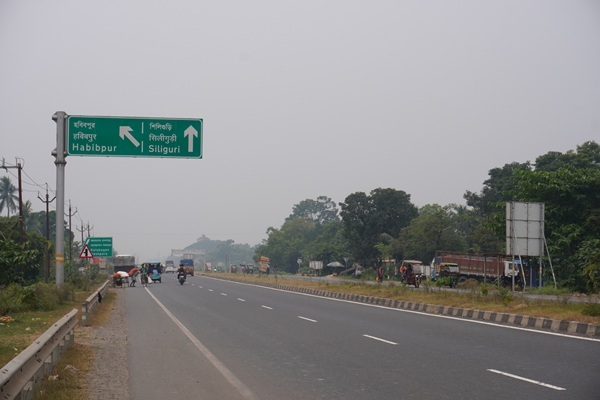
At the narrowest part of the corridor, barely 20-22 km separate Nepal from Bangladesh. Bhutan lies to the northeast, while further north is Sikkim, the Chumbi Valley and Doklam. Almost all surface connectivity between the Indian heartland and the Northeast passes through this strategic space. Roads, railways, pipelines, telecommunications and military logistics therefore converge within an unusually restricted geography.
China no doubt remains the high-end military contingency, notwithstanding the improved environment since 2020. The 2017 Doklam confrontation demonstrated why developments involving the Chumbi Valley and Bhutan have direct implications for India. Yet maps can exaggerate vulnerability. A PLA thrust southwards would have to contend with difficult terrain, strong Indian military dispositions and the inherent vulnerability of the narrow Chumbi salient itself. India has also strengthened military resources around the corridor and its extremities and upgraded command arrangements in the region. Siliguri Corridor is vulnerable, but it is certainly not undefended.
What has changed in recent times is the spectrum of threats.
The most dangerous scenario may not involve regular enemy formations physically attempting to cut the corridor. During a wider confrontation, disruption may be sufficient. A railway bridge disabled, telecommunications interrupted, fuel movement impeded, drones employed against critical installations or coordinated sabotage at several locations could generate disproportionate effects. Cyber-attacks and information operations could compound these by disrupting services, spreading misinformation and creating public anxiety. The nature of turbulence is only limited by human thinking.
The changed political environment in our eastern strategic space introduces another variable, but one requiring careful interpretation. Political change or deterioration in bilateral relations does not automatically make a neighbour into an adversary. India has every interest in stable and cooperative relations. Strategic planning, however, must cater for contingencies, including seemingly remote ones.
The concern is less about conventional military action from the eastern direction than the possibility that territory, networks or local vulnerabilities could be exploited by hostile external actors, with varying degrees of acquiescence or connivance. Pakistan could seek opportunities to revive old networks, while a larger confrontation in the north could create entirely different pressures. In hybrid conflict, facilitation can sometimes matter almost as much as physical participation.
This is why border management assumes significance far beyond preventing illegal crossings. Nepal, Bhutan and Bangladesh each present entirely different border environments. Legitimate movement, economic migration, illegal immigration and hostile infiltration must not be conflated. Demography becomes a security threat when unmonitored population movement takes place in such a strategic region. It brings even greater vulnerability when forged documentation, criminal networks or hostile intelligence agencies exploit it.
Bihar too has a stake in this security architecture. Its northeastern districts of Kishanganj, Araria and Purnea lie in the immediate hinterland of the corridor and form part of the larger movement and connectivity space linking the Northeast with the rest of India. Effective policing, intelligence coordination, monitoring of illicit networks and development in these districts therefore have implications beyond Bihar itself. Security of the Siliguri Corridor cannot be viewed purely through the geography of North Bengal; its strategic depth extends into adjoining Bihar.
Narcotics and gun-running add another dimension. The Siliguri Corridor lies at the intersection of routes connecting eastern India, Nepal, Bhutan, Bangladesh and the Northeast. Networks created to smuggle drugs, weapons, people or contraband develop transporters, safe houses, financial channels, forged documentation and knowledge of border surveillance. In normal circumstances these are principally law-and-order problems. During a security crisis, the same infrastructure can potentially move weapons, explosives, hostile operatives or intelligence material. Military oriented threats often ride on non-military networks.
It’s the police that has a major role here in an area too often viewed primarily through a military lens. That is the effect of the hybrid nature of conflict. The impact is on the military and yet the solutions often lie with the police which makes coordination a challenge. An all of government approach is the answer.
The BSF and SSB guard international borders; the Army prepares for external contingencies; intelligence agencies provide the larger picture. None can substitute for a technologically capable, locally knowledgeable police force operating continuously among the population. The Siliguri strategic region needs strong Special Branch capability, expertise in narcotics and arms trafficking, financial and cyber investigation, document-fraud detection, counter-drone awareness and specialised protection of railways, bridges, communications and energy infrastructure.
Above all, it needs intelligence fusion. A local policeman, BSF patrol, SSB post, railway security official, narcotics investigator and hard-core intelligence agency may each possess only one fragment. Connecting those fragments may reveal the network. Thankfully, this has already been well realised, early in our campaign
There is also a danger in viewing the population simply through a security prism. People inhabiting this sensitive region must be stakeholders in its stability. Development is therefore part of security.
A focused development approach should emphasise employment, skills, education, healthcare, roads, digital connectivity, tourism, women's participation and opportunities for young people. Regular administrative outreach and good community policing build confidence and generate local awareness which technology cannot replicate. The population should never be regarded merely as people living inside a strategic vulnerability; they constitute its first layer of resilience.
Finally, we could reduce the consequences of geographical dependence itself. More roads and railway axes, resilient telecommunications and power systems, distributed logistics stocks, air connectivity and alternative access to the Northeast create redundancy. Connectivity through Bangladesh has considerable economic and strategic potential when political circumstances permit, while routes through Myanmar provide another longer-term option.
The ultimate security of the Siliguri Corridor may therefore depend partly upon making the North East progressively less dependent upon it.
Securing the Siliguri Corridor today means much more than preventing an enemy from reaching the Chicken’s Neck. The real test is whether military pressure, sabotage, infiltration, criminal networks, information operations or disruption of a few critical arteries can isolate the North East or generate strategic paralysis. A constant effort to link hybrid conditions with the security of the corridor and the North East will remain a compulsion
Military preparedness remains indispensable. But in an age of hybrid threats, resilience must extend to borders, police, intelligence, infrastructure and, above all, people. The corridor will be truly secure when geography can no longer be easily converted into vulnerability.
More From BasisPoint