.png)

Minari Shah is a strategic communications leader who has helped Fortune 500 brands, such as Amazon, Tata Motors and Dell, build trust through storytelling.
July 22, 2026 at 1:27 PM IST
Millions of students compete regularly for a handful of seats as an act of faith, believing that in return for years of preparation and real financial cost, they will get fair rules to play by. When this trust is breached, it brings both anger and devastation.
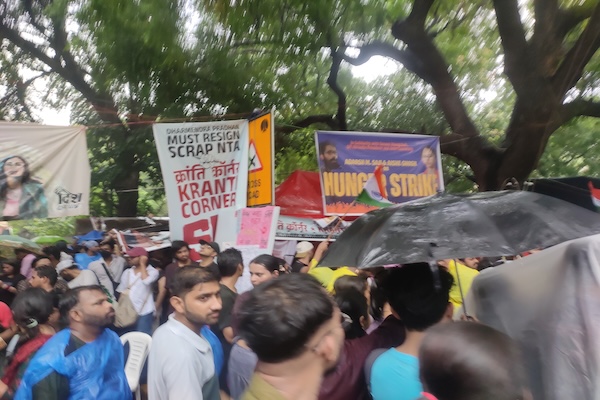
But what’s playing out in Delhi right now, and increasingly across India, goes beyond this anger at one failed test and instead reflects broken trust, from a systemic failure that’s happened once too often. A youth movement that began online as satire has now pulled tens of thousands onto the streets and, for now at least, seems to be scaling. What’s driving them is their shaken trust, questioning the system meant to convert effort into opportunity, where not only does the system feel broken but no one seems to own it, nor is anyone trying to fix it.
Leaks, failures, and the devastating personal cost they carry are unfortunately not new to us in India. But I cannot remember seeing a response of this scale. A generation often written off as disengaged is now demanding accountability and doing it with a persistence that’s hard to ignore.
That in itself means that whatever else this is, it deserves attention. Because once you strip away the noise, the affiliations, the competing interpretations, there is one question under it all: can the system be trusted? The protest asked this question specifically first about the exam, but it’s now compelling us to ask it of the broader democratic system itself.
What the students are asking for is simple: an operationally consistent, fair process they can rely on. Not everyone has the money or the time for a retest. For most of us, the leaks and the retests were headlines buried on inside pages, and the suicides that followed were just news we scrolled past between sips of tea. Watching students on the street for days has forced us to pause in a way those headlines never did.
Our exams have never been free of doubt, and no one seriously denies the role of privilege. What students hoped they could bank on, however, was the ability to plan: put in the time, spend what limited resources they had, take their shot. When neither merit nor timing can be predicted, the entire premise of competitive selection starts to give way.
To those who point to the retest as the answer: that’s an administrative fix rather than restoration of trust. Students lost months of preparation, often their savings, sometimes their psychological stability, along with the time they can’t recover in what’s already a difficult job market. Without any guarantee that the same failure won’t recur, why wouldn’t they ask who’s accountable for the breach? The Supreme Court’s dismissal of the matter, because the retest had already happened, answered the legal question. But sometimes a process can be legally closed and still feel unresolved.
The scale of this response, larger than anything a single exam leak has triggered before, is clear evidence of this.
Every institutional failure gets judged on three fronts: competence (could the exam be run securely), fairness (were all candidates held to the same conditions), and accountability (when it broke, was the truth told and was responsibility fixed on someone). It’s the third that decides whether trust can be rebuilt. A corrected process still carries the shadow of the failure until accountability is visible. People don’t just want the system to work. They want to know that when it doesn’t, there is full ownership and accountability.
In effect, this protest is about the failure of trust at a magnitude rarely seen, from the people who have borne the entire cost of a systemic breakdown. It’s tempting to read the student protests through a political lens: who’s backing them, who benefits, who’s amplifying them. But that would miss the real importance of what’s actually happening: a collective demand that the system be upheld to the right standards, and a demand for accountability of a sort we don’t often see in India.
Here is where the question of influence also comes up.
When trust is questioned, institutions have two choices. They can engage with the questions: explain, take responsibility, repair. Or they can manage the situation: contain the disruption, restore order, move on.
The second option is faster, and perhaps tempting for anyone in charge. But when order is restored through visible force, detentions, crackdowns, physical suppression, it necessarily carries its own meanings about the role of influence. It may bring the streets back under control. But it may also reaffirm the very distrust that put people on the streets in the first place. Because trust is built with ownership and responsibility, not forced compliance.
So what would actually rebuilding it require? Ownership, not blame-shifting. That the system often failed in the past is neither an answer nor an argument or reason to let it keep failing. It needs a willingness to be held accountable, matched with visible structural change rather than statements and assurances. Trust gets rebuilt when institutions show they’re willing to own the cost of their own failure instead of passing all of it downstream.
That means:
-
A clear, public account of what failed
-
Accountability traceable to a person or a process, not a vague apology
-
Demonstrable changes to how these exams are run
-
A defined protocol for what happens if integrity is compromised again
-
Some recognition, material and/or procedural, of what this cost students
-
Acknowledgement of the students and families who paid with a life
Supporting students here isn’t a political position. It’s a societal one. One can disagree on the methods. One can debate the form the protests have taken. What’s harder to argue against is the core demand: a system that asks for trust has to be worthy of it. And surely, this is hardly unreasonable. This seems to be the minimum requirement for legitimacy.
The question sitting in front of the country right now: will power, faced with this ask from its next generation, earn trust back, or burn through what they have in shutting the students down?
This piece first appeared on Minari Shah’s Substack page, The Long View.
More From BasisPoint