.png)

Indra is a Senior Industry Advisor in the BFSI unit at TCS, with three decades of experience in business strategy and IT consulting. He leads CXO advisory, and drives data and AI-led innovations.
September 16, 2026 at 5:32 AM IST
Indra is a Senior Industry Advisor in the BFSI unit at TCS, with three decades of experience in business strategy and IT consulting. He leads CXO advisory, and drives data and AI-led innovations.
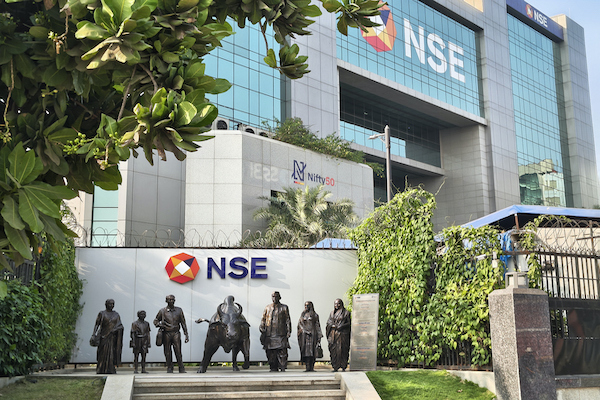
The National Stock Exchange transformed Indian trading from a fragmented, floor-based business into a national electronic market. Its long-delayed IPO is therefore more than another large listing - it is a public-market test of what investors are willing to pay for India’s dominant exchange franchise.
Demand is unlikely to be the problem. NSE combines a dominant market position with high profitability, a deep derivatives franchise and an integrated trading-and-clearing model. Even after a likely reduction from earlier valuation expectations, the issue could rank among the country’s largest IPOs.
Are Indian exchange stocks pricey?
At an indicated valuation of ₹4.42 trillion, or about $46.3 billion, NSE would be worth more than three times BSE and roughly five times MCX. It would also be about 1.66 times the combined market capitalisation of BSE, MCX, CDSL and NSDL. The MSEI and the NCDEX are yet not listed.
Most global exchange groups trade at lower multiples despite broader international operations and, in several cases, larger data and post-trade businesses, coupled with enhanced platforms that anchor innovative solutions across the investment value chain. ICE trades at 21.98 times, CME Group at 23.25 times, Deutsche Börse at 24.09 times, Nasdaq at 26.82 times, LSEG at 29.63 times and SGX at 37.38 times. The comparison is not exact, but it frames the key question: what earns NSE a premium to more diversified global peers? At the upper end of the indicated price band, NSE would trade at 42.88 times trailing earnings. That is below MCX’s 54.65 times, BSE’s 48.08 times and CDSL’s 60.23 times, while broadly in line with NSDL’s 41.33 times.
The wider Indian market is cheaper. The BSE Financial Services Index trades at 16.27 times trailing earnings, the Nifty Capital Markets index at 44.03 times, and the Nifty 50 at 19.85 times.
NSE’s premium may be defensible. But it cannot rest merely on India’s growth story or on the assumption that derivatives volumes will continue on a one-way escalator. Investors must decide whether the earnings underpinning that valuation are durable enough to justify a premium to many global peers.
The bullish case rests on three pillars: rapid financialisation, unusually strong exchange economics and Indias long-term economic growth.
Demat accounts at NSDL and CDSL rose from about 80 million in 2021 to 185.3 million at the end of 2024, and reached 237.7 million by August 2026, despite a recent slowing in new additions. These are accounts, not unique investors, but they still illustrate the widening retail footprint.
Mutual-fund assets under management rose from ₹0.91 trillion around the 2001 UTI US-64 crisis to ₹88.31 trillion by August 2026—a 97-fold expansion.
Primary-market activity has also broadened. IPOs, follow-on offerings and rights issues raised ₹2.3 trillion in 2025-26, up 11.7% year on year, while outstanding corporate bonds exceeded ₹60 trillion by July 2026.
Trading activity has grown even faster. Cash-market turnover rose 5.63 times over the past decade, implying an 18.87% CAGR. Equity-futures turnover and equity-options premium turnover grew at CAGRs of 12.27% and 45.13%, respectively. Commodity-futures turnover rose from ₹66.96 trillion in 2015-16 to ₹166.43 trillion in 2025-26.
These trends have enlarged the pool from which exchanges earn fees. But volume growth alone does not establish the durability of those fees.
Margin Rich Business
Indian exchanges are now globally significant. NSE ranked third in cash-equities trades in 2025 and led global derivatives-contract volumes, while BSE ranked tenth in cash equities and second in derivatives. MCX held leading positions in energy and precious-metals contracts.
India also remained among the world’s busiest listing markets. But the BSE and NSE listing counts should be handled carefully because many issuers list on both exchanges; they do not necessarily represent distinct companies.
Over four years, BSE, MCX and NSE recorded income CAGRs of 56.26%, 48.89% and 20.51%, respectively, without relying on large acquisitions. Their operating EBITDA margins—73% for MCX, 67% for NSE and 64% for BSE—are also unusually high.
Such profitability reflects capital-light models, high incremental margins and powerful network effects. It may also reflect the rich economics of a small number of products, particularly equity derivatives. Narrow product entrenching and high margins can signal a moat. They can also attract regulatory scrutiny.
Infrastructure spending, economic formalisation, digital access and a younger workforce are strengthening the long-term case for financial savings. A deeper pool of retail investors, mutual-fund money and prospective issuers should support the growth of Indian capital markets.
But a favourable macro backdrop is not a valuation guarantee. It does not remove regulatory risk, prevent competition or ensure that current margins are permanent.
Premium Check
NSE’s valuation will ultimately be tested on four fronts: regulatory exposure, the breadth of future revenue pools, control over post-trade economics and the durability of market infrastructure as technology changes.
Regulatory Uncertainty: India’s exchanges operate within a regulatory framework that can rapidly alter product economics. The proposed Securities Markets Code, 2025 could reshape market oversight; more immediate are rule changes affecting product portfolio, contract design, expiry structures, margins and retail participation.
The contraction in currency derivatives, the weak development of interest-rate derivatives and repeated revisions to equity-derivatives rules show how exposed exchange revenues can be to policy choices. NSE’s derivatives scale is a strength, but it is also a concentration risk.
Gateway Prospects: Nearly a decade after GIFT IFSC’s first exchange, equity and currency derivatives, debt, global stock, and bullion segments have grown significantly. IFSCA’s consultation on direct listings offer new listing prospects. Beyond disconnected domestic and offshore markets, IFSC-linked exchanges can facilitate cross-currency trading and settlement, supported by direct settlement links with international depositories. Though, global exchanges establishing local subsidiaries or a consortium pose competitive threats.
Multi-assets franchise: Corporate bond and repo markets remain fragmented and illiquid. Beyond patchy OBPP flows and trade reporting services, exchanges must anchor integrated CLOB and RFQ platforms. MCX’s non-agri monopoly and NCDEX’s presence in agri commodities create opportunities for BSE and NSE to establish their space. Unlike global peers advancing integrated private market infrastructure, Indian exchanges remain unprepared. Lacking regulatory clarity, crypto / digital assets and event-based contracts lies outside boundaries.
Clearing business autonomy: Following SEBI’s November 2024 consultation, issues around clearing corporations’ ownership and economic structure remain unresolved. As wholly owned exchange subsidiaries, exchanges influence governance, pricing, investment, and infrastructure decisions of clearing corporations. Any change to the Payment and Settlement Systems Act enabling a horizontal clearing model with financially autonomous clearing corporations could reshape market structure, exchange dominance, and transaction fee structures.
Data and Analytics: Transaction fees rise and fall with volumes. Data, analytics, indices, APIs, surveillance tools and risk-management products can produce more recurring and less volume-sensitive revenue.
The opportunity for NSE is not to become an AI laboratory. It is to turn proprietary market data into useful products: contextualized analytics, workflow tools, risk dashboards and research services that become embedded in investment decisions. That requires reliable data, product depth, distribution and trust—not merely a partnership with a cloud provider or an AI label, but a true investment ecosystem orientation.
Tokenisation: Tokenisation may eventually affect how securities are issued, traded, settled, held in custody and serviced. The commercial implications are still uncertain. But if tokenisation changes who records ownership, where trade settlement happens and how collateral moves, it could reshape parts of the exchange and clearing value chain—including transaction-fee pools.
NSE’s IPO will initially be judged by subscription levels, listing performance and shareholder returns. Those are the standard scoreboard measures for a marquee issue.
The more important test comes later. Can NSE preserve the trust that makes an exchange valuable while widening participation, strengthening market integrity and building businesses less dependent on a single, regulation-sensitive trading engine?
For an exchange, trust is not an ESG appendix. It is the fundamental bedrock driving market vitality.
*Disclaimer
The article presents a sector-focused perspective and does not recommend, advise, or solicit investments in any companies, whether listed or under IPO, mentioned herein.
The founding team members of Basispoint Insight held editorial leadership positions in Cogencis Information Services before it was acquired by NSE Data & Analytics Ltd.
More From BasisPoint