.png)


Dr Arvind Mayaram is a former Finance Secretary to the Government of India, a senior policy advisor, and teaches public policy. He is also Chairman of the Institute of Development Studies, Jaipur.
August 12, 2026 at 3:31 AM IST
The recent police action against students in Delhi has generated intense political controversy. The opposition alleges a heavy-handed crackdown. Government representatives insist that the force used was lawful and necessary. The Supreme Court has been informed that pellet guns are legally sanctioned. The CRPF leadership has defended the conduct of its personnel.
Yet, amid the competing narratives, an important question has received surprisingly little attention.
When the State decides to use force against its own citizens, who exercises an independent judgment that such force is necessary and proportionate?
The question goes far beyond the events in Delhi. It touches the architecture of democratic governance itself. Every constitutional democracy recognises that the State must possess coercive powers. Public order cannot be maintained without them. The challenge is not whether such powers should exist, but how they should be exercised and what institutional safeguards should accompany them.
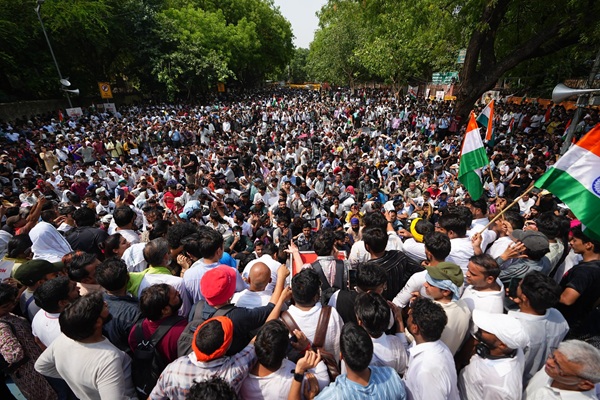
The images from Delhi have made this question impossible to ignore. Videos of school and college students being beaten with lathis, allegations of pellet guns being used, young women running from advancing police lines, and reports of protesters being subsequently identified through facial recognition technology have transformed what might otherwise have been viewed as a routine law-and-order operation into a wider debate about the limits of State power. The issue is no longer simply how the State controls crowds. It is how a democracy controls the exercise of its own coercive authority.
Why Independent Judgment Mattered
This arrangement was based on a simple understanding of human behaviour. Officers confronting an angry crowd are required to make decisions under extraordinary pressure. They face provocation, uncertainty, and sometimes direct threats to their own safety. Even the most professional officer cannot be expected to remain entirely detached in such circumstances. The law therefore recognised that the judgment about necessity and proportionality should be exercised by an authority standing outside the confrontation itself.
The wisdom of this arrangement is often misunderstood. It did not rest on the assumption that a magistrate understood policing better than the police. Nor was it intended to undermine operational effectiveness. Its purpose was to ensure that the officer confronting the crowd was not also the sole judge of how much force should be used against it.
The distinction may appear subtle, but it is fundamental. Democracies routinely separate powers not because one institution is inherently wiser than another, but because important decisions benefit from independent scrutiny. The use of force against citizens is among the gravest powers exercised by the State. It is precisely the kind of decision that requires an element of detachment.
A Colonial Safeguard, A Democratic Erosion
The separation of operational command from magisterial authority evolved within a colonial system that was neither representative of nor accountable to the Indian people. The British did not create it out of democratic idealism. They created it because they understood the dangers of concentrating operational engagement and the authority to sanction force in the same hands. Independent judgment was built into the architecture of coercion.
Independent India inherited that arrangement. Yet, over time, many of the institutional distinctions that separated operational engagement from authorisation have been diluted. The irony is difficult to miss. A safeguard conceived under a colonial administration has gradually weakened under democratic governments that derive their legitimacy from the people themselves.
Over the past several decades, India's administrative framework has evolved in a different direction. The commissionerate system, now prevalent in most large urban centres, has concentrated operational command and magisterial authority within the same institutional hierarchy. The rationale is understandable. Modern cities require rapid decision-making, unified command structures and clearer operational responsibility.
Yet every institutional reform involves trade-offs.
The commissionerate system may have increased administrative efficiency. But it has also raised a less discussed question: has the concentration of authority weakened an important safeguard of independent judgment?
The Problem of Diffused Responsibility
Government representatives state that the action was lawfully authorised. Delhi Police has defended its conduct. The CRPF has stood behind the decisions taken by its personnel. Yet none of these explanations clearly identifies who exercised the critical judgment that persuasion had failed, that force should be escalated, that tear gas shells should be deployed, or that pellet guns should be used.
This opacity is itself significant.
In any law-and-order operation, clarity of command is essential. Officers on the ground must know whose orders to follow. But in a democracy, clarity of responsibility is equally important. After the event, citizens should be able to identify who authorised the use of force and on what basis that decision was made.
Today, we are told that the action was lawful. We are told that procedures were followed. We are told that officers acted in good faith. Yet no institution appears willing—or perhaps able—to identify where the decisive judgment was exercised. Lawfulness is asserted. Responsibility remains diffuse.
One is left with an uncomfortable question. Is this opacity merely an unintended consequence of institutional evolution? Or has the present arrangement become so diffused that fixing responsibility after the event is inherently difficult? The point is not to attribute motives. It is to ask whether the system itself makes accountability unnecessarily elusive.
The issue is particularly relevant when multiple forces operate together. If Delhi Police, the Rapid Action Force and the CRPF are deployed in a common operation, who exercises the final judgment when the situation deteriorates? Who decides that persuasion has failed and coercion must begin? In a democracy, these questions should have clear answers.
Beyond the Moment of Force
The concern extends beyond the immediate use of force. The registration of FIRs, identification of participants through facial-recognition systems, arrests and subsequent investigations form part of the same continuum of State action. If these decisions are taken by officials emerging from an emotionally charged confrontation, does the present system provide sufficient institutional distance for calm and objective assessment?
This question assumes even greater significance in an age when technology has dramatically expanded the surveillance and enforcement capabilities of the State. Facial-recognition systems, digital databases and real-time monitoring tools have increased the reach of law enforcement in ways that were unimaginable a generation ago. The stronger the coercive capacity of the State becomes, the greater the need for independent oversight of its exercise.
Restoring the Principle
But institutional evolution should not come at the expense of constitutional safeguards.
The underlying principle remains relevant irrespective of the structure through which it is implemented. Democracies do not rely solely on the professionalism of public officials. They create systems that recognise the limitations of human judgment under pressure. Independent oversight is valuable not because officials are presumed to act in bad faith, but because power, particularly coercive power, requires restraint.
The Delhi episode should therefore prompt a broader discussion than the one currently taking place. The real issue is not whether one officer acted correctly, or another exceeded the law. It is whether India has gradually allowed operational efficiency to eclipse an important constitutional principle: that the exercise of coercive force should be subject to independent and dispassionate civil judgment.
The question is not whether India should restore a colonial-era administrative arrangement. The question is whether it has inadvertently discarded a safeguard that even the colonial State considered necessary.
A democracy is ultimately judged not merely by its capacity to maintain order, but by the safeguards it places around the exercise of power. The authority to use force against citizens is among the gravest powers entrusted to the State. Public confidence depends not only on legality, but on the assurance that such decisions are reached through processes that are transparent, accountable and independent.
If recent events have exposed uncertainty about where that independent judgment now resides, then the time has come to revisit one of the least discussed—but most important—questions in the design of the Indian State.
More From BasisPoint