.png)

Attack on One, Attack on All: What the Saudi-Pakistan-Turkey Defence Pact Means for India
The pact signals a Gulf push for greater strategic autonomy, but also exposes regional divides and fresh uncertainty over deterrence and alliances.

Lt Gen Syed Ata Hasnain is Governor, the State of Bihar, and Former Commander of India's Srinagar-based Chinar Corps.
August 9, 2026 at 6:14 AM IST
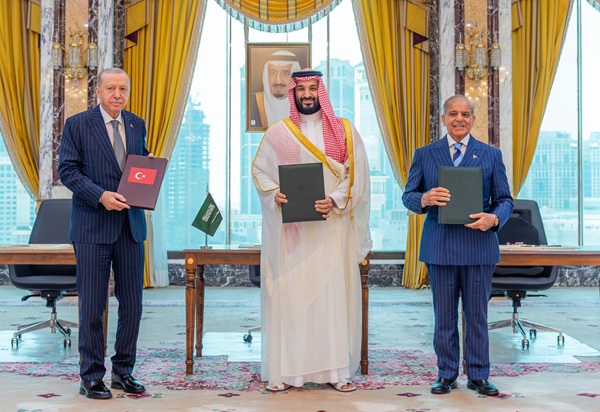
On August 7, in the holy city of Mecca, the leaders of Saudi Arabia, Pakistan and Turkey put their signatures to a document that could quietly redraw the security map of the Islamic world. The Mecca Joint Defence Agreement — signed by Saudi Crown Prince Mohammed bin Salman, Turkish President Recep Tayyip Erdogan and Pakistani Prime Minister Shehbaz Sharif — commits each country to treat an armed attack on any one of them as an attack on all three; on the lines of Article 5 of NATO. It is not signed in a moment of calm. It arrives while a US-Israel war against Iran threatens to reignite, while Houthi missiles continue to strike out of Yemen, and while Gulf capitals openly question whether Washington remains a security guarantor, they can rely on.
That timing matters more than the text itself. This is not a routine diplomatic upgrade; it is three of the Islamic world's modern militaries formalising a hedge against a regional order they no longer appear to trust to hold.
The Gulf: Self-Reliance Over the American Umbrella
The immediate practical effect is a stronger shield against the kind of missile and drone threats Saudi Arabia has faced from Iran-aligned Houthi forces. But the deeper signal is about self-reliance. Gulf states have spent the past several years watching Washington's commitment to the region wax and wane, and this agreement reads as an attempt to build indigenous deterrence rather than continue leaning entirely on the US security umbrella. However, acts in haste, such as this, do not necessarily meet the need of the hour.
It is worth noting what the pact is not. Analysts have been careful to describe it as an inflection point rather than a NATO-style alliance — the institutional scaffolding, integrated command structures and standing obligations of a true collective-defence bloc are not yet in place; the commitment has been showcased, the capability remains suspect. Kuwait has reportedly shown interest in a wider Gulf arrangement, but for now this remains a trilateral pact, and a revealing one; the UAE and Qatar, both central and important Gulf powers, are conspicuously outside it. That absence hints at a split within Gulf ranks rather than a unified regional front, and it is one of the more interesting narratives to watch as the pact matures.
It is worth resisting the reflex to label this a "Muslim NATO," a shorthand that has already begun circulating in commentary. Genuine collective-defence architecture — the kind NATO represents — is not the product of a signing ceremony but of years, often decades, of interoperable militaries, shared intelligence pipelines, joint command structures and repeated crisis coordination that gradually builds the trust needed for a state to subordinate its own decision-making to a collective response. NATO's Article 5 works because it sits atop that accumulated convergence, not because a treaty text declared it into existence. The Mecca pact, by contrast, is substantially a response to an acute, ongoing contingency — the live war radiating out from the Israel-Iran conflict and the Houthi threat to Saudi territory — rather than the culmination of long-gestated strategic integration between Riyadh, Ankara and Islamabad. That does not make the agreement meaningless; it makes it what analysts are correctly calling an inflection point rather than an alliance in the fuller sense. Whether it evolves into something closer to genuine collective defence, or instead proves to be a wartime expedient that loosens once the immediate crisis passes, will depend on choices these three governments have not yet had to make.
For now, it’s the vagueness and the lack of a proper framework that is perceived to act as a deterrence rather than any substance itself.
West Asia: Deterrence Aimed Two Ways
The less-stated but equally real target is Israel. With the region already gripped by an active Israel-Iran conflict, and with Israeli strikes having extended into Gulf airspace and even Qatar in recent months, the three signatories are also building leverage against an Israeli military posture that Sunni capitals increasingly view as unconstrained. Turkey's inclusion is significant here; it embeds Ankara — and its expanding defence-export relationships — more firmly into the security architecture connecting South Asia, the Gulf and Europe, reinforcing trade and energy networks that run through the region. Remember war stamina is today almost a declared principle of war.
Taken together, the pact reflects a broader theme playing out across West Asia; a push toward strategic autonomy, with regional heavyweights taking direct ownership of deterrence rather than deferring to external powers.
India: Watching Closely, Not Yet Alarmed
Still, the implications are real and layered. First, the pact deepens Pakistan's integration into a well-resourced West Asian military ecosystem, giving Islamabad access to advanced Turkish drone technology and Saudi financing that could reinforce its long-term defence posture and strategic depth. Second, if the agreement hardens into rigid bloc formation — Iran and its proxies on one side, a Saudi-Turkey-Pakistan axis on the other — the risk of a wider regional war grows, with direct consequences for India: disruption to the Strait of Hormuz and the Red Sea, higher crude prices, rising maritime insurance costs, and pressure on India's energy security. Third, West Asia hosts millions of Indian workers and enormous Indian investment; any escalation that draws in South Asian militaries alongside West Asian ones puts those citizens and assets under real operational risk.
The sharpest diplomatic question, though, is narrower and more pointed: will Pakistan attempt to invoke the pact's collective-defence language during a future crisis with India, effectively trying to internationalise a bilateral dispute? This is the scenario New Delhi will be watching most carefully.
Here, though, is India's genuine cushion. Analysts are largely aligned in judging that the pact's nuclear dimension is not designed with India in mind, and that Saudi Arabia is highly unlikely to be drawn into an active conflict against New Delhi. India has spent the last decade building a deep, standalone strategic and economic relationship with Riyadh — spanning energy, trade, investment and counter-terrorism cooperation — one that exists independently of Saudi Arabia's ties to Pakistan. Riyadh would do well to state plainly that the pact is not directed at India and does not dilute its own commitment to combating terrorism, a clarification that would remove much of the ambiguity that would fuel speculation in New Delhi. The last time the Saudis did say so.
For now, India's posture is likely to remain what it has been: neither alarm nor complacency, but sustained diplomatic engagement — with Riyadh in particular — to ensure the Mecca Joint Defence Agreement stays confined to its stated purpose of Gulf deterrence, and does not become a vehicle for internationalising South Asia's oldest rivalry.
More From BasisPoint