.png)

Jonathan D. Ostry is Professor of Economics, Global Affairs, and Public Policy at the University of Toronto.
September 4, 2026 at 3:42 AM IST
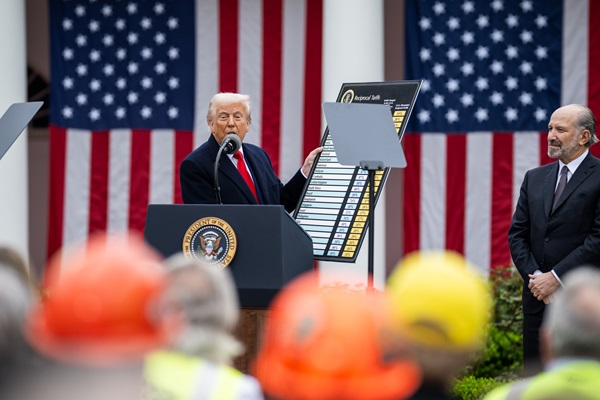
When US President Donald Trump warned business leaders in Davos last year that tariffs were coming, he offered a word of friendly advice: “Come make your product in America” and thereby sidestep looming import duties from the get-go. In the months that followed, Trump’s America First trade policy took shape. The “Liberation Day” tariffs were announced, paused, restored, found to be unconstitutional, and then replaced by duties enacted under different legislation.
The upshot was a combination of high tariffs (at rates last seen in the 1930s) and burdensome uncertainty for businesses that could no longer plan their operations. Even now, unpredictability remains a signature feature of US trade policy, with new rounds of unilateral tariffs recently announced amid the expiration of tariffs imposed in February and a renewed push to restore higher levels of protection for US firms.
These two components (restrictiveness and unpredictability) extend to the global trade policy landscape more broadly. As advanced economies have embraced industrial policy, tariffs have emerged as a central instrument to reduce dependence on foreign supply chains, promote reshoring of jobs and production, and address perceived unfair foreign trade practices. But what about the impact of the policy regime on inward foreign direct investment (FDI), which remains an important objective in its own right?
In a recent paper, my colleagues and I examined how trade-policy shocks affect bilateral FDI flows. While our research was motivated by policy developments in the United States, it takes a global perspective, covering bilateral investment flows from over 200 source countries to 35 OECD countries over nearly four decades. Our goal was to quantify causal effects: how FDI evolves in the aftermath of a trade-policy shock (an increase in restrictions or uncertainty) relative to the counterfactual of no shock.
In theory, trade restrictions have ambiguous effects on FDI. On the one hand, because tariffs raise trade costs, they will tend to deter efficiency-seeking and export-oriented FDI, which relies on the seamless exchange of intermediate goods across borders within global value chains. By increasing both the level and volatility of trade costs, trade-policy shocks (restrictions and uncertainty) reduce the expected profitability of integrated production networks and weaken incentives to locate stages of production abroad. Unpredictability depresses FDI by increasing the option value of delaying investment until the policy landscape is clearer.
On the other hand, trade barriers may encourage market-seeking or tariff-jumping FDI (as Trump alluded to), whereby firms establish production facilities within protected markets to preserve access and avoid import duties. This tactic was in evidence last year amid the US-China tariff escalations, when several Chinese firms expanded production in North America and third countries to circumvent US tariffs.
Taken together, these considerations suggest that the relationship between trade-policy shocks—both realised trade restrictions and increases in policy uncertainty (words and deeds)—and FDI is ultimately an empirical question.
Our findings paint a sobering picture of how both trade restrictions and policy uncertainty affect bilateral FDI inflows. While both shocks dampen FDI, the uncertainty shock is far more potent (its impact on a comparable basis is about three times larger than the restrictions shock—a 50% reduction (relative to the FDI sample mean) in the first year following a one standard-deviation uncertainty shock, compared to 15% for the tariff shock). The difference reflects how investment decisions involving high sunk costs respond to expectations about future regulatory environments. When uncertainty spikes, investors sit on the sidelines, delaying investments until the policy fog clears.
Interestingly, the damage to FDI appears to be stronger when source and host countries are geoeconomically and geopolitically close than when they are distant. When host and source countries are close partners in global production networks, the hit to FDI from trade restrictions is amplified. And when host and source countries are geopolitically close (based on United Nations voting records), the impact of uncertainty shocks is likewise amplified.
Amid governments’ reconsideration of the benefits of global trade integration, tariffs have emerged as a central policy instrument, justified on national-security grounds, to support domestic manufacturing and employment, or to correct other countries’ perceived unfair trade practices (including state subsidies and undervalued currencies). Seen in this light, the chilling effect of tariffs on FDI might be viewed as unavoidable collateral damage.
But even for those who desire less global trade integration, the surge in policy uncertainty seems to carry a cost without any corresponding benefit—an own goal or self-inflicted wound. In this respect, elevated policy uncertainty is a puzzle. If a country opts for higher trade restrictions to promote its (perceived) domestic interests, a predictable policy is far superior to a volatile one, as it avoids the unnecessary and large collateral damage to FDI inflows.
Copyright: Project Syndicate, 2026.
More From BasisPoint