.png)

Text of post-policy press conference of the RBI
The first-cut text of the Reserve Bank of India’s press conference after the meeting of the monetary policy committee.
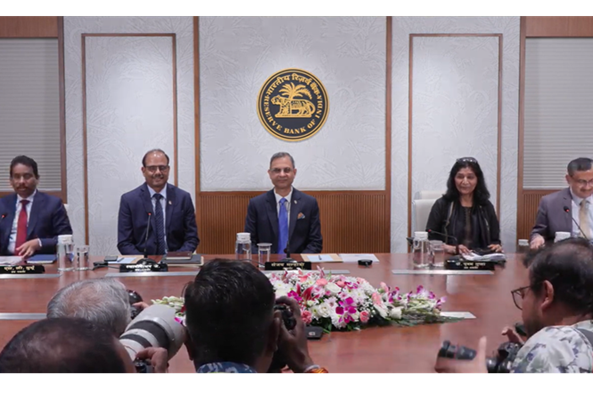

August 5, 2026 at 8:25 AM IST
Q: The market found the policy statement more dovish than expected. Your inflation forecasts are above 5% for almost a year, well above the 4% target, and the real rate therefore becomes negative for a good part of the next six months. Are you going to focus on core inflation? Are you reconciled to a negative or very low real rate?
Governor Sanjay Malhotra: First of all, we are neither dovish nor hawkish. We feel this is the right policy rate for the growth-inflation dynamics we are in today and the outlook that we have projected.
There is a lot of uncertainty, which will, of course, play out. The framework is very clear. I don't think there should be any confusion about the framework. Our target is headline inflation. It is not core or core excluding precious metals. Headline inflation is the target that has been given to us, and we will continue to be guided by headline inflation.
It is our endeavour to bring headline inflation in line with the target over the medium term.
Why do we look at core inflation and core excluding precious metals? Because we need to know what the underlying inflation is and where headline and underlying inflation are going to converge going forward. Headline inflation, because of food and now because of fuel and external shocks, can be very volatile.
As I mentioned even in the earlier press conference, this volatility is not something that we would like to bring into our policy repo rate. It is over the medium term that we target headline inflation. Accordingly, we will take action as may be required, depending on the outlook and how the growth-inflation dynamics play out.
Q: On the FCNR(B) scheme, is there an option to close it prematurely before the deadline if a certain amount of inflow comes in? There is a cost to the scheme because the RBI is subsidising the hedge, while India's foreign exchange reserve position is much stronger than it was in 2013.
Governor: We have got robust flows, as you mentioned, and we hope to get good, healthy flows going forward.
As of now, there is no proposal under consideration to close the scheme prematurely. We will keep you posted on this.
Q: We have seen around $40 billion being mobilised under the FCNR(B) scheme, yet the rupee has not appreciated much. Is that because the RBI is squaring off its forward position and the dollars are not coming into the market?
Governor: The underlying fundamentals of the Indian economy are very strong, as I have mentioned earlier.
There can be an argument, as some people have made, that in nominal or real effective exchange rate terms the rupee may be undervalued. There is a lot of uncertainty.
It is quite possible that going forward, as tensions and the conflict de-escalate, the rupee may further strengthen. It has strengthened over the last month or so, from around 97 levels to around 95 levels.
Our policy has always been that we don't pursue a particular level or band for the exchange rate. We intervene only in case there is excessive volatility or speculative pressure getting built up.
It will be our endeavour that the trajectory of the rupee remains orderly, that there is no disruptive movement and that self-fulfilling expectations do not get built into the exchange rate.
Q: On FCNR(B), can you give us the geographical split of where the deposits have come from? And have the flows ticked all the boxes in terms of balance-of-payments management, liquidity and foreign exchange?
Governor: As of now, it has ticked all the boxes.
On geographies, we don't have that information. We don't collect the geographical split.
The flows, as I said, have been robust. Even before these measures, we had a very strong and comfortable external position. This further fortifies our external position.
Q: Banks' margins are not as lucrative as they were earlier. Did the RBI take that into account while issuing the paper on differential rates for bulk deposits? Was the decline in NIMs one of the reasons?
Governor: The guidelines on interest rates for bulk deposits were not issued because of the decline in NIMs.
The underlying cost of deposits can be different for different depositors because our directions, particularly on LCR, differ. Keeping that in mind, we issued these guidelines.
Q: The RBI has announced changes relating to the calculation of loan interest rates. What relief will this provide to ordinary borrowers? When will the rules come into force?
Governor: The principal reason for these interest-rate rules is that different regulated entities had different directions applicable to them.
We have brought these rules to rationalise and standardise the framework. This will also increase transparency because everyone will know what the interest rates are and how they are set.
Primarily, it is a rationalisation exercise that will further strengthen consumer protection.
People should not understand this to mean that the EMI will necessarily change. The EMI will remain what it is, but there will be greater transparency in understanding the interest and principal.
Q: What do you mean by all regulated entities? Will NBFCs have to declare an external benchmark lending rate? Will NBFCs be brought under EBLR?
Governor: All those details will be there in the draft guidelines that we are coming out with. Please wait for those guidelines.
There is no major change in the requirements with regard to NBFCs or in terms of bringing them onto EBLR. It is primarily a rationalisation.
Deputy Governor: You have to wait for the circular. The only thing I can tell you is that there is no major change. The emphasis is on transparency and conduct.
Q: You said transmission of policy rates has moderated. With liquidity now increasing and potentially rising further, do you expect banks to pass on the benefit of liquidity to customers, particularly when banks are trying to improve NIMs?
Governor: Liquidity will obviously help everyone. It was required.
But let me mention that liquidity may remain in surplus only for the very short term. It may peak around the second quarter, around September or so.
Going forward, it should get absorbed because of the normal needs of the economy through increasing currency in circulation and higher reserve requirements because of deposit growth. We also have some forwards maturing.
Overall, it will help, but it is not extraordinarily high liquidity.
It will help only at the margin. It is not extraordinary or substantial liquidity over a prolonged period. This is the kind of liquidity that we otherwise provide every year through OMOs and other means, including swaps.
A lot will, of course, depend on the amount of FCNR(B) deposits that we receive, but it should more or less get absorbed over the medium term.
Q: On succession planning at banks, there have been instances where leadership renewal has taken longer and CEOs have left after one term. Given India's ambition to have larger banks with a global reach, is there room to review restrictions around compensation and other rules to help banks attract top talent?
Governor: There is no proposal as of now.
We obviously would like to have more and more banks becoming larger. But whether these rules are coming in the way has not been examined by us, and there is no proposal pending in this regard.
Q: The government has made amendments relating to payments and there is speculation that MDR could be levied on certain transactions, perhaps above ₹2,000 or on large retailers. You have earlier said somebody has to bear the cost of this public infrastructure. What is the RBI's view?
Governor: It is very premature. Right now, the government is still carrying out the amendment.
The costs have to be paid by someone. We all want this infrastructure to continue to strengthen and become more efficient. That continues to be our primary focus.
Let's wait and watch for further developments. I don't have anything more to add at this point.
Q: If a fee is levied on merchants, won't it eventually be passed on to consumers?
Governor: Let's wait. It is premature right now.
But please keep in mind that ultimately it is the consumer, in some way or the other, who is already paying for it. It may not be the same consumer; it may be the general economy, and you may not see it directly.
Someone has to pay the cost. I said this earlier and I am saying it now.
What is important is that we continue to invest and find the means to support this infrastructure. Whether that is through MDR or other things is a matter of detail. Let's see how the situation evolves.
Q: Your FY27 growth forecast was earlier 6.9%, then 6.6%, and is now 6.7%. Given that you expect around 7% growth in the first quarter, is there scope for full-year growth of 7% or more?
Governor: The 6.7% growth outlook we have given is an estimate.
We have also mentioned that risks are evenly balanced on both sides. We provide a fan chart that gives the relative probability distribution.
If you look at the fan chart, it suggests that there is a possibility that growth may be 7% or more.
Q: RBI had asked banks to submit board-approved policies on AI-related cybersecurity and resilience. We have subsequently seen a large bank facing a cyber incident in which customer data was put in the public domain. Will there be a cost when banks fail to adhere to these guidelines or are not prepared enough?
Governor: The IT systems of our major banks and large regulated entities are quite strong and robust. They have put checks and balances in place to ensure that they are secure.
We not only have guidelines and regulations; we also have supervision that is carried out regularly.
Any shortfalls or vulnerabilities are pointed out. Measures to further strengthen the systems are suggested and followed up and monitored.
New threats and vulnerabilities continuously emerge with developments in the IT sector. At the same time, our banks and regulated entities keep preparing themselves and making their systems more secure and resilient.
Q: Credit growth is significantly outpacing deposit growth. Could this lead to higher lending and deposit rates? Also, is monetary policy transmission now complete?
Governor: On monetary policy transmission, it is about 80 basis points. It has moderated from about 90 basis points on the lending side.
I would say it is more or less complete.
Q: The draft guidelines on remotely locking mobile phones financed through loans were issued earlier. When will the final guidelines be issued, and will lenders continue to be allowed to remotely lock phones in the event of default?
Governor: We are still analysing the comments on the draft guidelines. We should be in a position to finalise them shortly.
As you recall, we had proposed allowing regulated entities to restrict access in a phased manner with sufficient safeguards. Advance notice was one of them. Other safeguards included protecting private data and not using that data for any other purpose.
We will examine all the comments and issue the revised guidelines.
Q: FCNR(B) mobilisation has been very strong and much less back-ended than in previous episodes. Around $36 billion has already come in. Was this higher than the RBI expected? How much do you expect by the end of September?
Governor: We do not have any target in mind.
The flows, as I have already mentioned, have been robust, and we continue to expect further healthy inflows going forward.
We don't have a number in mind.
Q: Global shocks have become much more frequent since COVID, and the West Asia conflict is continuing. What confidence can you give people about India's ability to withstand these shocks? What should we be worried about?
Governor: I think the confidence comes from the way the Indian economy, all of us together and our institutions have met these challenges.
Whether it was COVID, the Ukraine war or the present shock, we have not only faced these challenges but have come out stronger.
Even this particular episode or shock is being treated as an opportunity to further enhance our resilience.
Our macroeconomic fundamentals are very strong. Growth is resilient. Although headline inflation is going up, underlying inflation pressures are muted, even as we see headline inflation beginning to align with core inflation.
Our banks, corporates and households have healthy balance sheets.
The government continues to focus on reforms and remains on a path of fiscal consolidation. Our policy frameworks are robust and institutions are strong.
That is what gives us confidence that, come what may, we will emerge stronger from each episode. There is nothing to worry about.
Q: What prompted the RBI circular on fixed deposits and uniformity in deposit-rate practices? Did you find instances where different rates were being offered? Could these rules affect deposit mobilisation, particularly at smaller banks?
Governor: There was a lack of clarity in certain aspects. Primarily, we have standardised and clarified how deposit rates should be offered in a transparent manner.
There is no major change, to the best of my knowledge.
It is all about transparency. We have asked banks to provide information in advance. This was already applicable in some cases and banks were already doing it, but we have clarified how this information should be communicated, including through their websites.
Similarly, for bulk deposits there was no standardisation of timing. We have now given them leeway until 10 a.m.
Deputy Governor: I would just add that the intention is transparency and a level playing field. Those are our main objectives. We have also standardised the timing.
Q: Do you expect government measures to be sufficient to protect rural demand from the impact of El Niño? Is India's growth story becoming increasingly dependent on urban consumption?
Governor: The Indian economy, particularly the agriculture sector, has demonstrated great resilience.
The monsoon is still evolving. El Niño conditions have developed, but there are other opposing factors that could perhaps counter some of the effects. It is still evolving.
There are various measures that the government has taken. We have seen that when agriculture does not do well, allied activities tend to do better. Households are able to adjust their own activities to generate income and offset some of the loss.
Irrigation has improved and the government has taken a number of measures.
Deputy Governor Poonam Gupta: I would more or less reiterate what the Governor said.
The overall economy has become very resilient, and that resilience extends to different sectors, particularly agriculture and the rural economy.
If you look at the data for the last 15 years, you see that resilience play out in multiple ways.
One is that there is the agriculture sector and there are allied sectors. Both have become strong and complement each other. If agriculture does not do well in a particular year, allied activities often do better.
The share of agricultural area that is irrigated is now much larger. It has increased secularly. That means rainfall deficiencies and vagaries still matter, but they matter less than they did in the past.
Inputs into agriculture have also improved, whether through credit to the sector or farm mechanisation. Crop and seed varieties have improved.
All these measures point towards a well-performing rural economy and a very resilient agriculture sector.
Q: What is the status of polymer banknotes? When could they come into circulation?
Governor: Polymer notes serve basically two purposes.
One is that they increase the life of banknotes. This is particularly relevant for lower-denomination notes, where the velocity of circulation is higher and therefore the lifespan is shorter.
Polymer notes have been in circulation for more than 30 years in various countries, and one finds that their life can be two to four times that of paper-substrate notes.
Second, they expand our capacity as the needs of the economy grow.
This is still a pilot. We will test and check how they perform under Indian conditions, including the climate and other infrastructure we have in place.
Only thereafter will we decide whether we need to scale it up as it is or make changes.
If everything goes according to plan, we are targeting the beginning of the next financial year for circulation.
Q: You said core inflation excluding precious metals will align with headline inflation by the end of the financial year. At present there are few signs of generalisation of price pressures. What could drive core inflation excluding precious metals from around 2.5% currently towards 4.3%?
Governor: Core inflation is going up for a variety of reasons. The underlying inflation, core excluding precious metals, is in the range of around 2.1% to 2.5%, and it is going up.
The benign inflation environment we were in is not expected to continue in the same way going forward.
We are watching that. If there is a need to recalibrate policy rates because of this, appropriate action will be taken.
Q: What will be the impact of the FCNR(B) collections on the RBI's balance sheet? How will the RBI manage the swap positions it receives?
Governor: It is like a normal operation. We keep doing swaps. We buy and sell foreign currency.
There is a high-level committee, which also includes members from the government, that meets regularly and takes decisions on how the reserves are to be managed.
There are three principles, which I mentioned in one of the interviews: security, liquidity and returns.
The liquidity injected through this will be there only for a short while. The balance sheet is growing at more or less a normal pace.
Unless there is an unexpected surge in deposits, which we don't anticipate, it is manageable.
Q: Liquidity is expected to be absorbed by the economy, while credit growth is already around 18%. Is the RBI's intention to increase demand, particularly ahead of the festival season? Is there a push for greater credit or demand because underlying core inflation is still low?
Governor: Two things.
First, we try to manage liquidity in a way that our operating target, the WACR, aligns with the policy repo rate.
The amount of liquidity we provide will depend on the policy repo rate. And the policy repo rate itself is determined by growth and inflation dynamics, where demand also comes in.
If there is slack, which we find there is, with growth below potential, then to that extent it will help demand.
Q: Despite elevated headline inflation, the stance has remained unchanged. What specific indicators or developments would prompt the RBI to reconsider or change the stance?
Governor: Obviously, it would be a change in the growth-inflation dynamics.
If there is very high inflation that requires us to raise rates, or the other way around if growth is very weak — although the primary mandate is, of course, inflation.
Let me emphasise that the primary mandate is price stability.
If inflation is going beyond the target, is not aligning with the target and remains so persistently over a long period, requiring significant rate action, then a change in stance may be needed.
When you are sure that you are going to raise rates in such a situation, that is when you may change the policy stance.
If you are uncertain, or if you expect policy rates not to be changed too much, you may not change the stance. As I mentioned earlier, we can still remain data dependent and take a call on changing rates.
Q: But inflation is already elevated and the projections remain high. Could we see a stance change in the coming months?
Governor: Let's see.
We will be data dependent. We will remain focused on our primary mandate and objective of maintaining price stability and meeting our target of 4% headline inflation over the medium term.
A lot will depend on the inflation path. As we have said, inflation is expected to come down. Where it comes down to and how quickly it comes down are important.
We are looking especially at the inflation path, its composition and where it ends. There are a lot of uncertainties.
We will take a call policy by policy. We do not want to give guidance on a stance change when we ourselves are not sure what policy action the evolving situation will entail.
Q: There were reports that public sector companies have sought an extension of the swap window for ECBs. Is the RBI considering these requests? Is there a need to extend the window?
Governor: There is neither a proposal under examination, to my mind, nor is there a need, given the robust flows, to extend the timeline as of now.
Q: With the current account deficit expected to remain manageable but external risks such as West Asia tensions continuing, how confident is the RBI that capital inflows, particularly FDI and FPI, will provide sufficient structural support?
Governor: As I said, our macroeconomic fundamentals are very strong and therefore we should continue to get good capital flows.
FDI is certainly more durable, more sticky and preferable. We have received good, robust gross FDI flows, and even net FDI is positive.
The government is taking a number of measures. One is the number of trade agreements that have been signed. That indirectly helps investment and will help going forward.
The government is focused on ease of doing business. That will help. It has opened up or expanded the scope of various sectors for FDI, for example insurance.
We have also taken a number of measures. We are trying to simplify the rules and regulations governing FPI. A draft, as you are aware, is under public consultation. We will streamline those rules.
The fundamentals of our economy are very strong.
Even if you look at the current account side, for the first two months for which we have data, despite the conflict, we have a current account surplus. Compared with the first two months of last year, the position is better.
That is because exports have done better and imports have come down.
Going forward, we expect our external position to remain very good.
The measures we have taken should also help through the expectations channel. FPI flows have been volatile, not because of any underlying weakness, but because of relative valuations.
As mentioned in my statement, the first-quarter results also show very good performance by the manufacturing and broader corporate sector.
Q: On polymer notes, where is testing being conducted and what security features will they have?
Governor: We will provide those details at the appropriate time.
We have issued the tender for the substrate — the polymer material on which the notes will be printed.
Once that comes, testing will take place. There will be security clearances and several stages of testing. There will be various security features.
At the appropriate time, we will inform you and the public about the security features.
Q: India's exports to the US fell by less than 1% between September and December last year despite India facing high US tariffs. There is now a sanctions bill being considered in the US Congress that could impose tariffs of up to 100% on India and China. Given the relatively modest impact of tariffs last year, how relevant are US tariffs to the RBI's growth estimates? Would the estimated impact now be lower?
Governor: As of now, the projections we have given incorporate the current tariffs.
Going forward, we really don't know whether tariffs will be higher or lower. There is also a trade agreement being negotiated, and then there is this bill that may get passed.
It is still evolving. The impact will depend on which sectors are affected, what rates apply, when they apply and who our competitors are. It will depend on many things.
Right now, we don't have enough information to undertake that kind of analysis.
But you are right that, whether it is the US or other countries, the impact of tariffs has not been as large as headline tariff rates might suggest.
There is some rerouting that happens. Even if you look at US trade data, effective tariff rates are much lower than the headline rates because there are so many sector exemptions and country exemptions.
So, obviously, the impact may not be as high as the headline tariff numbers suggest.
Q: When will the new list of Upper Layer NBFCs be released? What happens to an entity that has applied for deregistration?
Governor: It is now principles-based. Under those principles, everyone knows which entities fall into the Upper Layer, Middle Layer or Base Layer.
The list will be out very soon, but the rules have changed, so in a sense you do not need the list to determine the classification. Anyone meeting the criteria continues to remain in the relevant layer.
On any particular regulated entity, I would not like to get into specifics. The status remains what it was earlier.
Q: Are banks engaging in window dressing around results — taking short-term deposits to improve CASA, paying clients through marketing expenses to attract bulk deposits, or accelerating bad-loan recognition because of provisioning concerns? Has this become a concern for the RBI?
Governor: I don't think what you are describing as window dressing is a significant concern.
First of all, there is no real benefit from such window dressing. If any bank or regulated entity does this, stakeholders and customers today understand very well that such actions do not materially improve profitability or the balance sheet.
I don't think window dressing is happening on a very large scale or that it is a particular concern for us.
Our directions on this are very clear. Our supervisors periodically examine banks' books and accounts. If they find anything of this nature, they instruct the regulated entity to correct it.
It is not a special concern for us.
Q: But if it happens around the announcement of results, an investor buying the shares may think the results are better than they actually are.
Governor: Our supervisory teams examine these things. If an entity is repeatedly doing something of this sort, including around the time results are announced, it is looked at.
Deputy Governor: I would just supplement what the Governor has said.
You have listed many concerns, but I can assure you that the facts are not as bad as the picture you have presented.
The system is robust, as the Governor mentioned earlier. Stakeholders are well aware, and it is not easy for anyone to sustain for long a projected picture that does not reflect the true and fair position of the underlying condition.
It cannot provide a long-term solution.
Second, we have strong supervision. If there is any outlier behaviour by an entity, we deal with it bilaterally — not through the media, but directly with the entity.
There may be individual situations, but rest assured that, as covered in the MPC statement as well, the banking system and NBFC sector remain quite resilient despite the volatility in economic conditions.
We will continue to watch data from every regulated entity through both on-site and off-site supervision and deal with any instances of non-compliance.
At the system level, things are adequately well managed.
Q: What is the status of the SOP relating to restoration of money in fraud cases?
Deputy Governor: An SOP has already been prepared and submitted to the Supreme Court. The court passed an order yesterday and has given the RBI four weeks.
We will fine-tune the SOP in light of the Supreme Court's observations and issue it soon.
On the one hand, significant efforts are being made to prevent frauds from occurring. On the other, consumer awareness is being stepped up significantly by both the RBI and regulated entities.
Where people have fallen victim to fraud, law-enforcement agencies and regulated entities will make the best possible effort to restore their money to the extent feasible.
Q: What is the progress on CBDC and the Unified Lending Interface?
Deputy Governor: We are making good progress. Adoption is increasing.
These are not pilots in the sense that they are merely experimental systems. They are actually on the ground and being used.
We are following up with banks to increase use cases for both CBDC and ULI, and we are engaging with various state governments to increase ULI adoption.
In the period ahead, we expect much greater usage and popularity of both CBDC and ULI.
Q: Is the CBDC pilot therefore over? Has it moved to a full launch?
Deputy Governor: No. It is already being used for actual transactions, so in that sense you cannot call it merely a pilot.
However, because we are still testing the technology and various methods of adoption, it continues to be called a pilot.
There are various use cases, including cross-border applications, specific government-directed uses and transfers to particular segments. All of these are being expanded, which should lead to increased adoption and usage.
Q: On ULI, have land records been digitised state-wise to increase penetration?
Deputy Governor: Twelve states have digitised land records so far. Other states are also doing the work.
A lot of interest is being shown by different state governments in using CBDC and ULI for different schemes.
We are in constant dialogue with them to increase usage.
More From BasisPoint