.png)

Why Corporate India Chooses Silence Over Political Confrontation
Corporate India’s silence is neither surrender nor complicity. Political discretion protects shareholder interests, while dissent finds quieter institutional channels.

Rakesh Khar is a seasoned editor. He writes at the intersection of politics, business, technology and society.
October 31, 2026 at 8:21 AM IST
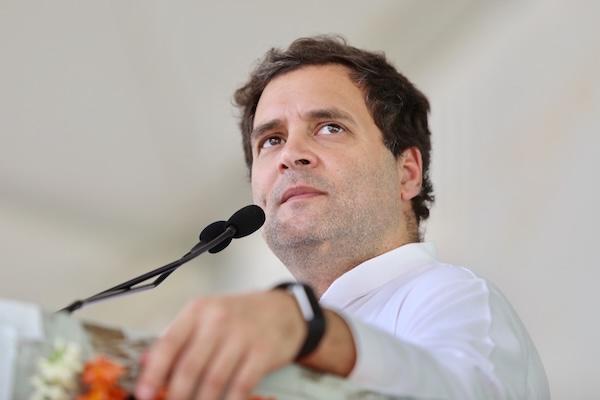
Congress Party leader Rahul Gandhi’s recent social media post alleging the "criminal destruction" of the Tata Group came with a pointed nudge, questioning the silence of India's business leaders. It is a classic political manoeuvre, designed to draw Corporate India into the opposition's confrontation with the government.
Is Gandhi misreading how business leaders operate?
India Inc. does not need to make a public spectacle of itself or the government to express dissent. Its silence is not capitulation; it is a highly calibrated strategy.
Fiduciary Duty
The core reality that political observers often ignore is the concept of fiduciary duty. A corporation must operate within the realm of maximising shareholder and stakeholder returns.
Business already runs on risk: from supply chain volatility to heavy global economic headwinds. If a business leader speaks out politically and their company subsequently suffers regulatory friction or consumer boycotts, they have actively failed in their duty to protect shareholder value. There is simply no logical point in adding a layer of political risk by being seen as partisan.
This pragmatism is not uniquely Indian; it is a global corporate reality. Around the world, the era of the "activist CEO" is largely retreating as executives realise the steep cost of alienating divided consumer bases.
Consider recent developments in the United States.
Elon Musk essentially served as the "DOGE minister", co-leading the Department of Government Efficiency, acting almost as the next in command to the President. Yet, when that temporary department ceased operations and he transitioned out of direct governmental authority, even a figure as notoriously vocal as Musk did not make undue political noise about the exit. Ultimately, even the most politically engaged business leaders prioritise the pragmatism of running their empires over perpetual political warfare.
Global Blueprint
To truly understand the dynamic between state and capital, one must accept how unapologetically governments globally champion their corporate interests.
The relationship between governments and business was illustrated at a press conference in New Delhi in early 1995, when then-US Commerce Secretary Ron Brown was asked why he was so aggressively pitching for American companies. His unblinking response was that his foremost job was to build America and American business, and India was a logical market.
Cut to this very month in Jamnagar. US Secretary of State Marco Rubio visited the Reliance refinery, openly courting Indian business to build refining capacity for Venezuelan oil to secure broader energy and geopolitical goals.
This brings into sharp focus how government and business must work together strategically.
But even when business leaders collaborate this closely with the state, they maintain a safe distance—avoiding micromanagement on one side, and public political commentary on the other.
Beyond Party Lines
When capital and the state align, they frequently transcend political affiliations for the sake of nation-building.
Gandhi’s comment that the government is "criminally destroying" Tata ignores recent, highly consequential history. The Modi government trusted the Tatas to take back the state-owned national carrier Air India, a landmark measure that required immense mutual trust.
Historically, a bipartisan collaboration has always been the norm, and it has shown India in a good light. Rewind to 2004: the then Prime Minister Manmohan Singh appointed Ratan Tata to head the Investment Commission to draw foreign direct investment into India, drawing on his corporate stature for national gain.
Conversely, consider Nandan Nilekani, co-founder of Infosys, who fought the 2014 Lok Sabha elections as a Congress candidate from Bengaluru. Yet, the incoming Modi government seamlessly embraced him for his acumen to drive India's digital public infrastructure revolution, from Aadhaar to UPI.
Business leaders can, and do, have political affiliations, but when it comes to the architecture of the economy, pragmatism trumps politics. And that is the way it should be. Their discretion should not be portrayed as timidity, nor should they have to take up the cudgels on behalf of the opposition to prove their courage.
Cover of the Collective
This does not mean India Inc. is a mute spectator to bad policy.
Corporate leaders have traditionally rated Union Budgets with predictable generosity, rarely awarding a score below 7 out of 10. This has been a recurring feature of post-Budget reactions since the economic reforms of 1991.
But that is merely the public face.
Dissent, pushback, and hard negotiations happen firmly behind closed doors.
Corporations use the cover of the collective, channelising their grievances through industry bodies like the CII, FICCI, and ASSOCHAM.
This institutionalises their feedback, giving it weight, while shielding individual balance sheets from political crossfire. Except for the late Rahul Bajaj, whose trademark frankness made him an anomaly, strategic discretion is the absolute rule.
When corporate stability is genuinely threatened, state intervention is a vital necessity, not a crime. We saw this during the Satyam crisis under the UPA government, where swift regulatory intervention saved an important IT giant.
The then Prime Minister Manmohan Singh was accused of getting involved in the Ambani brothers’ tussle, which his office vehemently denied.
The current rift within the House of Tata certainly demands stringent regulatory oversight, starting with the Reserve Bank of India and the Charity Commissioner, because it affects the national economic interest.
But it requires institutional regulation, not political grandstanding on either side.
Expecting CEOs to publicly criticise the political establishment while risking hard capital is an unrealistic demand born of political theatre, not economic reality. When politics nudges capital to speak up in the town square, the silence that follows isn't an absence of courage.
It is the disciplined, pragmatic language of business.
More From BasisPoint