.png)

Prasanna Mohanty is a journalist, researcher and author.
November 27, 2026 at 6:47 AM IST
India’s need to reform its open-ended foodgrain procurement system is long-standing. But the technology-driven churn now unfolding calls for a balance between calibrated, production-linked and fiscally prudent procurement and protecting farmers’ incomes without restricting access or exposing them to market risks.
The churn centres on paddy procurement. In October 2021, the Centre directed all states to align procurement with average yields, ensuring that only genuine farmers benefited and preventing traders from profiteering by bringing in paddy from neighbouring states. A similar system had existed in states such as Haryana since 2017-18, and the Centre sought to extend it nationwide.
The issue gained significance with the launch of the Centre’s ‘AgriStack’ digital platform in 2025 under the Digitisation Agriculture Mission of 2024. It digitally maps farmers, their landholdings and crops. The platform became critical after the Centre explicitly linked it to paddy procurement in January this year.
Paddy Disruption
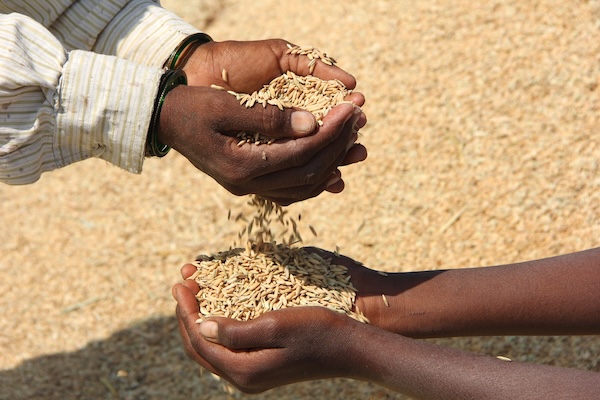
'AgriStack’ is disrupting paddy procurement in Chhattisgarh. Within a week of procurement starting on November 15, thousands of farmers in Balod, Durg, Bilaspur and other districts were stranded. The platform shows that they have either not grown paddy, grown it on less land than claimed, or planted other crops. As a result, their paddy cannot be procured at MSP.
The discrepancies have been attributed to data entered by private surveyors hired to map crops at ₹10 per plot. Revenue officials responsible for physical verification went on strike, protesting the additional workload and arguing that they were neither trained nor qualified for it. Following widespread distress, the state government assured farmers that no registered farmer would be denied procurement.
The mismatch first surfaced during the previous paddy procurement season, from November 2025 to January 2026. The Opposition alleged in the Assembly in February 2026 that 210,000 of 2.74 million registered farmers could not sell their paddy because of it. Ironically, Chhattisgarh had won the Centre’s appreciation for being the first state to implement ‘AgriStack’ in paddy procurement.
Haryana farmers faced a similar situation, though for a different reason, as explained below. ‘AgriStack’ was linked to procurement in the state during the season from September 29 to November 15, 2026. Against a target of 5.8 million tonnes (MT), actual procurement was 5.05 MT.
The shortfall may not threaten food security or fuel food inflation. India’s wheat and rice stocks exceed 81 MT, more than three times the required buffer. To contain inflation, the government also doubled its open market sale target for rice from 2.5 MT to 5 MT during 2026-27, up to October 31.
But lower procurement matters for farm incomes and the rural economy.
El Niño has brought drought conditions to 47.2% of India’s geographical area, according to IIT-Gandhinagar’s India Drought Monitor. Kharif output, including paddy, has been affected, though the extent is unknown. Chhattisgarh, with 39.2% irrigation coverage, escaped the worst, receiving 6% above-normal rainfall. Haryana also escaped despite rainfall being 23% below normal, thanks to its extensive irrigation network.
Other indicators point to pressure. Wheat-sown area has fallen 6%, to a 26-year low, amid continuing El Niño conditions. Rural CPI inflation crossed 6% in September and October, and is expected to rise further. The new rural job guarantee scheme, VB-G RAM G, provided 16% fewer jobs between July and November 24 than in the corresponding period of the previous fiscal year.
Lower paddy procurement would hit farm incomes amid rising inflation, weaker Rabi output expectations and fewer employment opportunities.
Contrasting approaches of Chhattisgarh and Haryana
Procurement is complex and decentralised, with states exercising some discretion under the Centre’s overall control over when, how much and at what price (MSP) to procure. ‘AgriStack’ adds another layer of centralisation.
Haryana has followed yield-based procurement since 2017-18, fixing average yields for each district. This caps the quantity procured from each farmer, based on the district’s average yield multiplied by the area cultivated. The yield is fixed at 21 quintals per acre in Palwal, 25 in Karnal and 29 in Kurukshetra. Regardless of actual output, this is the maximum quantity procured per acre. The number of aggrieved farmers has not been large enough to trigger visible protests.
But this violates the open-ended procurement policy adopted in 1965, under which all foodgrains brought by farmers to notified centres are procured at MSP.
Chhattisgarh follows a different system: acreage-based output. It fixes one yield per acre for the entire state, despite significant differences between tribal and plain areas. The current ceiling is 21 quintals per acre. Farmers also receive a ‘bonus’ of ₹659 per quintal over the Centre’s MSP of ₹2,441. The payment is officially called ‘relief’ under the Krishi Unnati Yojana, known as the Rajiv Gandhi Kisan Yojana between 2018 and 2023.
Thus, a farmer producing 10 quintals on one acre receives an additional ₹13,839, calculated on the 21-quintal ceiling, over the ₹24,410 earned from selling 10 quintals at MSP.
This additional payment has encouraged paddy smuggling from neighbouring states since 2018, a practice that continues. The 21-quintal-per-acre ceiling is also exceptionally high. The Agricultural Statistics at a Glance 2024-25 puts Chhattisgarh’s average paddy yield at 10.3 quintals per acre in 2023-24 and 10.7 quintals in 2024-25. Haryana is not a major paddy-producing state, and its data are missing from the report.
Wider Application
The Centre is rolling out ‘AgriStack’ for several purposes. Though agriculture is a state subject and the platform is not mandatory, it is gaining ground through Centre-led advisories and schemes, particularly because the Centre funds food and fertiliser subsidies. When launched in 2025, it was intended to collect data with farmers’ consent, promising privacy and sharing only with their consent and under state governments’ control.
Since then, it has been put to various uses. Andhra Pradesh uses ‘AgriStack’ to distribute free ration, Punjab to digitise agriculture-related portals and Karnataka to procure millets and other coarse grains. Odisha began registering farmers a few months ago, assuring them that procurement would not be mandatory or linked to the database . Telangana is piloting it for fertiliser subsidies , while Madhya Pradesh is rolling it out statewide.
‘AgriStack’ has a sound rationale. It promises to ensure that genuine farmers benefit from procurement and fertiliser subsidies, improve transparency, prevent traders and middlemen from hijacking the system, and support planning, resource mobilisation and better accounting of subsidies. Food and fertiliser subsidies are estimated at ₹3.89 trillion in 2026-27 (BE) and could rise further as fertiliser import prices increase.
But the Centre and states must proceed cautiously, especially with foodgrain procurement. Chhattisgarh’s experience offers important lessons. Digitisation must be tested for robustness before rollout to prevent data mismatches and corruption. It must not restrict farmers’ access to procurement or become a backdoor means of curtailing open-ended procurement through administrative ceilings, particularly ill-advised acreage-based yield assessments imposed without debate or stakeholder consultation.
‘AgriStack’ also has a major design flaw: it excludes tenant farmers and sharecroppers. India has moved far beyond the food scarcity of the 1950s and 1960s. Procurement must no longer incentivise paddy and sugarcane, water-intensive crops grown in regions facing groundwater depletion, soil degradation and environmental damage from excessive use of chemical fertilisers and pesticides.
In short, India needs a holistic agriculture policy, last framed 26 years ago, not piecemeal initiatives such as ‘AgriStack’ that risk creating new problems without resolving existing ones.
More From BasisPoint