.png)

Rajesh Ramachandran is a former Editor-in-Chief of The Tribune group of newspapers and Outlook magazine.
November 27, 2026 at 9:17 AM IST
The jury is still out on the geopolitical impact of the epochal trilateral summit in Shenzhen, the Chinese city of skyscrapers, on November 19. The real agenda remains obscured in protocol and photo-ops of Chinese President Xi Jinping welcoming US President Donald Trump on the tarmac, hugging him in a rare display of diplomatic faux friendship and then holding hands on the escalator.
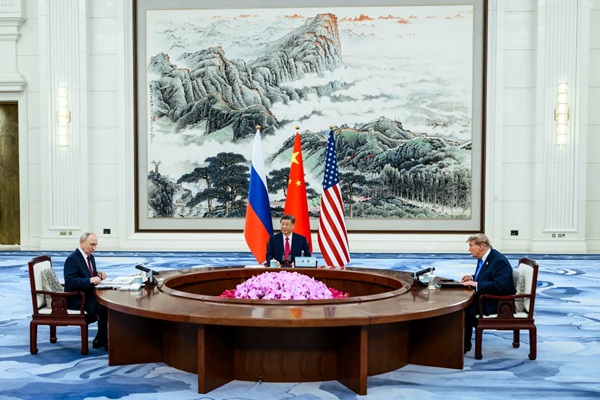
What struck the world dumb was the sight of Xi sitting in the middle, with Trump and Russian President Vladimir Putin on either side, deep in discussion, triggering memes of the three world leaders gobbling up the globe.
For many analysts, this was a throwback to the earlier trilateral of the winners of World War II at the Yalta conference in February 1945, hosted by the Soviet Union’s Premier Joseph Stalin and attended by US President Franklin D. Roosevelt and UK Prime Minister Winston Churchill.
If those three had carved up the world into two zones, triggering the Cold War, the Shenzhen summit appears to be more of a twenty-first-century reboot of the unipolar world, like cold-starting the computer without the cached Cold War hubris and colonial hangups. It was a reminder to the world, as well as self-realisation for the participants, about the new world order.
Advantage Russia
Russia is back at the high table. The Yalta conference analogy is the best to explain the reality of losers and winners. As in 1945, now also, there is entry only for winners in this exclusive club of superpowers.
Losers are dictated to, but the winners at Shenzhen discussed their future as equals across the table that looked like an isosceles triangle with Xi at the centre and Trump and Putin at equal distance from him.
The trilateral has put a stamp on Russia winning the proxy war with the West and the hot war against Ukraine. The US has acknowledged this victory by agreeing to the G-3, the most consequential grouping that renders G-7 and G-20 less significant.
There cannot be better news for New Delhi than this summit, as India had relied on Russia for energy and defence cooperation all this while.
India took a hit in terms of a worsening bilateral relationship with the US for remaining a steadfast friend of the Russians in the context of the Ukrainian war, and for buying oil from them. It is Indian diplomacy’s victory to have historically hitched on to the steady wagon of Russian friendship, which entails an elaborate security architecture.
It is a matter of diplomatic reassurance that one of the three superpowers will be at the Indian corner whenever it is forced to take on irksome neighbours.
India-China
Indians were prescient in de-escalating tension on the Chinese border. It is rare for a nation to get its priorities right, particularly when leadership, aimed at domestic audiences, dictates policy.
India got it right when it sat down to painstakingly build confidence with China, which is still a work in progress.
It was never an easy task to discuss as equals with a neighbour that has zoomed past in terms of economic might, infrastructural growth and technological prowess. India did it and ensured that it does not have to fight someone else’s war with a superpower.
The Shenzhen summit proves Indian negotiators right; China has indeed risen. Yet, India holds on to its territorial integrity and strategic sovereignty as a powerful neighbour and a major world power.
This could only have been attained by avoiding conflict, not by appeasing a bully Appeasement would have only led to conflict, but tough negotiations bring in enduring peace. Peace with China is now a possibility, which helps India rise without getting chained down to debilitating conflicts.
Fatal Friendship
The grand exposition of the capricious DNA of the bipartisan, institutional, US foreign policy establishment, which only respects power and acts solely on supreme self-interest with no permanent friends or foes.
Henry Kissinger’s famous remark, “It may be dangerous to be America’s enemy, but to be America’s friend is fatal,” gets amplified every time the US sits down to negotiate with the rest of the world.
And this message validates the need for India to assert repeatedly its position that it will not wage proxy wars atop the Himalayas or go against its national interest in the Black Sea or the Persian Gulf.
US tariff threats, the latest of which was issued on Wednesday, and the American assessment of China helping Pakistan cannot be guiding factors for India to draw up its trade policy or defence strategy.
US tariffs go up from 18% to 25% to 100% and then go down to nothing when it suits the US. After having stopped importing Russian oil, again having to revert to that very source, only to be slapped with the Lindsay Graham Act and then to be given a waiver to bring down oil prices, India has had to negotiate several sharp U-turns in oil policy just this year alone. Each manoeuvre is threatening and debilitating its economic and energy sovereignty.
The Shenzhen Reboot tells India to mind its own gaps, build its armoury and infrastructure and to treat the US as the enemy queen on the chess board. It is undoubtedly going to remain the biggest superpower for some time to come.
It is significant that the UK is no longer at the high table, and taking the UK’s absence as a cue, Europe should restrain its warmongers. The US seems to have become wary of Europe’s unending demands to destroy Russia, while the Iranians show no signs of war fatigue.
In fact, Iran’s tenacity has proven to be an unprecedented stabilising factor in this era of sub-critical wars, and it is one of the reasons for the rebooting of the world order.
India has a long, arduous climb to reach this summit, whose only path is through the valley of peace and prosperity across a tranquil border with China.
More From BasisPoint