.png)

The Business Risks Are Bigger Than 25 bps
Rising input costs, tighter finance and global uncertainty are testing corporate plans. Can businesses protect margins and sustain investment as these pressures reinforce each other?


Anuj Agarwal is the Group Chief Economist at Welspun World.
October 7, 2026 at 10:25 AM IST
The Reserve Bank of India’s decision to raise the repo rate by 25 basis points to 5.50% at its October policy meeting was not unexpected. What is more important is the change in stance—from neutral to calibrated tightening. At a time when the Indian economy is growing at a healthy pace, the RBI has chosen to look beyond the immediate growth numbers and focus on the risks that could make inflation more persistent.
This is not a conventional rate-hiking cycle. The RBI is not trying to cool an overheating economy. In fact, it has raised its 2026-27 GDP growth forecast to 7.1%. April–June growth of 7.8% was stronger than expected, domestic demand remains resilient, investment is supported by high capacity utilisation and credit growth, and services exports continue to perform well. The problem is elsewhere: inflation is no longer as benign as it was last year.
Consumer price index inflation rose to 4.8% in August from 4.5% in July, while core inflation increased to 4.2%. More importantly, the breadth of inflation is increasing. Around 37% of the CPI basket is now recording inflation above 4%. The RBI expects CPI inflation to average 5.2% in 2026-27, with upside risks from energy prices, commodities and geopolitical developments.
The Pressure on Margins and Investment
CPI, however, is only one part of the story. The wholesale price index provides a useful indication of the pressures building up earlier in the production chain. WPI inflation was close to 10% in August, with both the fuel and power category and the manufactured products category showing particularly strong price pressures. The divergence between CPI and WPI is important. Consumers may still be experiencing relatively moderate inflation, while producers are facing a much sharper increase in the cost of materials and energy.
For businesses, this matters because cost pressures are building before they are fully reflected in final selling prices. Companies with pricing power can pass through some of the increase, while others may have to absorb it or find efficiencies elsewhere. Crude oil is the obvious example. A sustained increase in energy prices affects transportation, chemicals, plastics, packaging, construction and manufacturing, with effects eventually spreading through the broader cost structure of the economy.
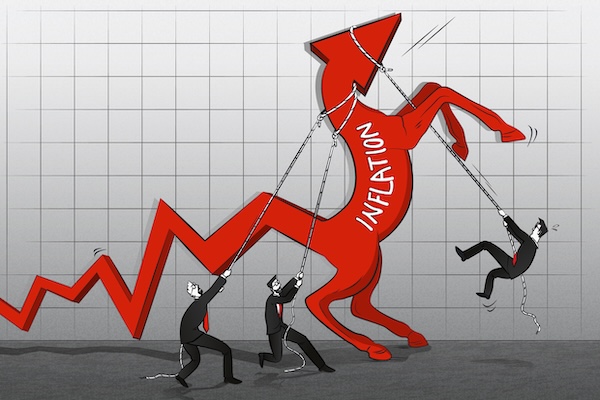
This also explains the RBI’s concern about second-round effects. A temporary increase in crude or commodity prices is manageable. The bigger risk is that businesses begin to raise prices routinely, employees seek compensation for higher living costs and expectations of higher inflation become entrenched. Once that happens, a supply shock can become a more persistent inflation cycle. Monetary policy cannot reduce the global price of crude, but it can help prevent the initial shock from becoming embedded in domestic inflation expectations and pricing behaviour.
The investment cycle in India remains compelling. But businesses will likely become more selective about where capital is deployed. A higher cost of capital changes the economics of marginal projects. It also increases the relative value of cash flows generated earlier and reduces the attractiveness of investments whose returns are heavily back-loaded. A project that generates attractive returns when financing costs are low and commodity prices are benign may look very different when both variables become more volatile. Management teams will increasingly need to stress-test investments against higher interest rates, higher input costs, a weaker currency and delays in ramping up operations.
Working capital also becomes more important. When input prices rise sharply, the amount of money tied up in inventory and receivables can increase even if physical volumes remain unchanged. Higher interest rates then increase the cost of financing that additional working capital. Inflation can therefore increase both the cost of production and the amount of capital required to finance production. For highly leveraged businesses, even a modest increase in financing costs can materially alter the economics of expansion.
Global Risks Meet Domestic Resilience
The RBI has also flagged elevated valuations of AI-related assets as a global financial risk. The AI investment cycle is no longer simply a technology story. The enormous investment in data centres, semiconductors, computing infrastructure and power is becoming an increasingly important part of global capital expenditure. Estimates suggest that AI and data-centre capital expenditure could approach $800 billion in 2026, with companies looking to raise around $500 billion in debt to fund this investment—potentially contributing to upward pressure on US and global bond yields. The opportunity from AI is real, but so is the risk that capital expenditure and asset valuations run ahead of the pace at which economic returns materialise. If AI-related earnings or productivity gains disappoint relative to current expectations, a correction could extend beyond technology stocks. It could affect global risk appetite, capital flows and financial conditions. For India, the transmission could come through the rupee, bond yields, equity markets and the cost of external financing.
There is, however, a positive message in the RBI’s decision. The central bank does not see a broad-based deterioration in domestic demand. A rate hike accompanied by falling consumption and investment would be a much more concerning combination. That is not the situation India is facing today. The economy enters this phase with relatively strong domestic fundamentals. India’s growth story therefore remains intact. But the operating environment around that growth is becoming more complex. Businesses are entering a period in which several sources of uncertainty are interacting—geopolitical tensions, energy prices, trade fragmentation, higher global bond yields, elevated asset valuations and tighter monetary conditions.
The RBI has chosen to act before the current inflationary pressures become entrenched. Businesses should take a similar approach to their own risks. The 25-basis-point hike itself is manageable. The bigger challenge is operating in a world where both the cost of inputs and the cost of capital are becoming less predictable.
More From BasisPoint