.png)



Gaurav Rastogi, Founder at Kuvera, was a portfolio manager at Morgan Stanley. He likes to write about markets, and why we do what we do with money.
November 26, 2026 at 5:41 AM IST
In January 1861, a barrel of crude oil from the wells along Pennsylvania’s Oil Creek sold for about ten dollars. Drillers had struck oil there less than two years earlier, and landowners along the creek rushed to drill wells of their own. By June the price of a barrel had fallen to fifty cents. By the end of that year a barrel of oil fetched ten cents, which was less than the cost of the wooden barrel that held it.
Many of the early producers were ruined within months. Oil would become the most important fuel of the next century, but they produced so much of it that the price fell to almost nothing.
A young commission merchant in Cleveland, John Davison Rockefeller, took up a different part of the business. He left the drilling to others and bought into refining, which turned crude oil into kerosene for household lamps. He then won favourable shipping terms from the railways and later built pipelines to carry oil to market. Standard Oil was incorporated in January 1870 with a million dollars of capital, and by 1879 it controlled about 90 per cent of America’s refining capacity.
The drillers found the oil, but Rockefeller made most of the money because he controlled refining and transport, the steps between the well and the customer. Investors in artificial intelligence now face the same question on a far larger scale: which part of the business will keep most of the profits?
The fight over surplus
Every technology that reshapes an economy creates a large economic surplus. Economists define surplus as the gap between what buyers would be willing to pay for a new capability and what it costs to produce. Electricity, railways, the telephone and the internet each opened such a gap, and each time a long fight followed over who would keep it. In many of those fights the inventors and early builders kept only a small share.
The investor Peter Thiel borrowed an idea from the French philosopher René Girard to explain why. Girard argued that human desire is imitative, because we learn to want things by watching what other people want. In markets, imitation leads rivals to chase the same customers with the same products, and the competition erodes everyone’s margins. Thiel summed up the argument in the title of a 2014 essay in the Wall Street Journal, “Competition Is for Losers.” By that logic, a crowded field of well-funded rivals is a bad sign for future profits.
Frank Herbert’s 1965 novel Dune is built around the same problem. In the novel, the most valuable substance in the universe, the spice, exists on one desert planet, and every great power in the story organises itself around controlling its supply. The spice extends life and makes space travel possible, so the Spacing Guild’s monopoly on travel between planets depends on that one source. In David Lynch’s 1984 film, Baron Harkonnen puts it in one line: “He who controls the spice controls the universe.” The novel shows how the Emperor, the Guild and the noble houses each control a different stage of the spice trade and take a different share of its profits.
Investors and executives have split into two camps over how the AI contest will end, and each camp has its own view of where the bottleneck sits.
The software camp expects the owners of the best models to keep most of the profit. Serving one more user costs almost nothing, and every new user helps improve the product for the next one. On this view the leading model companies and the platforms built on their models will hold a lasting monopoly, and the suppliers of chips, power and buildings will earn thin margins like a utility.
The infrastructure camp argues the reverse, on the grounds that physical inputs are scarce and models are not. Rivals copy a new model quickly, free versions that anyone can download arrive within months, and a model company loses its pricing power once any business can run a capable model on its own hardware. Power stations, transmission lines and grid permits cannot be copied at all. On this view, whoever controls electricity, grid connections, land with permits and perhaps one day launch capacity will collect the surplus that software companies cannot keep.
Spending by Big Tech
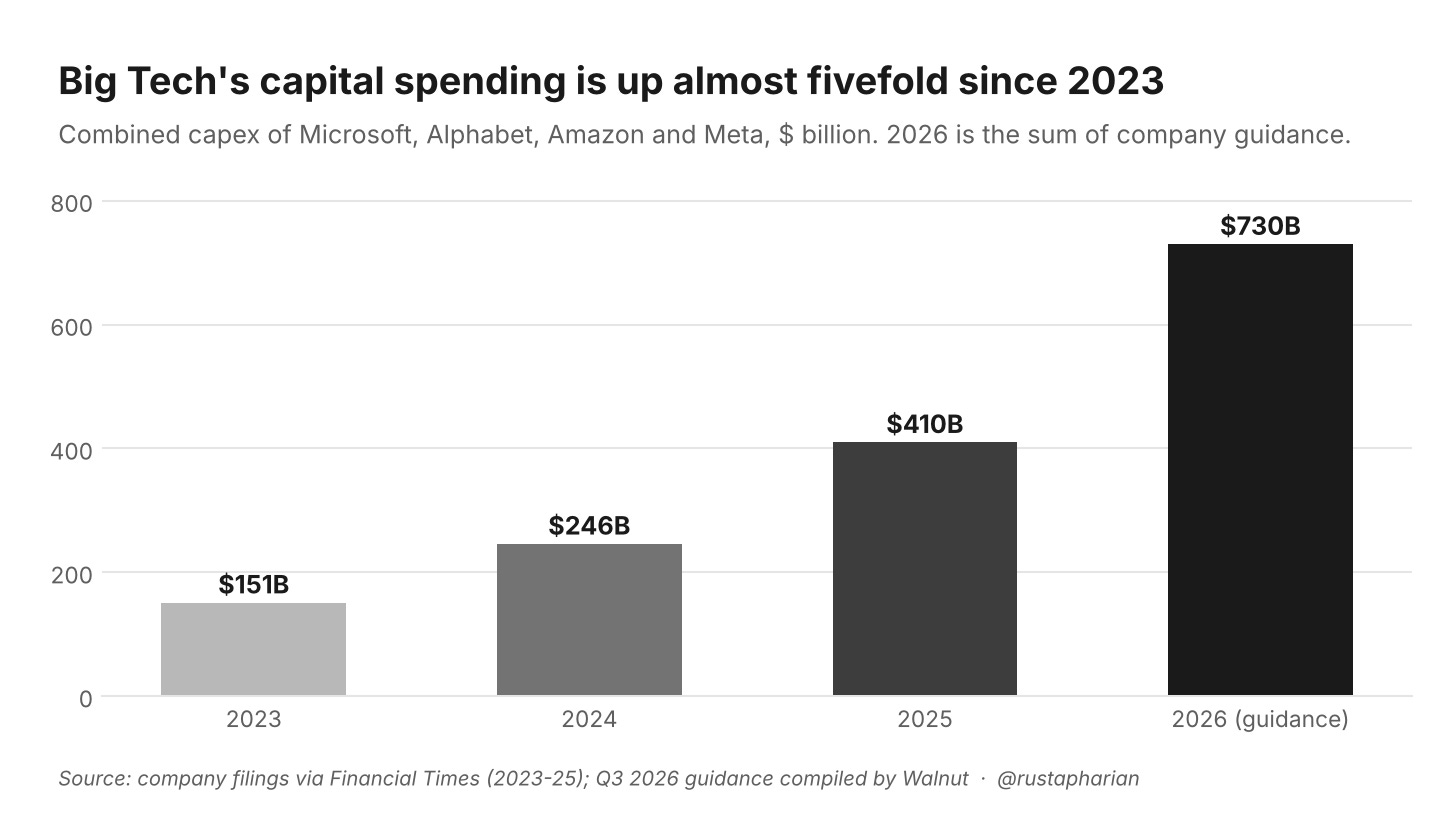
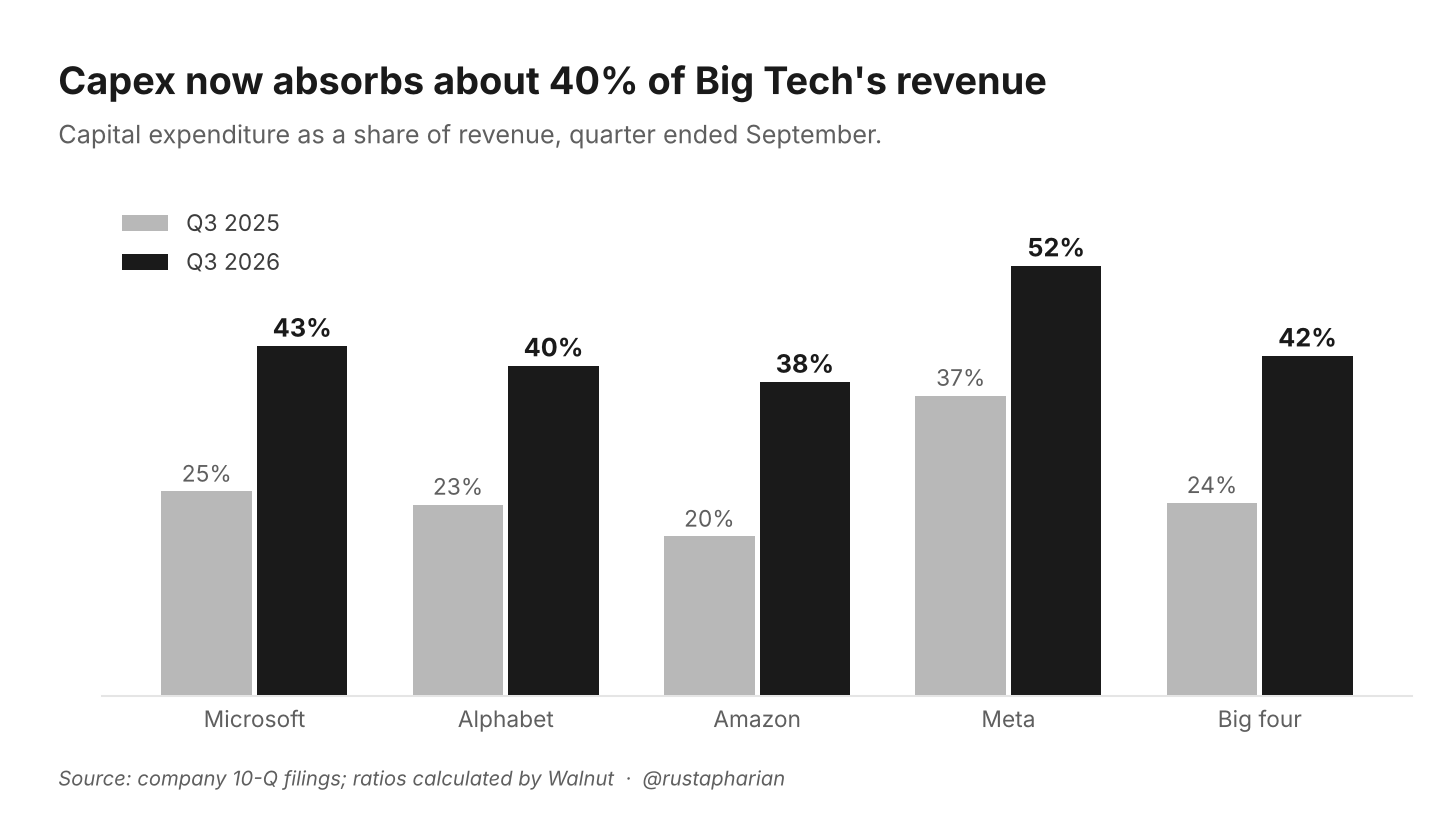
The biggest technology companies are spending as though the software camp is right. Microsoft, Alphabet, Amazon and Meta, the four companies often called the hyperscalers, spent a combined $151 billion on capital projects in 2023, $246 billion in 2024 and about $410 billion in 2025. Their guidance for 2026, updated on the October earnings calls, adds up to roughly $730 billion. That would be almost five times the 2023 figure in three years. In the September quarter alone the four companies spent $202 billion, more than double the same quarter a year earlier.
In Girard’s terms, this spending is a race between imitators. Four companies are chasing the same capability, measured on the same benchmarks and sold to the same business customers. Each company spends because the others spend, and none of them can afford to stop first.
The case for the spending rests on the usual economics of software: almost no cost to serve one more user, customers locked into a platform, and data from each user improving the product. Some analysts add that smaller models will run on phones and laptops and make AI cheap for everyone. Both arguments assume that software companies keep their pricing power. If free alternatives take that power away, the race will push software margins toward zero, and investors will need another reason to pay the record valuations of 2026.
The price of running a model
The early evidence on pricing power favours the infrastructure camp. AI companies charge by the token, a chunk of text of about three-quarters of a word. Researchers at Epoch AI estimate that the cost of running a language model at a fixed level of performance has fallen about 40-fold a year, with rates that range from 9-fold to 900-fold depending on the task. Since January 2026, open-weight models, which anyone can download and run, have trailed the best closed models by about four months on average, according to Epoch’s capability index. Most of the leading open models now come from Chinese labs such as DeepSeek, Alibaba’s Qwen team, Moonshot and Zhipu. Because prices fall so fast and open models follow so closely, a model that is a few months behind the best one now sells at commodity prices.
The software camp has a fair reply to this evidence. The most capable models, often called frontier models, are getting more expensive to run, because they reason for longer and take on harder tasks. A study led by researchers at MIT estimates that the price of running the newest frontier models is rising between 3-fold and 18-fold a year. The top of the market may stay profitable even as everything a few months behind it turns into a commodity.
Isaac Asimov’s Foundation novels describe a mathematician who forecasts the fall and rebirth of a galactic empire with statistical precision. His plan holds for centuries until the Mule, a mutant whom nobody had foreseen, breaks it within a few years. The AI market met its own surprise in January 2025, when a little-known Chinese lab called DeepSeek released a model that rivalled leading American systems at a fraction of their reported cost. Nvidia lost about 17 per cent of its market value, roughly $600 billion, in a single day. A forecast that depends on the best models staying scarce can fail within days, because a rival can match a model for far less than it cost to build the first one.
Chips and memory
So far the makers of chips and memory have collected the largest share of the surplus, more than the model companies or the power companies. In the quarter to 25 October 2026, Nvidia reported $115.8 billion of revenue, of which $107.6 billion came from data centres, at a gross margin of 74.8 per cent. Its net income for those three months was $65.3 billion. For scale, the four hyperscalers spent $202 billion on capital projects in the September quarter, and a large part of that money paid for Nvidia’s systems.
The memory makers have also taken a large share. Samsung, SK Hynix and Micron together earned about 88 per cent of global DRAM revenue in the second quarter of 2026, according to TrendForce. TrendForce expected contract prices for PC memory to more than double in the first quarter of 2026, the largest quarterly rise on record, as AI servers absorbed supply. Microsoft attributed about $25 billion of its record capital budget to higher memory prices alone.
In Dune’s terms, the chipmakers look like the Spacing Guild, because every large AI company needs their product and few can make an equivalent. The Guild’s monopoly lasted because the spice came from one planet. Nvidia’s lead rests on design, software and factory capacity, and rivals can build all three. Google now runs its eighth generation of in-house TPU chips, and Anthropic has committed to up to 5 gigawatts of capacity on Amazon’s Trainium chips. Rivals can cut a chipmaker’s margins within a product cycle or two, but a better chip does nothing to shorten a five-year wait for a grid connection.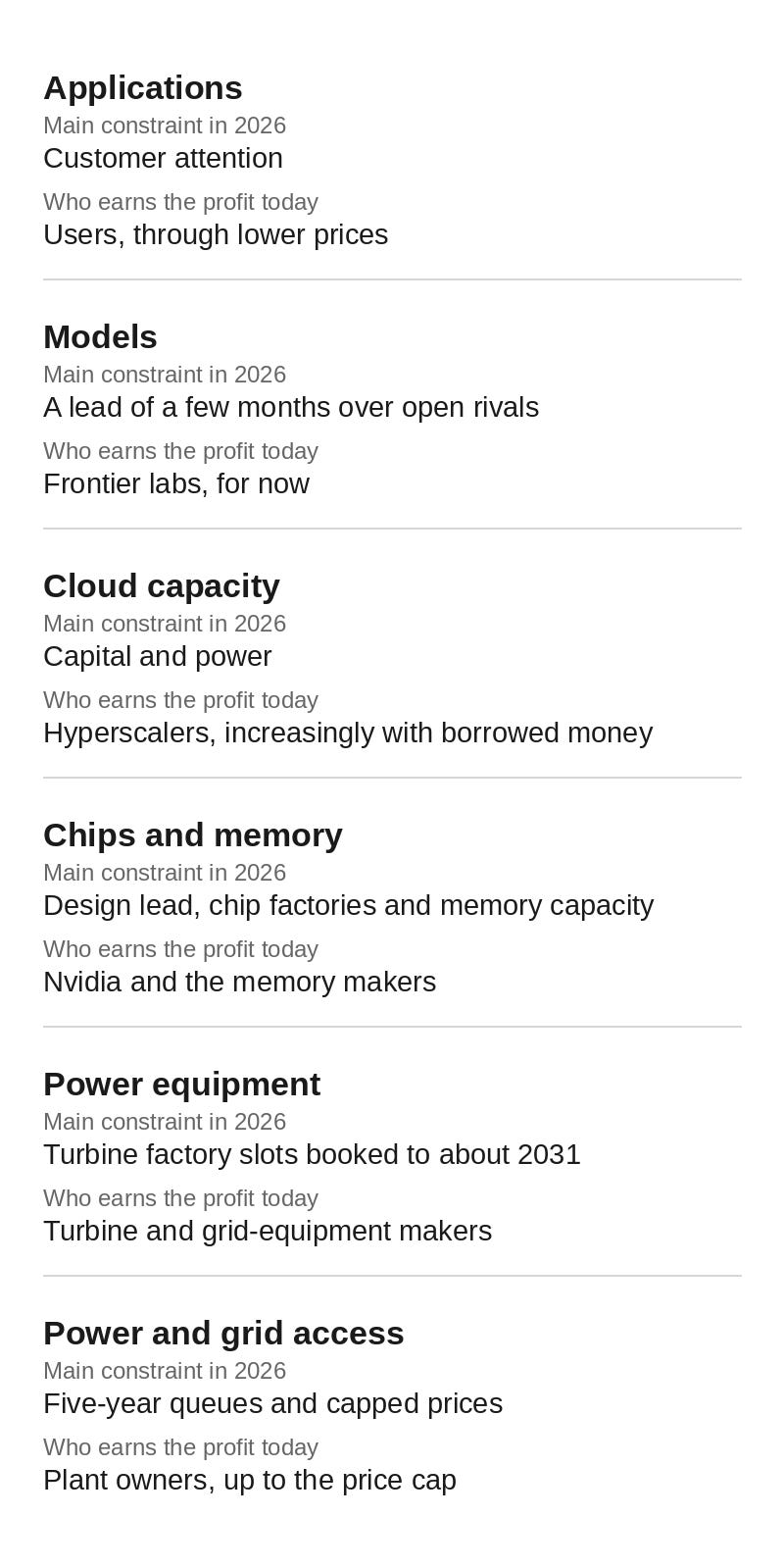
Power, turbines and land
The four hyperscalers now spend a share of revenue on capital projects that is normal for electric utilities and telecom networks. In the September quarter of 2026 they spent 41.5 per cent of their revenue on capital projects, up from 23.6 per cent a year earlier. Meta, the biggest spender relative to its size, put 52.5 cents of every revenue dollar into capital projects.
Since then PJM, the state governors and federal regulators have agreed a price cap, and the three auctions held under it all cleared at the cap: $329.17, $333.44 and, in July 2026, $325. PJM estimates that the July auction would have cleared at $554.72 without the cap, about 71 per cent higher. Even at the capped price, the auction secured 6,831 megawatts less than PJM’s reliability target, and only 525 megawatts of the cleared supply came from new plants or upgrades.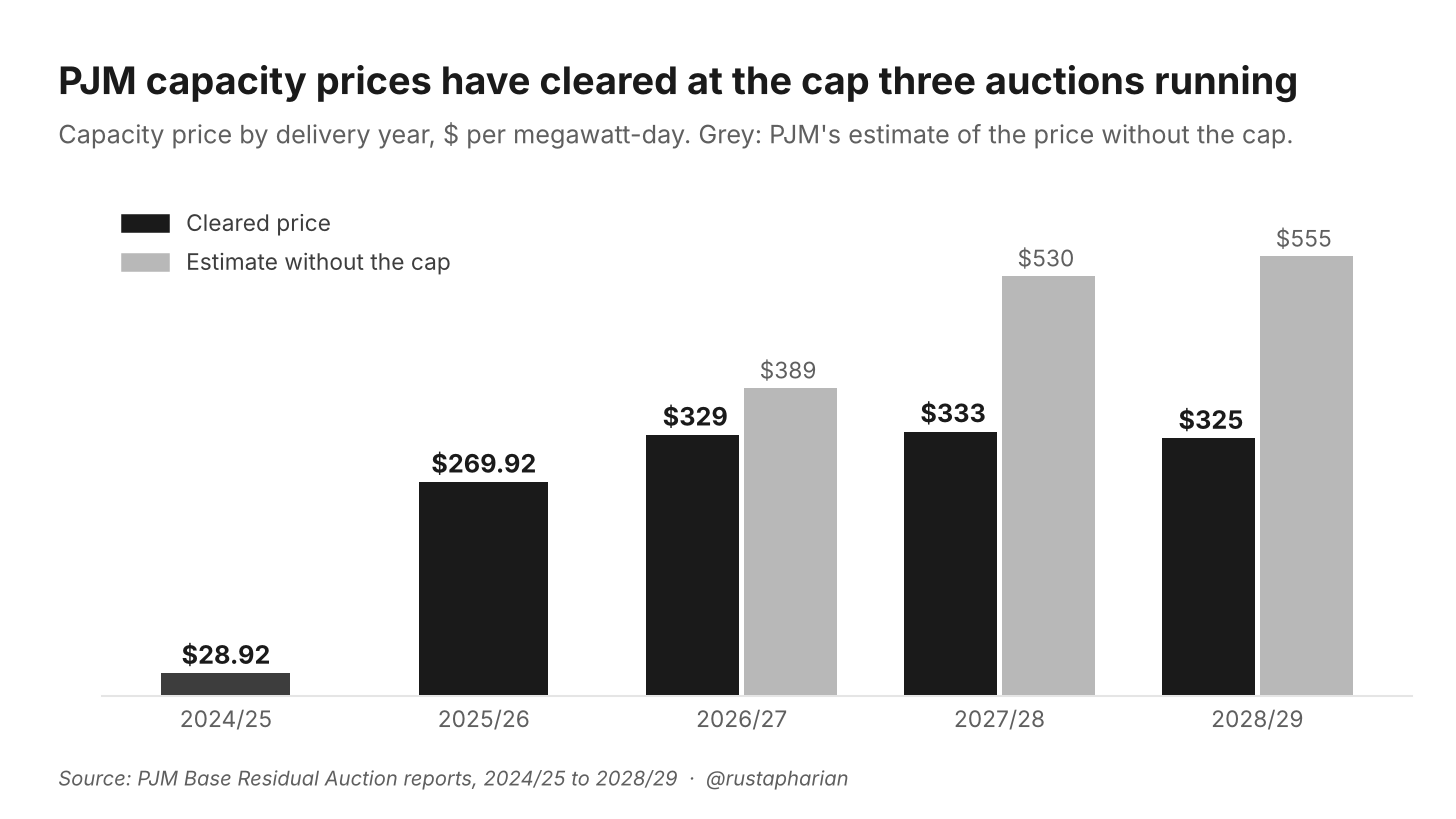
Those prices flow to the owners of the plants. One independent producer, Talen Energy, said the July auction will bring it about $1.2 billion of capacity revenue for the 2028/29 delivery year alone.
The makers of generating equipment are also collecting part of the surplus. GE Vernova’s backlog of gas-turbine orders and reserved slots rose from 50 gigawatts in March 2025 to 122 gigawatts by September 2026, and a heavy-duty turbine ordered now arrives around 2031. In the middle of 2026, Siemens Energy reported a backlog of 69 gigawatts and Mitsubishi one of 35 gigawatts. GE Vernova says higher prices are lifting its margins as developers compete for delivery slots.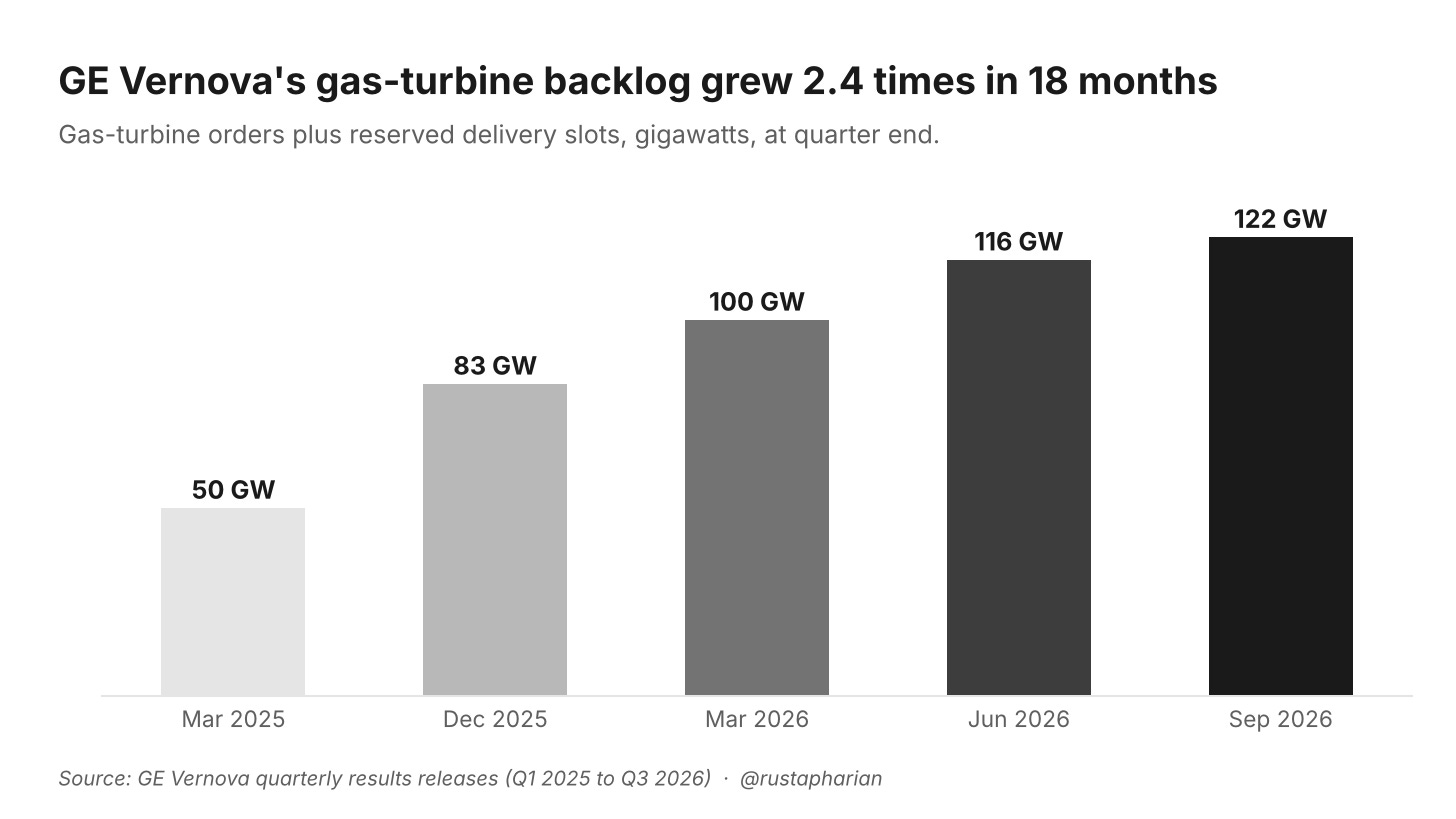
The economist David Ricardo described this pattern two centuries ago. As demand forces farmers onto poorer land, the owners of the best land collect a rising premium, which he called rent. For data centres, the best land is a site with fibre routes nearby, a high-voltage line within reach and industrial zoning already approved. When demand for computing grows faster than the supply of such sites, their owners collect much of the surplus.
Build times for chips and power
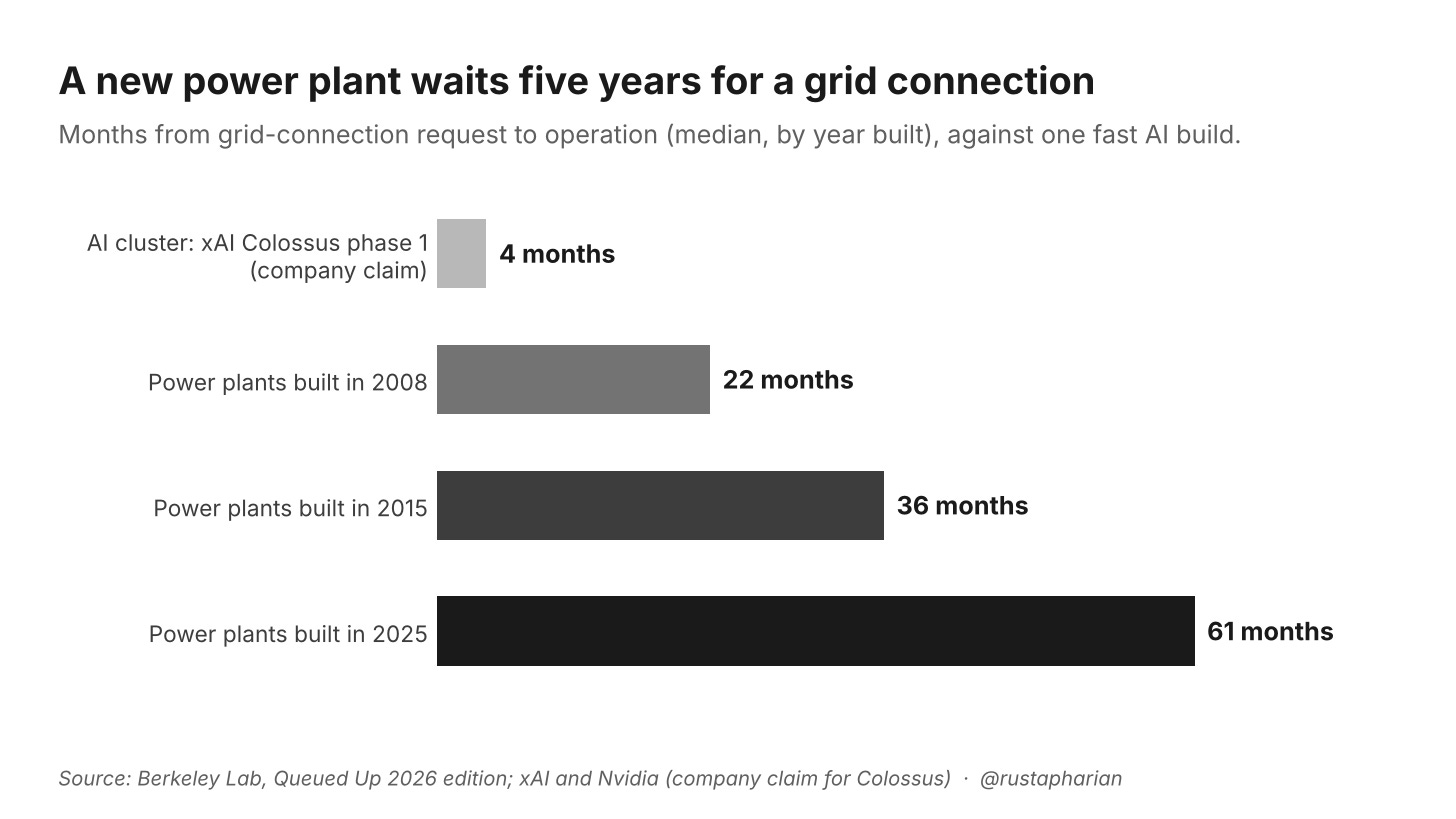
The two camps disagree most sharply about timing, because a data centre’s chips can be installed in months while a power plant takes years. xAI says it built the first phase of its Colossus cluster in Memphis, with 100,000 Nvidia GPUs, in 122 days in 2024. It moved into a disused appliance factory and ran gas turbines on site to power it.
New power plants take far longer to come online. Berkeley Lab tracks the queues that new power plants join to connect to the US grid. Its 2026 report finds that the median project that came online in 2025 took 61 months, a little over five years, from the request to connect to commercial operation. The same wait was 36 months for projects built in 2015 and 22 months for projects built in 2008. Only 13 per cent of the capacity that applied to connect between 2000 and 2020 had reached operation by the end of 2025, and 75 per cent had withdrawn.
Efficiency and the Jevons paradox
Computer scientists see the power shortage as an engineering problem with engineering fixes. Better training data, smaller models and cheaper ways of running them all cut the energy needed for each answer. Epoch estimates that better algorithms alone let developers reach the same performance with about a third of the computing power each year.
Greater efficiency does not reliably reduce total demand for energy. The English economist William Stanley Jevons observed in 1865 that more efficient steam engines had increased Britain’s coal consumption, because cheaper power found many new uses. AI has followed the same pattern so far, since each fall in the price of a token has opened new uses and raised total demand for computing and electricity. US data centres used about 176 terawatt-hours of electricity in 2023, or 4.4 per cent of the national total. A 2024 report for the Department of Energy projects that share at 6.7 to 12 per cent by 2028. On this record, more efficient models are more likely to raise that share than to cut it.
Douglas Adams turned the same pattern into a joke in The Hitchhiker’s Guide to the Galaxy. The supercomputer Deep Thought spends seven and a half million years computing the answer to the ultimate question, which turns out to be 42. It then designs an even larger computer, the Earth, to work out what the question was. In the story, an answer creates demand for more computing, and so far AI has worked the same way.
Money and margins in 2026
In 2026 the chipmakers collect the largest share of the surplus from machine intelligence, and the owners of power plants and generating equipment collect a growing share. The model companies collect the smallest share relative to what they spend. Greater efficiency is unlikely to change that order, because cheaper computing has so far raised total demand for it. The second part of this essay asks whether the owners of the scarce physical assets will keep their rent, or lose it the way Britain’s coal industry and Standard Oil eventually did.
Part II of this essay, “The Emperor”, follows next week.
More From BasisPoint