.png)


Ganga Narayan Rath is a former central banker and a contributor to leading financial publications.

Chirayu Sharma is an independent researcher.
September 28, 2026 at 10:04 AM IST
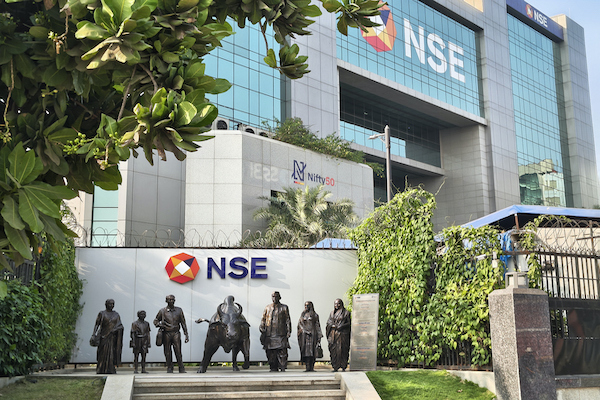
Four days after finally making its stock-market debut, National Stock Exchange of India shares slipped below their IPO price on Monday. The fall, which to be sure was not out of sync with the broader market, added another wrinkle to a listing that had already proved less exuberant than the decade-long wait might have suggested.
NSE shares began trading on the BSE on September 24, ending a tortuous listing process that had been stalled for nearly a decade. The debut was underwhelming by the standards of India's primary market: the stock opened at ₹1,800, a premium of just 0.84% over the issue price of ₹1,785 — a muted start for India’s second-largest public offering after Hyundai Motor India.
The ₹225.63 billion issue was entirely an offer for sale — roughly 5.11% of NSE's equity, sold by existing shareholders with no fresh money flowing to the company. It drew respectable but not spectacular demand, closing with overall subscription of 5.71 times, led by qualified institutional buyers at 12.68 times and non-institutional investors at 6.55 times. Retail investors — the base that often supplies the frenzy in India's primary market — subscribed just 1.39 times.
Grey-market chatter ahead of the listing had pointed to a stronger debut, with unofficial premiums suggesting a gain closer to 2.24%. The market undershot that expectation, much as it has with several other large offerings this year.
A Record Year, Numerically
NSE's listing pushed India's 2026 primary-market fundraising past ₹1 trillion for a third straight year — the fourth time overall this milestone has been crossed.
Through August, 62 mainboard IPOs had raised ₹736.74 billion, while 126 SME issues collected a further ₹57.39 billion. Heavy September issuance, capped by NSE’s offering, subsequently pushed the mainboard count towards 82 for the year.
September itself has been extraordinary: the month brought 30 IPOs worth ₹387.85 billion, the busiest month for India's IPO market since 1996, even as the secondary market wobbled.
Widen the lens to the financial year instead of the calendar year and the picture is similarly strong. Provisional data put 2025-26 mainboard fundraising at a record ₹1.77 trillion across 109 IPOs, against ₹1.63 trillion from 80 IPOs in 2024-25. India accounted for roughly 14% of global IPO listings by March 2026, second only to China.
The SME segment, by contrast, cooled. Some 105 SME IPOs on NSE's Emerge platform raised about ₹51.21 billion in 2025-26, down from 163 issues raising more than ₹70 billion in 2024-25. Average deal sizes on the platform, however, have continued to rise, from roughly ₹130 million in 2019-20 to around ₹500 million now.
Compared with the last two calendar years, 2026 sits in a strong but not unprecedented run. Calendar 2025 saw 373 IPOs — 103 mainboard and 270 SME issues — mobilise about ₹1.95 trillion, while 2024 brought 268 listings — 90 mainboard and 178 SME — raising ₹1.67 trillion, a year boosted by Hyundai Motor India's record offering.
Taken together, India has now crossed ₹1 trillion in IPO fundraising in every year since 2023. Some market estimates see primary-market fundraising approaching ₹4 trillion in 2026 as a whole.
Where the Money Actually Goes
The more revealing number, though, is not how much has been raised but where the money is going.
OFS structures — where existing shareholders cash out rather than the company raising growth capital — have dominated proceeds. In 2025-26, OFS transactions accounted for 61% of mainboard IPO proceeds, against 39% from fresh issues, continuing a trend that took the OFS share of 2025 proceeds to a three-year high of 63.2%.
Of the roughly ₹1.12 trillion raised so far in 2026, more than ₹666.3 billion has come through OFS structures rather than fresh capital.
NSE's own listing is the starkest example: a pure OFS with no fresh issue at all.
It is not alone. A growing cluster of foreign-parented Indian subsidiaries have used the IPO route primarily to allow overseas owners to sell stakes. Among six foreign-owned companies that listed Indian units since 2024, only one raised fresh capital; the rest were structured entirely as OFS deals.
In several cases, this has allowed global parents to monetise Indian holdings at valuations substantially different from those commanded in their home markets.
That flow sits against a broader pattern this year in which foreign portfolio investors pulled roughly ₹2.84 trillion out of the secondary market in 2026 even as they put about ₹471.5 billion into the primary market — selling existing holdings while still buying selectively into new issues.
No Guarantee of a Pop
The aftermarket has also turned less forgiving.
Where roughly 70% of the 102 mainboard IPOs in 2025 closed their debut session in the green, 2026 has been closer to a coin toss. One tracker of the year's listings found 17 winners against 16 losers, with the best debut delivering a 76% gain and the worst falling more than 31% below the issue price on day one.
Several IPOs that opened at steep discounts have since recovered sharply, while some that popped on listing day have subsequently sunk. NSE slipping below its issue price within days of listing is another reminder that the opening bell is not a verdict.
Debut-day arithmetic tells only part of the story.
That caution mirrors the broader market.
The Nifty 50 closed 2025 at 26,146.55 and briefly pushed past 26,300 in the first days of January. Since then, it has lost ground in a volatile market, trading through September mostly in the 23,063-24,055 band — a decline of roughly 9% from where the year began.
Individual sectors, including metals and public-sector banks, have had strong stretches. But against a benchmark that has moved from record highs into a meaningful correction, this year's IPO arithmetic — muted listing gains, a more even split between winners and losers and softer retail oversubscription — begins to make more sense.
The primary market can keep producing records even when the secondary market stops handing out easy rewards.
The Bigger Question
NSE's IPO prospectus put a number on something the exchange had long been circumspect about: how dependent its own earnings are on options trading.
Options, taken together, generated 60.2% of NSE's operating revenue in 2025-26 — ₹99.98 billion of ₹166.01 billion.
MD and CEO Ashishkumar Chauhan told reporters around the listing that weekly options specifically — the contracts SEBI has spent the past two years trying to rein in — now account for about 42% of NSE's total revenue, down from 60%-70% three to four years ago.
The balance increasingly comes from cash equities, monthly options, futures, co-location and data services.
Chauhan said NSE had braced for volumes and revenue to fall by 50%-60% after SEBI's October 2024 curbs on weekly expiries. The actual decline came in at around 3% in 2025-26, showing how resilient derivatives activity has remained even after the regulator tightened contract sizes, restricted each exchange to a single weekly expiry and mandated upfront collection of option premiums.
That resilience sits uneasily against what the regulator's own research has found.
SEBI's most recent full-year study showed more than 91% of individual traders in the equity derivatives segment made a net loss in 2024-25, with aggregate losses widening 41% to roughly ₹1.06 trillion, from about ₹748 billion the year before.
Cumulative losses since the regulator began tracking the segment in 2021-22 now run into several trillion rupees.
A follow-up study covering 2024-25 and 2025-26 found the picture only partially improving: losses moderated somewhat in 2025-26, even as 91% of individual traders still ended the two-year period in the red, with cumulative net losses exceeding ₹2 trillion.
The same body of research has consistently found that proprietary trading desks and FPIs were net gainers in periods when individual traders collectively lost money. Meanwhile, algorithmic trading now accounts for 54% of NSE's cash-market turnover and 69% of its equity-derivatives turnover, sharply higher than a decade ago.
Regulators have also moved to tighten the mechanics around how prices are set.
From August 3, 2026, SEBI replaced the old method of calculating a stock's closing price — a volume-weighted average of trades in the final half-hour — with a Closing Auction Session, a 15-minute call auction between 1515 and 1530 IST for stocks with derivatives contracts.
The change is designed to make the official close less susceptible to last-minute orders and bring India closer to practices at exchanges such as the NYSE and LSE. A related overhaul of the pre-open session followed in September.
An Uncomfortable Symmetry
None of this means derivatives trading is without legitimate purpose. Futures and options remain essential tools for hedging, price discovery and market liquidity, and professional or institutional participants operate very differently from a retail trader taking positions in a weekly Nifty option.
It would also be a stretch to attribute all of the losses identified in SEBI's studies to weekly contracts alone.
But the combination is difficult to ignore: NSE still derives a large share of its revenue from options; algorithms and institutional desks account for a substantial portion of derivatives turnover; and the overwhelming majority of individual derivatives traders lose money.
That raises a question India's capital markets have often answered through turnover, liquidity and exchange profitability rather than investor outcomes.
NSE itself is now a listed company, answerable to shareholders for maintaining and growing the revenues generated by this market activity.
Whether the success of a market should be measured mainly by how much changes hands, or also by what happens to the people doing the trading, may prove a more consequential question than the 0.84% premium at which NSE made its debut.
Four days later, with the shares already slipping below the issue price, the market has at least made one thing clear: even the exchange itself is not guaranteed a listing-day premium forever.
(This column reflects the author's personal views and is based on publicly available information. It is intended for general commentary and analytical purposes only and should not be construed as investment advice.)
More From BasisPoint