.png)


Ketaki Thakur is a Mumbai-based research analyst whose work focuses on the intersection of Gender, Digital governance, and Public health.
August 20, 2026 at 6:10 AM IST
India's digital transformation rests on a striking asymmetry. The state can point to 1.42 billion Aadhaar identities and boasts that 99.7% of ration cards are now seeded to biometric systems. It processed 2.31 billion authentication transactions in November 2025 through devices deployed in nearly every fair price shop. Yet it measures deployment with meticulous precision while paying remarkably little attention to what happens next: whether the citizen actually receives the ration, pension or service for which all this infrastructure was built.
Verification and delivery move at fundamentally different speeds. Authentication is near-instantaneous. Delivery is not. In the gap between them, difficulty accumulates and waiting persists in a system designed to eliminate it.
Consider the Public Distribution System. When a beneficiary's fingerprints fail to authenticate, the grain does not follow. Such failures are routine. In July 2025, the Parliamentary Public Accounts Committee flagged biometric authentication failures as a serious concern, noting they wrongfully excluded the elderly, manual labourers and tribal communities. Months earlier, the food ministry had tightened the rules, demanding complete e-KYC verification from all cardholders. Yet the government has still not released centralised data on how many beneficiaries were denied rations because authentication failed. This omission reveals the problem starkly: the state records infrastructure deployment but leaves completion unmeasured.
A beneficiary whose fingerprints have worn from manual labour, whose shop loses connectivity mid-transaction, or whose device malfunctions has encountered not an abstract software problem but the failure of physical conditions that digital governance depends upon. Whether the transaction succeeds on retry, whether she must journey again to try again—these facts vanish from any official record.
Physical Infrastructure
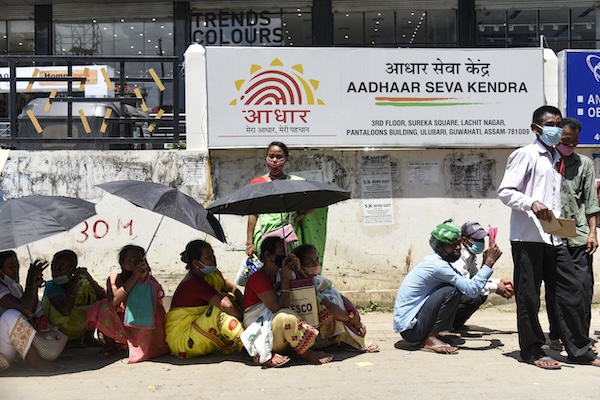
This dynamic extends well beyond welfare. Every digital service contains physical moments. Updating biometric records requires visiting the nearest centre, with its electricity, equipment and functioning staff. Many access these services through Common Service Centres precisely because they lack smartphones, connection or literacy to proceed alone. These intermediaries do not prove digital governance has dissolved barriers. They demonstrate that the digital state still rests on physical infrastructure before most citizens can engage with it at all.
Digitisation has not eliminated waiting. It has displaced it. Uneven physical infrastructure produces its own temporalities of difficulty. Rural internet penetration stands at roughly 48 per 100 persons against substantially higher urban rates, and it binds where need is greatest. Evidence of this gap has accumulated across nearly a decade. Village studies in Jharkhand documented ration cardholders turned away under mandatory biometric authentication. The State of Aadhaar survey found that 27% of users failed biometric authentication on first attempt. Of those who failed at a ration shop, over 30% never received their grain at all. National polling confirms this pattern: the Lokniti-CSDS post-election survey of over 12,000 electors found that 28% of ration-card households reported being denied rations due to Aadhaar-related problems. Among the poorest, this rose to 39%.
The queue has not disappeared. It has transformed. It now takes the form of the repeated authentication attempt, the return journey to the enrolment centre, the wait for connectivity to restore, or dependence on someone who can navigate the system. Automated governance, celebrated as a democratic equaliser, reproduces existing inequalities through these hidden temporalities. The burden falls unevenly. Rural residents travel further. Older persons struggle with biometric systems. Women fold visits around unpaid care. Daily wage workers absorb the cost each time a failed transaction forces them back.
Measuring Completion
Automated systems are never merely technical. They are always infrastructural. They become the equitable platforms they claim to be only when infrastructure beneath matches the scale and speed of processes above.
Policy follows clearly. If digital reliability depends on infrastructure rather than technology alone, every digitised public service should report completion alongside deployment. Publishing data matters: first-attempt completion rates, retry rates, repeat-visit proportions, authentication failures, and the share of cases requiring physical visits. Disaggregate by district and by rural or urban location.
Recurring failures then point to deficits in connectivity, power, device maintenance and service-centre availability. A high retry rate becomes an infrastructure signal, open to the same planning as roads, drainage and public transport. Until completion is treated as a measure of public performance rather than left to individual persistence, the largest costs of digital governance will continue being borne quietly by citizens. For a state that measures so much else so carefully, these costs remain statistically invisible.
More From BasisPoint