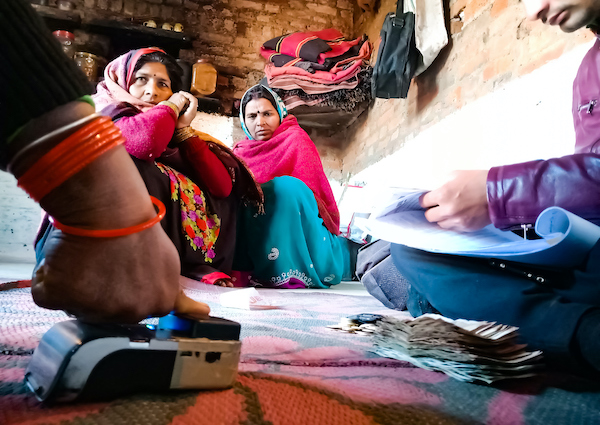
The Reserve Bank of India's Financial Stability Report, released on June 30, 2026, shows that the microfinance borrower base shrank by 2.27 million in January-March 2026. Credit to the sector rose in the same quarter, the first increase after seven quarters of decline. The share of loans 31-180 days past due fell for the fifth successive quarter.
The December 2025 report recorded a fall of 7.8 million active borrowers in April-September 2025. Together, the two reports count more than 10 million exits over nine months, by this author's arithmetic. No official dataset shows where those borrowers went.
Credit Without Them
The rest of the credit system is expanding fast. Non-food bank credit grew 19.1% in the year to September 30, 2026, against 11.2% a year earlier. Bank credit to agriculture grew 19.5%, against 8.9%, and personal loans grew 17.3%, against 11.5%.
Non-bank lenders show the same pattern. NBFC credit grew 15.4% in September 2026, and NBFC retail loans grew 21.9%, up from 16.8% a year earlier. NBFC credit to agriculture grew 17.8%, against 5.2%.
Microfinance sits outside that expansion. Credit to the sector fell 9.3% in April-September 2025, its sixth consecutive quarterly decline. NBFCs and NBFC-MFIs, which hold 56.7% of microfinance credit, grew their books by 5.9% in October 2025-March 2026.
Lending to the segment also became costlier. The credit cost of NBFC-MFIs rose from 4.4% in September 2023 to 15.5% in September 2025. The June 2026 report describes it as having eased, but remaining elevated.
Household debt reached 45.5% of GDP at end-September 2025. Non-housing retail loans made up 58.4% of household borrowing by March 2026.
Who Qualifies
The RBI's 2022 framework treats any collateral-free loan to a household earning up to ₹300,000 a year as a microfinance loan. Repayments on all of that household's loans are capped at 50% of its monthly income.
The fastest-growing retail credit needs collateral. Gold loans are the largest segment of non-housing retail credit and have grown at a compound annual rate of 42.4% since March 2024, against 23.0% for non-housing retail credit as a whole. The RBI attributes the growth mainly to existing borrowers using higher gold prices to borrow more and roll over loans.
Loan-to-value caps on gold loans range from 75% to 85%, so a household borrows only against gold it already owns. At end-March 2026, banks' gross NPA ratio was 0.7% for secured retail loans and 1.7% for unsecured retail loans.
Lenders are also favouring stronger credit profiles. The June 2026 report finds the share of prime and above borrowers rising, by both amount and number. In an RBI survey of ten banks, prime and prime-plus borrowers took about three-fourths of personal loan originations.
Subprime borrowers rarely change tier. Between March 2025 and March 2026, in all 76.8% of them stayed subprime, against 46.9% of prime borrowers who stayed prime.
Rising Costs
The exits coincide with a squeeze on rural budgets. MoSPI's October 2026 CPI release puts rural food inflation at 9.09%, up from 8.06% in September, against 8.68% in urban India. Rural headline inflation reached 6.63%, against 5.41% in urban areas and 6.09% nationally.
Borrowing costs rose on October 7, when the Monetary Policy Committee raised the repo rate by 25 basis points to 5.50% and moved its stance to calibrated tightening. The vote on the rate was unanimous, but two of six members preferred a neutral stance. The RBI projects CPI inflation of 5.2% for 2026-27.
The latest official survey of household debt dates from 2019. NSO's All India Debt and Investment Survey found that 34% of rural households' outstanding cash debt came from non-institutional sources on 30 June 2018, against 13% in urban India. About 10.2% of rural households borrowed only from such sources, against 4.9% of urban households.
Rural incidence of indebtedness stood at about 35%, against 22.4% in urban India. The average indebted rural household owed ₹170,533, against ₹536,861 for an indebted urban household.
The Counterargument
The case that these exits are healthy has real support. First, over-borrowing has fallen. The share of microfinance borrowers with loans from three or more lenders fell to 9.7% in March 2026, after a marginal rise in September 2025.
Loans 31-180 days past due at NBFCs and NBFC-MFIs fell from 4.4% in September 2025 to 1.8% in March 2026. Among the ten banks the RBI surveyed, one-year default rates for subprime personal loan borrowers fell from 1.85% in December 2024 to 1.01% in December 2025. Across all borrowers at those banks, default rates fell from 0.51% to 0.35%.
Second, the pace of exits has slowed. Borrowers left at about 1.3 million a month in April-September 2025 and about 0.76 million a month in January-March 2026, by this author's arithmetic.
Third, other small-ticket credit is growing. Fintech lenders hold 56.8% of personal loans below ₹50,000, and their lending grew 41.6%, against 20.1% for the segment. Lenders had also disbursed more than 570 million loans worth ₹40.07 trillion under PM MUDRA Yojana by March 27, 2026.
None of this answers the core question. Fintech small-ticket books report delinquencies of 6.4%, and 70.5% of their loan books are unsecured. No RBI, NSO or credit bureau release shows whether former microfinance borrowers moved to fintech, borrowed against gold, turned to a moneylender or exited the credit system altogether.
Next Test
The Financial Stability Report counts the borrowers who leave but not where they go, and it gives no count for October-December 2025. The NSO last measured informal borrowing in 2019.
The MPC announces its next decision on December 4. MoSPI releases November CPI on December 14, and the RBI's December Financial Stability Report will update the borrower count. Together, these three releases will test the argument.
Until then, the official record stands at more than 10 million microfinance exits over nine months. The public data do not show where those borrowers went.
.png)