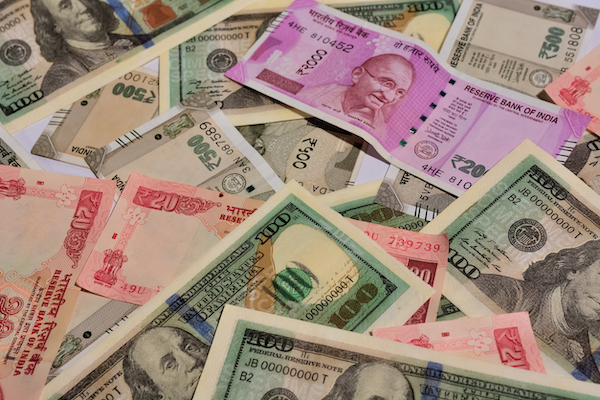
India’s foreign exchange reserves look impressive in absolute terms. They have climbed back above $700 billion, coinciding with the RBI’s decision to close the concessional dollar-rupee swap window on August 31, 2026, for three- to five-year Foreign Currency Non-Resident (Bank) deposits, while retaining similar facilities for external commercial borrowings and overseas foreign-currency borrowings until December 31, 2026.
The scheme has a simple structure. Dollars raised through FCNR(B) deposits and other eligible borrowings enter the RBI’s spot reserves. The central bank injects rupee liquidity into the domestic system and books an offsetting forward short position.
As the RBI absorbs these dollars, headline reserves rise. Markets, however, are not necessarily reassured by reserves accumulated through swaps. They may discount the increase because the matching forward liabilities reduce the immediately usable cushion. Since the RBI began using buy-sell swaps in March 2019, some global investors have regarded the strategy as reserve management that improves the headline without adding equivalent unencumbered cover.
The relevant question is whether the window addressed a genuine external-financing need or primarily projected strength while capital-account fundamentals remained uneven.
Forward Discount
The IMF’s 2025 Article IV consultation noted that systemic financial risks were broadly contained but flagged “pockets of vulnerability resulting from concentration risks and rising interconnectedness.” While the Fund did not single out the RBI’s forward book, market participants and analysts routinely adjust India’s reserve-adequacy measures for net short forward commitments.
The RBI’s disclosed net short forward position reached a record $106 billion–$107 billion in mid-2026. Once the additional forward commitments created by FCNR(B) deposits and other foreign-currency inflows raised under concessional swap facilities are included, the broader swap-linked exposure could approach $180 billion. At that scale, the gap between headline and readily usable reserves becomes material. Import cover and the ratio of reserves to short-term external debt look less comfortable once these commitments are taken into account.
A net short forward position of that scale is not catastrophic in itself, but it narrows the RBI’s room for manoeuvre. Investors see less unencumbered reserve cover against external shocks and may therefore demand a higher risk premium on Indian assets.
History offers cautionary parallels, even if the contexts differ.
In Thailand in 1997, a large share of reported reserves was committed through forward contracts defending a peg. When markets recognised how little remained unencumbered, the baht collapsed, and the Asian financial crisis accelerated. In Mexico in 1994, dollar-indexed Tesobonos created contingent liabilities that overwhelmed usable reserves, helping to precipitate the Tequila crisis.
India today operates a managed float rather than a hard peg, and its absolute buffers are far larger. The narrower lesson remains relevant: forward intervention can buy time, but cannot remove the pressures that made it necessary. Once markets begin pricing the forward book directly, a reserve headline intended to convey strength can instead invite greater scrutiny.
China offers an imperfect contrast. The People’s Bank of China also maintains sizeable forward and swap positions, but these sit atop a multi-trillion-dollar reserve stock accumulated through persistent current-account surpluses. India’s forward short book has been predominantly defensive, used to offset sustained foreign portfolio outflows, weak net FDI after repatriation and outward investment, and pressure on the rupee. China manages such positions from abundance; India has used them partly to compensate for capital-account weakness.
Costly Stopgap
The capital-account picture itself remains mixed. Foreign portfolio investors recorded large cumulative equity outflows through much of 2026, even after a partial recovery in July and August. Gross FDI inflows have been robust, yet net FDI remains modest once repatriation, disinvestment and outward investment by Indian firms are subtracted. Short-term external debt and trade credit have risen as a share of total external liabilities, elevating rollover risk. The rupee has also remained under depreciation pressure, adding to the RBI’s intervention burden.
In this environment, the FCNR(B) window functions as a stopgap: it delivers medium-term dollars quickly, allows the RBI to rebuild spot reserves or reshape the maturity profile of the forward book, and signals a willingness to defend the external buffer.
Yet the instrument is costly. By offering the swap at a concessional rate, the RBI absorbs part of the market hedging cost and effectively subsidises the inflow. Depending on the corpus and market assumptions, estimates put the cumulative five-year cost at about $10 billion–$11 billion. That is manageable relative to the reserve base, but still a real transfer. Moreover, the swaps add longer-tenor short positions to the forward book. Near-term delivery risk may decline, but they create a fresh three- to five-year overhang, with part of the maturity wall falling around the 2029 general election cycle. These are borrowed dollars secured at a high cost. They improve spot reserves without addressing the shortage of durable equity capital.
Other instruments were available. Buy-sell swap auctions could have offered market-based price discovery, although their appeal to overseas investors is limited and they would not eliminate the forward liability. Targeted support for hedging costs on external commercial borrowings by corporate borrowers with demonstrable funding needs would have addressed a more specific vulnerability.
Use of a costly, temporary facility may also be read as an acknowledgement that natural capital inflows, in the form of robust net FDI and sustained portfolio investment, may not resume quickly enough to stabilise the external account unaided. A durable reserve buffer requires those flows, not merely borrowed dollars that swell spot reserves while generating offsetting forward claims.
Until those fundamentals improve, India’s reserves will remain impressive in the headline but conditional in the footnotes. The FCNR(B) window has bought time and strengthened near-term cover. Whether it is remembered as prudent buffer-building or headline management will depend on whether that time is used to rebuild durable capital inflows and reduce reliance on the forward book.
.png)