.png)

Amitabh Tiwari, formerly a corporate and investment banker, now follows his passion for politics and elections, startups and education. He is Founding Partner at VoteVibe.
October 21, 2026 at 6:45 AM IST
India’s most politically explosive unfinished business is back on the table. Delimitation, the redrawing of parliamentary constituencies and the allocation of seats among states, has returned to the national conversation. Reports of a possible fresh legislative push have revived the debate, after the government’s delimitation-linked constitutional amendment failed in Parliament in April. The central question is whether the BJP can find the numbers, and whether it can afford to try again.
Delimitation is the process of redrawing the boundaries of Lok Sabha and state Assembly constituencies so that each represents roughly the same number of people. It is intended to uphold the constitutional principle of “one person, one vote, one value”. The exercise also determines how many seats each state gets in the Lok Sabha.
India has had four delimitation exercises, in 1952, 1963, 1973 and 2002. However, the allocation of Lok Sabha seats among states has remained frozen on the basis of the 1971 Census. The 84th Constitutional Amendment extended this freeze until the relevant figures from the first Census conducted after 2026 are published. The 2002 delimitation exercise, subsequently adjusted using 2001 Census data, redrew constituency boundaries without changing the total number of seats allocated to each state.
The Case for Expansion
The case for change is straightforward. The Lok Sabha’s 543 elected seats are still based on a population distribution that dates back decades. In 1971, India had about 548 million people, equivalent to roughly 1 million people per seat. The country’s population is now estimated at around 1.4 billion. A single MP may represent 2.5 million people or more, making it increasingly difficult to provide effective representation to such a large constituency.
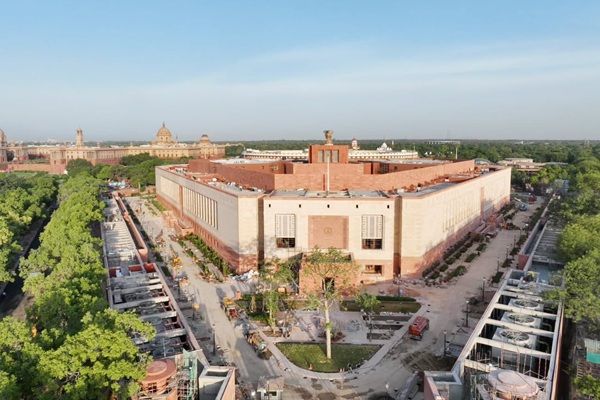
Applying the original ratio of roughly 1 million people per MP would imply a House of about 1,400 members. That is impractical, and the new Parliament building’s Lok Sabha chamber has a stated capacity of 888 members, with additional capacity for joint sittings. The constitutional amendment introduced in April proposed raising the Lok Sabha’s maximum strength to 850. That would expand the House substantially, although it would not, by itself, settle how seats should be distributed among states.
Southern Anxiety
The real controversy is distribution. If seats are reallocated strictly in proportion to population, states that have grown faster would gain more representation. Southern states, which account for about 20% of India’s population but an estimated 30–35% of its GDP, fear they could lose political influence relative to the rest of the country. Their argument is that they invested in education, healthcare and family planning, and that population-based delimitation could effectively penalise them for those achievements.
The population figures illustrate the concern. Between 2001 and 2011, Uttar Pradesh’s population grew by 20.2% and Bihar’s by 25.4%, while Kerala’s grew by 4.9% and Tamil Nadu’s by 15.6%.
A 2019 Carnegie Endowment report modelled a Lok Sabha with 846 members. Under that scenario, Uttar Pradesh’s seats would rise from 80 to 143, Bihar’s from 40 to 79, Maharashtra’s from 48 to 76, West Bengal’s from 42 to 60, and Tamil Nadu’s from 39 to 49. Tamil Nadu would gain seats in absolute terms but lose ground in relative representation. That distinction lies at the heart of the dispute.
My own zone-wise calculations point in the same direction. Four of the six zones would gain share. The Central zone would rise from 7.4% to 7.8%, the North from 27.8% to 29.4%, the East from 21.7% to 22.2%, and the West from 14.4% to 14.9%. The South would fall from 24.1% to 22.2%, a decline of 1.9 percentage points, while the North East would drop from 4.6% to 3.5%, a decline of 1.1 percentage points. Given the BJP’s strength across much of the Hindi belt, opponents see the proposed redistribution as a shift in political weight towards the north.
The Government’s Answer
The government has sought to address these concerns. Home Minister Amit Shah has said that no state would lose seats, either in absolute terms or in its share of the House. During the April debate, the government offered a uniform 50% increase in seats for every state, which would preserve their existing relative shares.
On paper, this is an elegant compromise: every state gains seats, while none loses its share of the Lok Sabha. But the trade-off is significant. A uniform increase would preserve existing disparities in representation rather than bring constituency sizes into closer alignment with population. A voter in a slower-growing state would continue to have greater relative weight than a voter in a faster-growing one.
Equality and equity therefore pull in different directions. Any formula must reconcile the principle that each vote should carry comparable weight with the concern that states which successfully stabilised their populations should not lose political influence as a result.
The Arithmetic
The immediate obstacle is parliamentary arithmetic. A constitutional amendment must secure a majority of the House’s total membership as well as a two-thirds majority of members present and voting. The precise number of votes required therefore depends on attendance, although 362 would be the two-thirds threshold if all 543 elected members were present and voting.
The NDA has 294 Lok Sabha members. Adding the DMK’s 22, a group of 20 MPs from the Trinamool Congress camp, Shiv Sena (UBT)’s six and the NCP (Sharadchandra Pawar)’s eight would take the tally to about 350. Even on these assumptions, the government would remain short of 362 if the entire House voted.
Those additions are far from certain. The DMK has been among the most vocal critics of the proposal, while other opposition parties have raised concerns about the impact on federal representation. The April defeat was a major setback for the government: the constitutional amendment received 298 votes in favour and 230 against, falling short of the required special majority. A fresh attempt would require the government to secure broader support or make changes that persuade at least some opponents to reconsider.
Political Stakes
The political context makes a second attempt more difficult. Protests by the opposition and Citizens for Justice and Peace over allegations of “vote chori”, or vote theft, have added to the government’s political challenges. The BJP needs legislative wins to restore momentum, but it cannot easily risk another defeat on a measure of such constitutional significance.
Bringing the legislation back without the numbers would be a gamble. Holding it back could be portrayed as a retreat. That leaves the government with a narrow path: it must persuade parties that currently oppose the proposal or remain unconvinced.
That will require more than ministerial assurances. Firmer guarantees on the distribution of seats, potentially written into the constitutional framework, could help build trust. Southern parties have little reason to rely on verbal promises when the stakes involve their long-term representation in Parliament.
The Federal Bargain
Delimitation is about more than seat counts. It touches the federal bargain that holds India together. Southern states have long argued that their economic contribution to the Union is not adequately reflected in the distribution of resources. A perception that their voice in Parliament is also diminishing could deepen that grievance.
A widening North-South divide would carry political costs for the BJP, too. The party has ambitions to expand its presence in states south of the Vindhyas. Pushing through a formula perceived as unfair could undermine that effort.
The challenge is to balance equality of representation with equity between states. The expansion of Parliament may be overdue, and the burden on MPs representing millions of people is undeniable. But the distribution of new seats will determine whether delimitation is remembered as a necessary modernisation of Indian democracy or as a new fault line in the Union.
The BJP’s challenge is not simply to find the votes for 362. It is to build a formula that the South can accept as fair, and that other states can defend to their voters. Without that political consensus, even a larger Lok Sabha may deliver a smaller measure of trust.
More From BasisPoint