.png)

Blumenthal’s Tariff Should Push India, China and Russia into a Cosy Corner
The US Senate's bipartisan push for punitive tariffs on countries buying Russian oil is more than a trade measure. The move presents a rare opportunity for India, China and Russia to deepen strategic cooperation and reshape the emerging global order.
Rajesh Ramachandran is a former Editor-in-Chief of The Tribune group of newspapers and Outlook magazine.
July 31, 2026 at 7:50 AM IST
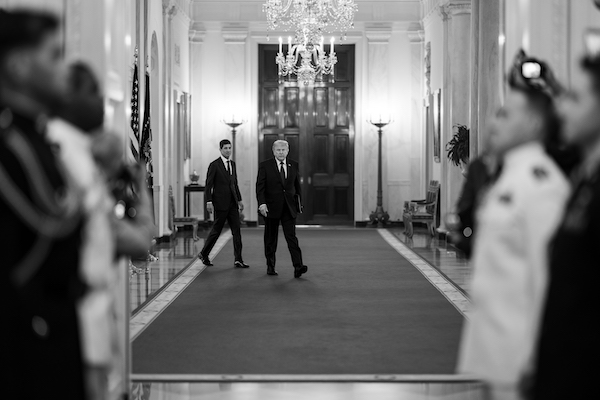
On September 1, Prime Minister Narendra Modi, Russian President Vladimir Putin and Chinese President Xi Jinping had a pull-aside at Tianjin when they met for the Shanghai Cooperation Organisation Summit. It was Modi’s only visit to China in seven years and the first after the Doklam standoff. Now is the time for another Russia-India-China huddle. A deeper, longer, and more meaningful embrace of these three civilisations is the only way out of a crisis being engineered in Washington DC.
The West Asian war, entirely triggered by the US-Israel combine’s attack on Iran, has made India dependent on Russian Urals crude oil. The closure of the Strait of Hormuz and now the uncertainty over Houthi attacks on Saudi Arabian tankers in the Strait of Bab el-Mandeb in the Red Sea have made Urals crude the only viable option for Indian refineries. From 1 million barrels per day in February, India imported 2.6 mbpd in June — a windfall to the Russians and a huge loss for the Anglo-American companies operating West Asian oil fields.
By June, India was sourcing 50% of its crude imports from Russia, amounting to nearly 55% of Russia’s total oil exports. This figure may go up in July, with Indian imports expected to touch 3 mbpd. Russia is, in fact, sourcing refined products from India after its refineries were struck by Ukraine, which is also targeting Russian oil tankers.
It is in this context that the US establishment is threatening to deliver a debilitating 100% tariff blow to the Indian economy if it buys Urals crude. This is neither the eccentricity of US President Donald Trump nor MAGA madness, but a sure-footed step by the brute bipartisan majority of the US Senate. This move is being pushed by a “mainstream, liberal, progressive and conventional” senator from Connecticut, Richard Blumenthal — as blue as any Democratic Party senator ever could be. He was a classmate of Bill and Hillary Clinton at Yale; Michelle and Barack campaigned for him; and he was friends with Biden’s late son.
Blumenthal, a pro-Israel politician, co-authored and introduced the “Sanctioning Russia Act of 2025” with the Republican hawk Lindsay Graham in April 2025. After his passing, it has now been renamed the “Lindsay O. Graham Sanctioning Russia and Iran Act of 2026”. The Senate approved the bill with an 86–12 vote, which clearly proves the US bipartisan attitude towards India. If at all there were any doubts, Blumenthal explained that this bill was “carefully crafted to make sure we are not hitting our allies and that we are hitting China and India.” And for him, China and India are the “main culprits”.
Granted, the process has only begun in the Senate, where there will be a detailed debate and possible amendments. After that, there will be a cloture vote if the debate rambles on, and then the final passage vote. While 60 votes constitute a supermajority and 67 constitute a two-thirds majority, the bill has already garnered 86 votes, making it nearly unanimous, as the Senate has only 100 members. From the Senate, the bill goes to the House of Representatives before being sent to the President for signature. The bill does not impose a 100% tariff right away but gives the tariff-happy president the power to impose tariffs of up to 100% against India and China.
This gives “the main culprits” a great opportunity to get together for another huddle along with Russia. In fact, it was Russia that helped the two Asian giants walk back from the Himalayan brink by offering a platform for peace at Kazan on October 23, 2024, on the sidelines of the BRICS summit. India presides over this year’s BRICS summit, expected to be held in Delhi on September 12 and 13. If Kazan helped thaw relations and Tianjin created the optics for a multipolar world, Delhi should draw up the sea map for a Russia-China-India eastern energy and trade corridor from Vladivostok to Shanghai to Chennai — a peaceful, strong, maritime route away from the piracy-ridden Western seas.
The US has been hostile to India ever since the latter refused to act as a proxy to contain China in the Himalayas. The deadly Pahalgam terror attack and India’s response, Operation Sindoor, made things worse, with the Western press praising Pakistan with war poetry over falling Rafale jets (now, expectedly, there has been little reporting on claims that Iranian attacks struck F-35s) and Trump hailing his favourite Field Marshal. Then there were tariff threats. That was the moment that led to the Tianjin huddle. It is time for another — one that should go beyond optics and be rooted in assurances of mutual respect, territorial integrity, non-aggression, non-interference and boundless trade.
A BRICS currency does not seem ready to become a reality, considering how cautious India is in taking every step in the Western geopolitical minefield. For all we know, this bipartisan 86-against-12 attack by the US Senate on India and China could be a warning shot, reflecting concerns over de-dollarisation of international trade. For post-colonial nations, this is familiar territory. This is how, by accepting painful trade concessions and self-defeating territorial trade-offs, India and China lost their sovereignty in the eighteenth and nineteenth centuries.
The colonial redux could not have been more stark. The legislature of a nation lying 13,000 km away wants to control Indian trade and, by extension, global oil flows. After the US abduction of the Venezuelan President, now there are only two important oil-selling countries in the world outside the pale of the Anglo-American empire — Russia and Iran. And India, the world’s third-largest oil importer, is being stopped from accessing these two sources to ensure superprofits for the Anglo-American oil companies.
This US diktat offers India and China a rare opportunity to trade in their own currencies — a $150 billion rupee-yuan trade would strengthen Asian currencies without introducing a new BRICS one. The “main culprits” should come together to stare down the bully and help shape the emerging global order if they want to safeguard their strategic autonomy against recolonisation through trade tariffs.
More From BasisPoint