.png)

Gaurav Rastogi, Founder at Kuvera, was a portfolio manager at Morgan Stanley. He likes to write about markets, and why we do what we do with money.
November 17, 2026 at 7:59 AM IST
I keep thinking about a bridge that fell down in 1907. It was meant to be the longest cantilever bridge in the world, rising over the St. Lawrence River near Quebec City. To save money on the piers, its consulting engineer stretched the main span from 1,600 feet to 1,800. Nobody went back to recalculate what the longer bridge itself would weigh.
That August, a young inspector named Norman McLure saw the steel in the lower chords beginning to bend. The bends grew, and the letters and telegrams went back and forth for three weeks. On 29 August the engineer finally wired the builders to add no more load, but work carried on. Late that afternoon the bridge fell into the river and killed 75 men.
The Royal Commission that investigated found the cause in the design itself. The dead load, the weight of the bridge alone, had been assumed too low and never revised.
The Call
The bulls answered with George Soros, who described decades ago how bubbles form. In his telling a boom gets “repeatedly tested by external shocks.” Each test it survives makes the belief stronger, and then comes the acceleration where the largest fortunes are made. On that reading, this fall is a test and the time to buy is close.
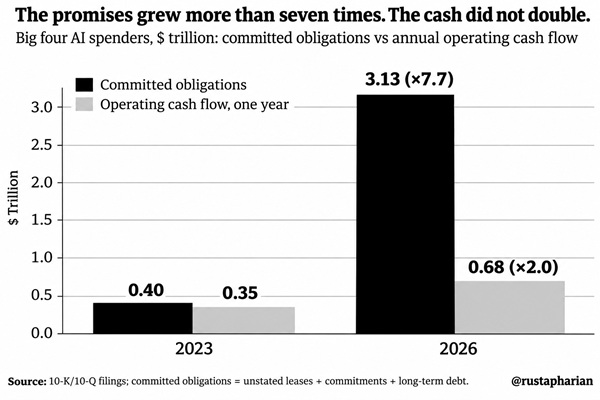
I think the bulls are reading the theory backwards. A test comes from outside a boom, and this pressure is coming from inside it. I have added up what the four biggest AI spenders have committed to pay: signed leases that have not started, purchase commitments, and debt. In 2023 that came to about $400 billion. Today it is about $3.1 trillion, 7.7 times as much. Their operating cash flow over the same period has risen from $345 billion to $677 billion, which is not quite double.
I divide that pile by a year of operating cash flow and call it the Dead Load, after the bridge: the structure’s own weight, measured against the cash holding it up. Cash flow no longer carries it, so the rest has to come from investors buying new bonds and shares. Once that happens, a falling share price makes the business itself harder to fund. Soros called this stage the twilight, when a trend keeps running on inertia after the belief behind it has gone.
1.The Dead Load
The result is the number of years a company would need to cover those promises if it stopped all new spending and sent every dollar of operating cash to them.
I went back to 2019 to see what normal looks like. For four years the ratio for the group barely moved: 1.1 in 2019, 1.0 in 2021, 1.2 in 2023. Then it reached 1.9 by the end of 2025. In the nine months since, it has more than doubled again, to 4.6.
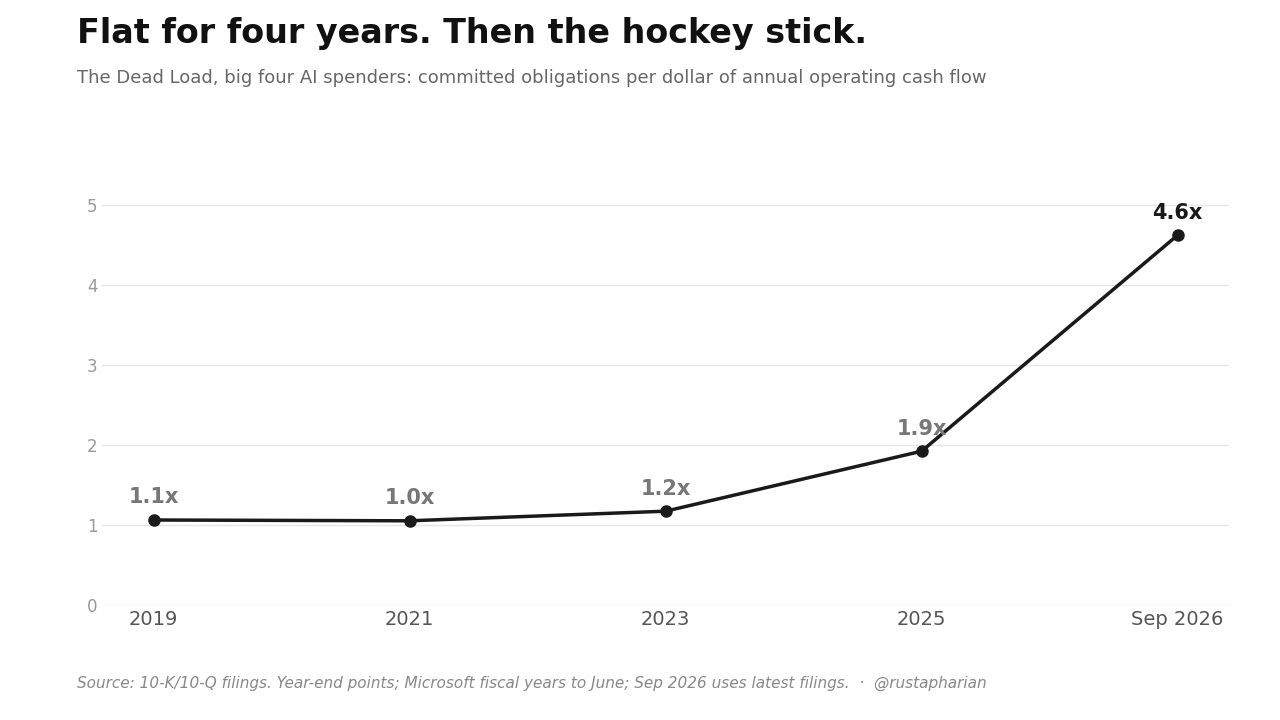
Spending plans rose again and again through the year. The promises grew with them, much faster than the cash.
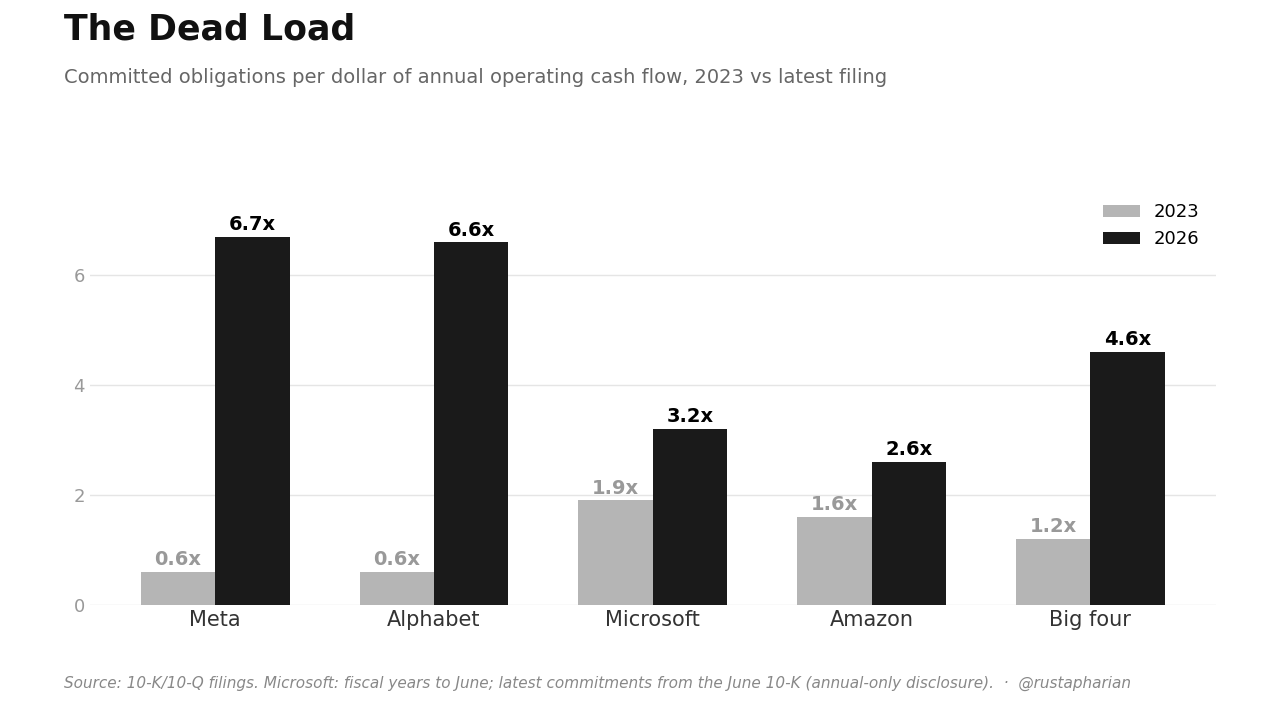
Meta’s ratio was 0.6 at the end of 2023, and today it is 6.7. Meta has disclosed $356 billion of leases that have not started and $455 billion of other commitments, and it carries $81 billion of debt. Alphabet has gone from 0.6 years to 6.6. Its long-term debt rose from $13 billion at the end of 2023 to $125 billion in September, and its purchase commitments from $46 billion to $924 billion. Microsoft has gone from 1.9 to 3.2, and Amazon from 1.6 to 2.6. Amazon’s figures now come from its September quarterly filing.
These promises are paid over many years, not tomorrow, and cash flow will probably keep growing. Definitions also differ a little between companies, and the receipts post shows each line. So the ratio measures weight rather than solvency, and none of the four is close to default. It does show speed, because the group ratio has almost quadrupled since 2023.
My number probably understates the load, and Meta’s largest data-centre project shows why. In October 2025 Meta moved Hyperion, in Louisiana, into a joint venture 80% owned by funds managed by Blue Owl. The venture sold $27 billion of bonds to build it. Meta will lease the campus on an initial four-year term and guarantees the venture’s value for the first sixteen years. The bonds sit on someone else’s balance sheet, so a ratio built from Meta’s filings likely captures only part of what Meta has promised.
The load matters because of where the money to carry it now comes from. In the September quarter, three of the four spent more on capital projects than their operations brought in. Alphabet generated $42 billion of operating cash and spent $51 billion. Amazon generated $42 billion and spent $77 billion. Meta’s free cash flow turned negative for the quarter. Only Microsoft still pays for its building from operating cash. The other three are funding the gap from investors: Meta has sold $25 billion of bonds and is selling up to $97.5 billion of new shares, Alphabet raised about $62 billion selling shares and $85 billion in bonds in the first nine months of the year, and Amazon’s long-term debt rose from $66 billion to $173 billion over the same period.
2. Who stands behind the promises
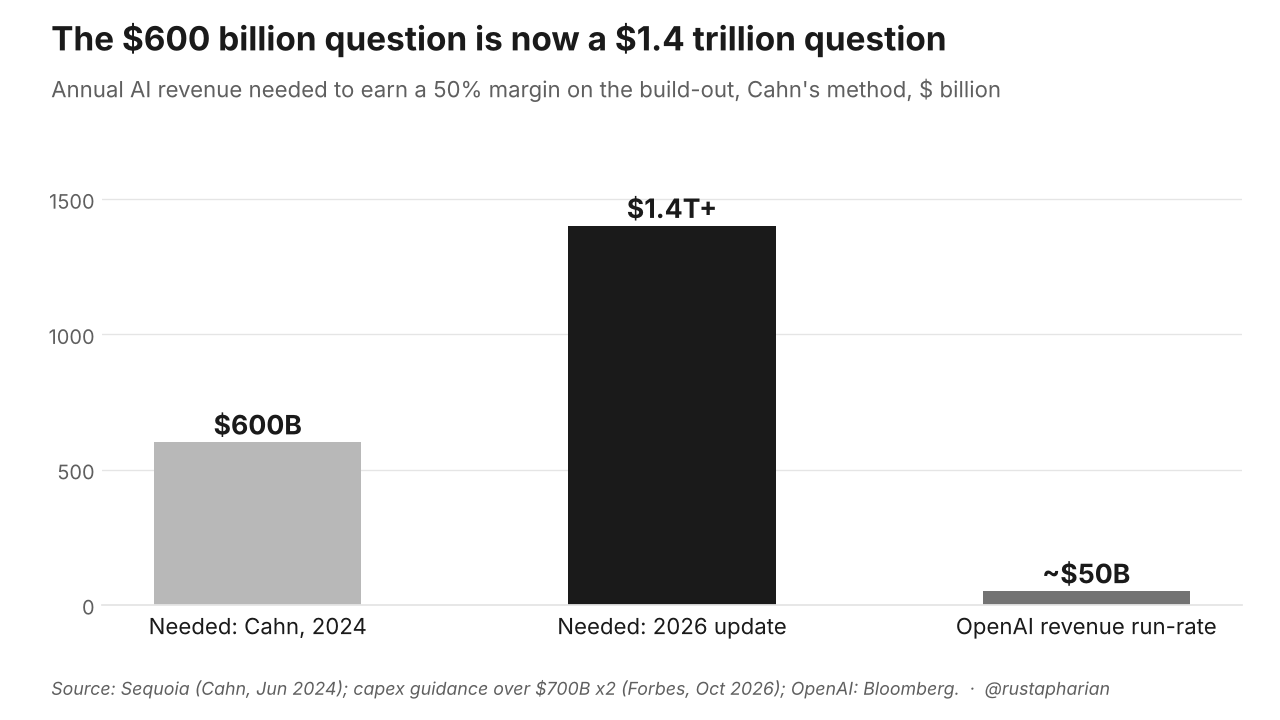
In June 2024 David Cahn of Sequoia Capital asked what he called AI’s $600 billion question. He took Nvidia’s data-centre sales, doubled them to get the full cost of a data centre, then doubled again for the margin its users would need to earn. On his arithmetic, AI had to bring in $600 billion a year to pay for the hardware being bought.
This year the four have guided to more than $700 billion of capital spending on their own. That already counts the whole data centre, so only the second doubling applies. Run Cahn’s arithmetic on it and the question becomes about $1.4 trillion of revenue a year. The update is my own, and it uses Cahn’s rough assumptions. For scale, OpenAI, the largest company selling AI directly, earns at an annual rate of about $50 billion.
Bulls will say the gap is covered by contracts. Microsoft’s commercial backlog of future contracted revenue has reached $677 billion. Oracle’s backlog stands at $664 billion as well. On this view, the builders are only building what customers have already bought.
That makes it important to know who signed those contracts. In January Microsoft said that about 45% of its commercial backlog came from a single customer, OpenAI. Roughly half of Oracle’s is reported to be tied to the same company.
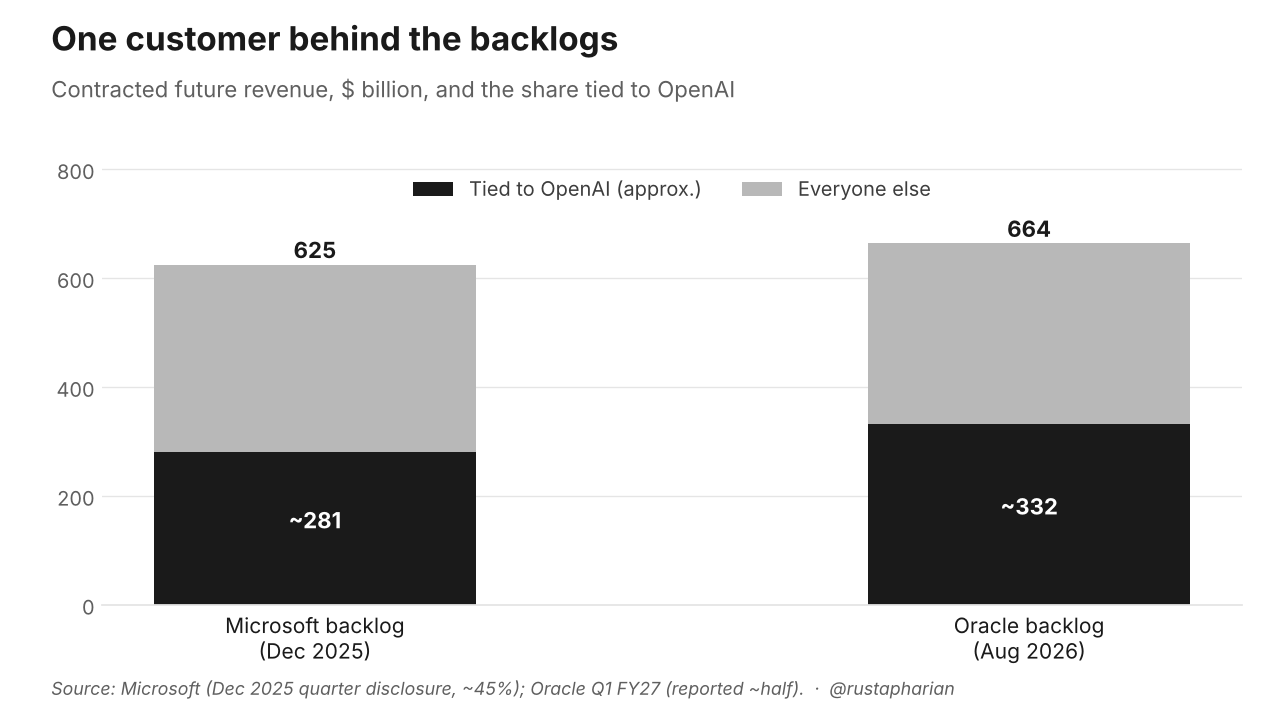
OpenAI’s revenue is growing fast, but its commitments run to hundreds of billions, so it must keep raising money to honour them. The backlog that is meant to make the promises safe is itself a promise from a company that depends on outside capital. If investors stop funding OpenAI, a large part of Microsoft’s and Oracle’s backlog becomes uncertain with it.
3. The loop
When a company funds construction by selling shares, its share price becomes one of its costs. Soros called this kind of feedback loop reflexivity. Alphabet raised $62 billion this way in nine months. Meta has announced plans to sell up to $97.5 billion of new shares. A high share price makes new capital cheap to raise. Cheap capital builds data centres, the orders lift chip makers’ earnings, and the earnings lift share prices again.
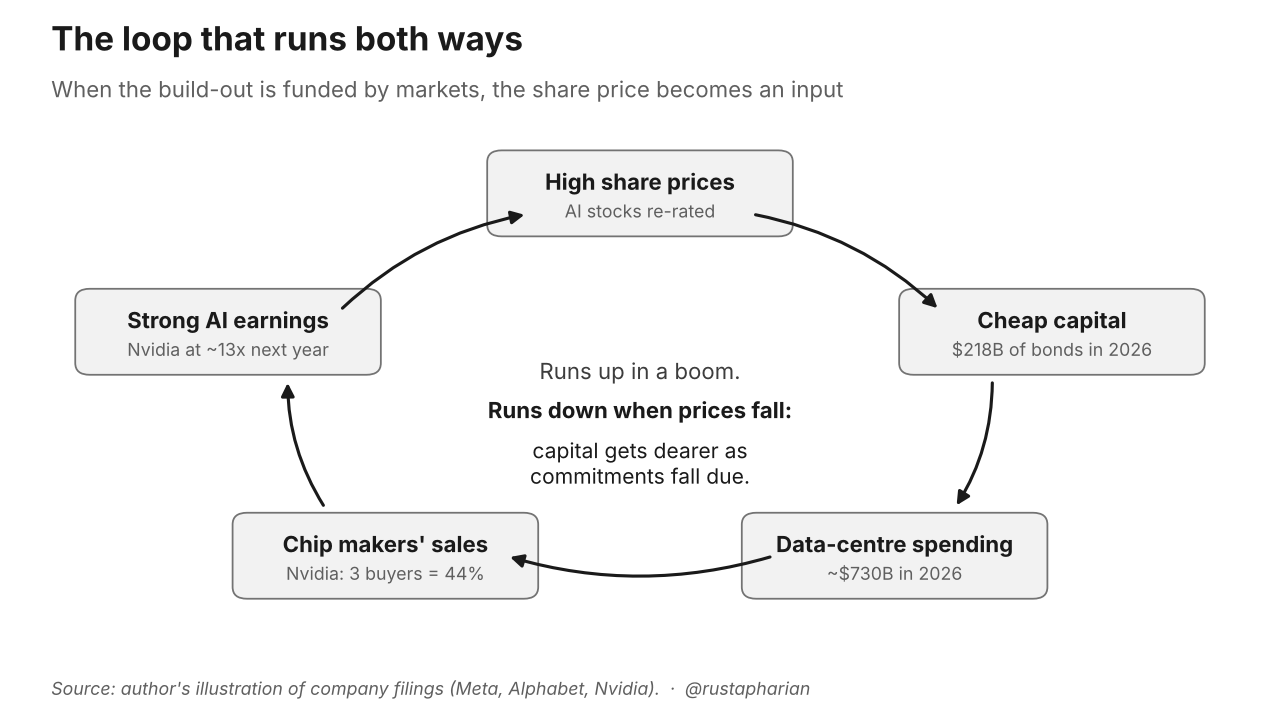
Meta’s share sale shows how the feedback works in practice. The first piece, a $25 billion forward sale, was priced at $625 a share, and Meta receives the cash only when the contracts settle, by November 2027. A further $12.5 billion comes from mandatory convertible securities, which convert into 17 to 20 million shares in August 2029. The largest part, up to $60 billion, is an at-the-market programme Meta has announced but not yet signed; it says the timing, size and terms are not determined. If the at-the-market tranche ends up sold at a price 40% lower, it alone would take about 160 million shares, roughly 6% of the company. A falling price means existing owners give up more of the company for the same data centre.
Nvidia, the main seller of AI chips, sits at the centre of this loop. In the first half of Nvidia’s fiscal year, three direct customers supplied 44% of its revenue. When Meta announced its share sale, Nvidia, AMD and Broadcom indicated interest in buying up to $5 billion of the new stock in total, an indication the prospectus describes as non-binding. Nvidia also guarantees up to $3.5 billion of its cloud partners’ data-centre leases and has committed $36 billion to renting cloud capacity. Each of these items is small next to Nvidia’s revenue. Together they show a supplier helping to finance its own customers, which means it is no longer selling at arm’s length.
Britain went through something similar in the 1840s, during its railway mania. George Hudson, the “Railway King,” controlled a large part of the network. He kept dividends high, and he often paid them out of capital rather than profit. New money paid old investors, so returns looked superb for as long as capital kept arriving. In 1849 committees of shareholders finally opened the books. Hudson was made to repay large sums, went bankrupt, and lived abroad for years to avoid arrest for debt. His railways stayed in use, but many of the shareholders who paid for them lost heavily.
Nobody is paying dividends out of capital today. But when a supplier’s revenue comes from its customers’ borrowed money, and it lends some of that money back, the money moves in a similar circle.
When prices fall the loop runs backwards, and new capital gets dearer just as the promises fall due. The weakest borrowers in the chain feel it first. CoreWeave, which rents AI chips to others, now pays more than 10% a year to insure its debt against default. Like McLure’s bends, that is easy to explain away as a local problem. In 1907 many on the job believed the bends had been in the steel from the beginning.
4. Why this is not 1998
The bulls’ favourite precedent is 1998, when the Nasdaq lost about 30% between July and October, as Russia defaulted and the hedge fund LTCM collapsed. The Fed cut rates three times in seven weeks, and the Nasdaq more than tripled by March 2000. That was a real test, and it had three features.
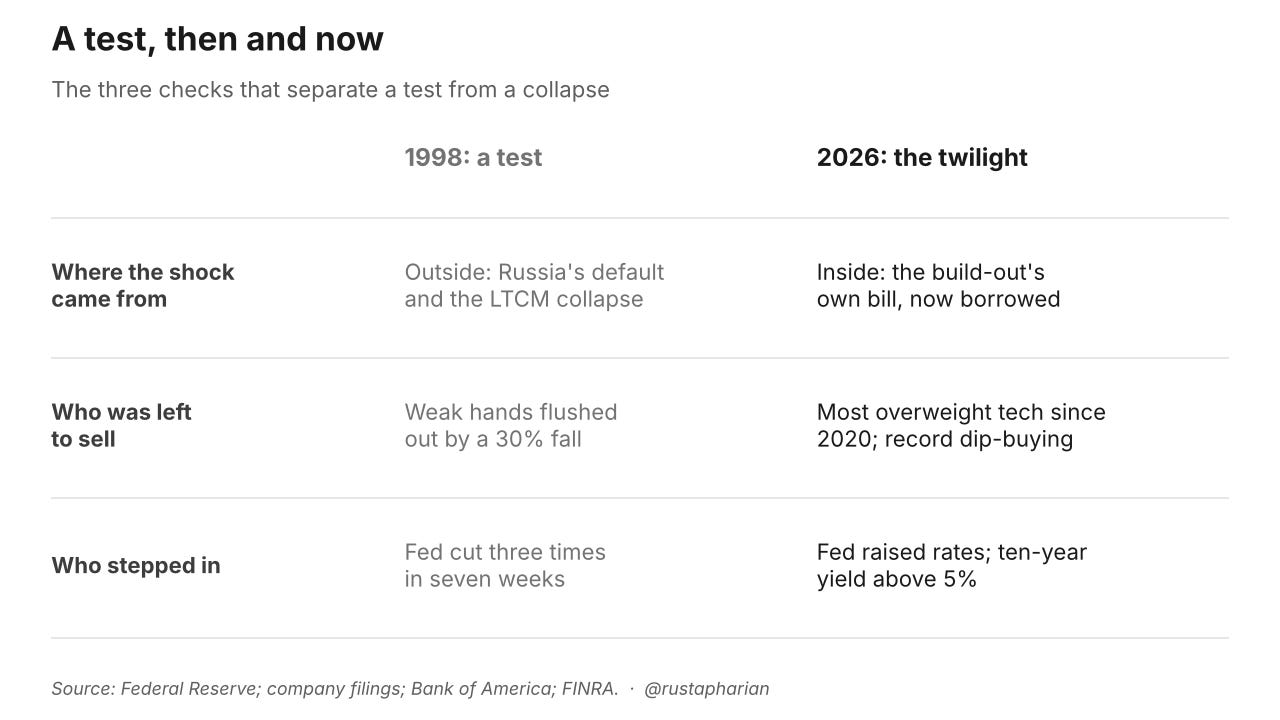
The shock came from outside the boom, nervous investors sold out during the fall, and the central bank rushed in with cheaper money. In 2026 all three point the other way. This time the shock is the bill for the build-out itself. Fund managers in Bank of America’s October survey were more overweight technology than at any time since 2020, and in July individual investors put a record $12 billion into chip funds in a single week. The Fed, meanwhile, raised rates in September, and the ten-year Treasury yield has climbed above 5%, its highest level since 2007.
The closer precedent, in my view, is the American railway boom that ended in 1873. Jay Cooke was the most celebrated banker in America, the man who had sold the Union’s Civil War bonds. He was financing the Northern Pacific railroad by selling its bonds to the public. When buyers stopped coming, Jay Cooke & Company closed its doors on 18 September 1873. The New York Stock Exchange shut for ten days, the first time in its history. The depression that followed lasted more than five years and took down 121 railroads. The Northern Pacific was finished all the same, ten years later, with new investors’ money.
5. What the bulls get right
The best case the bulls make has three parts. Capital spending is a choice, so the companies can cut it the day demand slows. GPUs are sold out, which means demand has not slowed. And the debt is tiny next to these companies’ market value, so talk of strain is overdone.
Each point is true as far as it goes. Spending can be cut, but most of the obligations cannot. The leases and purchase orders in my ratio are signed, and Meta describes its commitments as non-cancelable. Suppliers are usually sold out near the top of a boom, especially when customers are buying with money they have just raised. Market value is also the number most likely to fall in a twilight, and these companies are now selling shares to pay for the build.
The bulls’ other main argument is that Nvidia is cheap. It trades at roughly 13 times next year’s expected earnings, far below the multiples of 2000. But the multiple is low because the earnings are high, and the earnings are high because customers are spending borrowed money. Supplier stocks often look cheapest near the peak of a spending cycle, just before their earnings fall.
The biggest unknown in all of this is the Federal Reserve. Rates may be rising because the economy is strong, and the Fed may cut at the first sign of trouble. If it does, the cheap money that rescued 1998 comes back, and the case for a passed test gets much stronger. Until then, a boom that needs fresh capital is building on the most expensive money in nearly two decades.
AI itself is real, and nothing in these filings disputes that. The railways and the internet were real too. Both changed how people lived, and both cost many of their early investors heavily. A technology can succeed while the people who paid for its first build-out lose money.
Add no more load
On the last afternoon, the Quebec engineer finally wired the order to add no more load. As far as I can find, none of the four has cut its spending plan this year.
The bulls’ reading of Soros needs a shock from outside the boom. This pressure comes from the companies’ own commitments, which is why I do not expect the boom to pass this test. The Quebec bridge was rebuilt after the collapse, and trains still cross it today. I expect AI to follow a similar path, with much of the reward going to investors who arrive after the first build-out.
Gaurav Rastogi also writes on his Substack page.
(This column reflects the author's personal views and is based on publicly available information. It is intended for general commentary and analytical purposes only and should not be construed as investment advice.)
More From BasisPoint