In February, the Union Budget for 2026–27 set aside ₹1.71 trillion for fertiliser subsidy. A few weeks later, ships could no longer move freely through the Strait of Hormuz, and the cost of gas, ammonia and imported urea went up sharply. In May, an official of the Department of Fertilisers said an increase of about ₹700 billion could not be ruled out. Subsequent press reports have pointed to an overrun, although the full-year bill remains uncertain.
The response so far deserves credit, but absorbing an overrun is not the same as budgeting adequately for the risk.
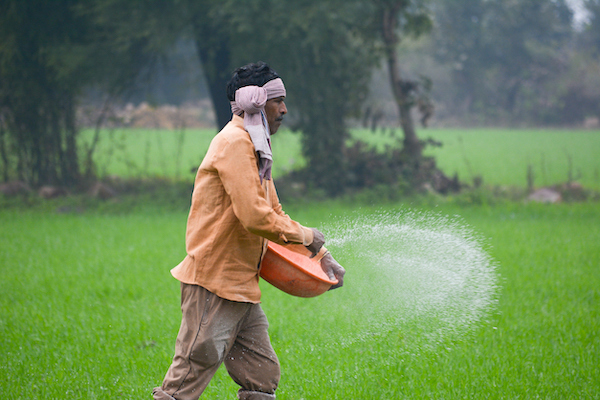
First, farmers were protected. The price of a bag of urea stayed the same. The Finance Ministry’s Monthly Economic Review says that buying from new suppliers kept key inputs available, and that the government did not pass the full rise in global energy prices on to consumers.
Second, the government’s accounts held up. The RBI says spending on major subsidies, food, fertiliser and petroleum, was 35.1% higher in April–July than a year earlier. Even so, the fiscal deficit for those four months was a smaller share of the full-year budget than last year, because tax collections were strong and interest payments were lower. Capital spending went up 29.9%, showing that higher subsidy payments had coexisted with strong investment spending.
By August, the fiscal position was less comfortable. The Centre had spent ₹1.87 trillion on major subsidies, and the deficit was 41.9% of the full-year target, compared with 38% a year earlier. Officials maintain that the deficit can still be contained at 4.3% of GDP. Net market borrowing for the year remains ₹11.7 trillion, while gross borrowing has been cut by about ₹1.2 trillion, mainly through bond switches. That is a debt-management adjustment, not an equivalent saving on expenditure.
Additional receipts could provide some relief. On October 14, the Cabinet cleared the sale of a 60.72% stake in IDBI Bank to Fairfax for ₹528.78 billion. The Centre’s share would be about ₹260 billion once the transaction is completed. That would help absorb this year’s pressure, but a one-off receipt is not a substitute for budgeting for a recurring risk.
Third, prices are now coming down. The IMF’s October World Economic Outlook says the prices of urea and other nitrogen fertilisers have fallen 31.5% since March, though phosphate fertilisers are still 22.4% dearer. Fertiliser output at home was 12.4% lower in August than a year earlier, so India will still need imports for the rabi season, although lower global urea prices could ease the bill.
Repeated Underestimation
The weakness lies in the starting allocation. Actual or revised fertiliser subsidy expenditure has exceeded the budget figure every year from 2021–22 to 2025–26. In 2021–22, the budget set aside ₹795.30 billion and the revised figure was ₹1.40 trillion. In 2022–23, the year the war in Ukraine began, ₹1.05 trillion in the budget became ₹2.51 trillion actually spent. The overruns were smaller in the following years: 8% in 2023–24 and 4% in 2024–25, while the revised estimate for 2025–26 was 11% above budget.
In three budgets, for 2022–23, 2024–25 and 2026–27, the allocation was set below what the government already expected to spend in the year that was ending. Some misses, such as the one in 2022–23, reflected exceptional shocks. But repeated overruns warrant a closer look at the assumptions built into the original allocation.
Our research is on behavioural biases among dealers in the government bond market. One thing we see again and again is that people hold on to a familiar number and do not change it enough when conditions change. This is known as anchoring. It offers a useful analogy, not proof of what drives subsidy allocations. The budgeting question is whether the starting estimate gives enough weight to adverse price movements, rather than assuming that current conditions will persist.
Budgeting Risk
Here is already a possible buffer. In August, the Finance Ministry told a parliamentary committee that an Economic Stabilisation Fund of about ₹1 trillion offered room to absorb a mild shock without changing the deficit target. The task is to show how that buffer would be used, rather than assume that its existence protects the deficit from any overrun.
Three steps would help. First, publish a cost range alongside the fertiliser subsidy allocation, worked out from alternative paths for gas, urea and diammonium phosphate prices, using forward prices where available. Say how the upper end would be paid for within the deficit target, including any available, already-funded provision in the stabilisation fund. The purpose is to identify the risk and provide for it at the start, rather than assume that room can always be found during the year.
Second, let the farm price of urea go up with costs in small steps announced in advance, and give direct help to small and marginal farmers, with that support in place before higher prices take effect. The budget would then no longer carry the whole additional cost each time global prices rise.
Third, sign long-term contracts with the new suppliers found this year, so that India depends less on the Gulf even after prices settle, while avoiding terms that lock in crisis-level prices.
This year, India has protected farmers while keeping its deficit target within reach. It should now budget for the cost of that protection under adverse prices, rather than make repeated mid-year adjustments the default method of financing it.
* Views expressed are personal and do not reflect those of the institutions the authors serve.
.png)