.png)

Why India Must Stay the Course on US Trade Deal
The US ruling trims presidential power, not trade risk. India’s answer lies in deeper competitiveness, not reclaiming lost protection.

T.K. Arun, ex-Economic Times editor, is a columnist known for incisive analysis of economic and policy matters.
February 21, 2026 at 8:27 AM IST
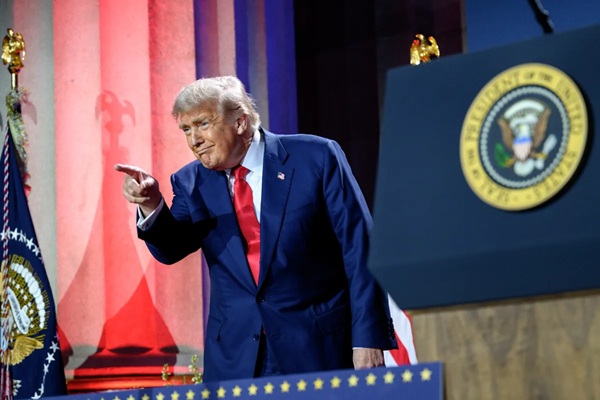
The US imperial presidency has been rendered a shade less imperious, after the Supreme Court struck down some of President Donald Trump’s tariffs. That is welcome. The ruling has introduced an added element of uncertainty about the sanctity of other Presidential measures, prospective as well as those already carried out. Whether the tariffs that Trump would now introduce under different statutes would survive judicial scrutiny remains unknown. Such uncertainty would slow down investment in sectors other than Artificial Intelligence, and is not good for the US economy. And since the US is, at about 26%, the biggest chunk of the global economy, that uncertainty is bad for the world economy as well, notwithstanding that collective sigh of relief we hear whooshing from tariff-burdened nations big and small.
The US Supreme Court has struck down some tariffs, not all, only those President Trump had declared under a statute known as the International Emergency Economic Powers Act. These cover the so-called reciprocal tariffs he had announced, including the 18% tariffs on India. There are multiple other legal provisions under which tariffs can be brought back, and Trump has already announced that 10% tariffs will cover all imports.
After insulting the US Supreme Court, especially the two Justices whom he had nominated but voted against his tariffs, President Trump said, in his reaction to the Supreme Court order, that foreigners are dancing in the streets at the news. “They won’t dance for long,” he declared. If anyone in India has been tempted to rustle up dhols, dholaks and daflis for an energetic round of Bhangra, after hearing news of the US Supreme Court action, they would be well-advised to sit back and reach for some thandai.
There are alternative laws under which a determined US President would be able to levy punitive tariffs on countries he sees as hurting US interests. Section 122 of the Trade Act of 1974, meant to maintain stable balance of payments, Section 232 of the Trade Expansion Act of 1962, which allows tariffs to be levied on national security grounds, Section 301 of the Trade Act of 1974, which allows tariffs to retaliate against unfair trade practices, and the rarely used Section 338 of the Tariff Act of 1930, to counter discriminatory practices.
Some of these laws call for detailed, formal investigations and determinations, some call for Congressional ratification. Tariffs declared under any statute might still fall foul of the Supreme Court’s standard of legitimacy.
The tariffs levied on copper and steel remain intact, so do the tariffs on China levied after detailed investigations. The tariffs on automobiles and parts also fall outside the ambit of the International Economic Emergency Powers Act, and so remain unaffected by the Supreme Court ruling.
The Supreme Court has ruled invalid only the tariffs, but not the tax cuts that Trump has given effect to by means of the One Big Beautiful Bill. Once the tariffs that have been levied have been ruled illegal, the next logical step is for companies that have paid the tariff to demand refunds. If the US exchequer is forced to give up a large portion of the revenues collected under the tariffs that have now been struck down, that would widen the fiscal deficit, necessitate additional borrowing, and push up yields, adding one more layer to the risk Trump’s first year of policy adventures has brought to the US economy.
Did India make a big mistake by finalising its trade deal with the US, instead of waiting for the US Supreme Court’s verdict on the tariffs? No, it did not. India liberalised trade across the board before inking the deal with the US earlier this month, striking new deals with the UK, Oman, the European Union and New Zealand, as also giving effect to the trade deal struck in 2024 with the European Free Trade Association of non-EU European nations, namely, Iceland, Liechtenstein, Norway and Switzerland.
It is not feasible for India to say that what is sauce for the Norwegian goose cannot be sauce for the American gander, without being accused of discrimination between nations and genders. It is welcome that India’s protectionist trade regime has been liberalised. While Indian big business might chafe and complain about being bullied by American pressure, micro, small and medium enterprises stand to gain — after all, this sector bears the brunt of the protection offered by the government to Big Business that produces MSME’s inputs. By being forced to become more competitive, thanks to greater competition from the rest of the world, even India’s Big Business would gain from such liberalisation.
Some argue that India should claw back some of the protection it had given up under duress from the American tariffs. This is like arguing that someone who used to weigh 120 kg and shed 20 kg on account of a provisional diagnosis of Type 2 Diabetes should put back those 20 kg, once the provisional diagnosis turns out to have been wrong. No, Sir, the right course of action is to shed another 20 kg, and be ready to take on the world.
More From BasisPoint