.png)


September 12, 2026 at 10:30 AM IST
A perfect storm of events is building up, pushing up yields and prices, and reducing the Reserve Bank of India’s ability to hold rates in the October MPC meeting. The main drivers are crude prices and US interest rates. The price of Brent Crude, which has been rising since the onset of the West Asia crisis, has crossed $100/bbl. Any level above $80-90 spells trouble for India, because we import almost all our crude requirements.
Higher crude prices push up the current account deficit, weaken the exchange rate, and eventually pass through to higher domestic prices. US interest rates impact the balance of payments from the capital account side: when US yields go up, foreign capital is likely to be pulled into US assets rather than to riskier emerging markets. US Treasury yields are rising across maturities.
The 10-year yield is close to the psychologically important level of 5%, despite the announcement of a $6 billion bond buyback plan. Market expectations of a Fed rate hike have gone up significantly after the August CPI inflation number for the US came in at 3.4%, and oil prices showed no sign of easing.
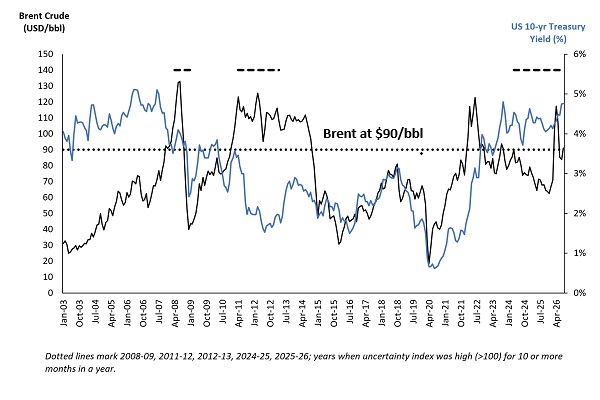
Rising crude prices have coincided with rising US rates only twice before in the past two decades. The first episode occurred between 2004 and 2006, when the US Fed raised rates to manage inflationary pressures from rising crude prices, and to curb the boom in housing and credit markets.
However, by the time crude soared above $80/bbl at the end of 2007, the subprime housing crisis had broken out, and US yields were on the way down. The second episode occurred during 2022 and 2023; once again triggered by rate hikes to combat inflation resulting from supply chain disruptions, the post-pandemic demand surge, and the Ukraine war.
This time crude breached $100/bbl early on, but US yields stayed relatively subdued throughout. During each of these episodes, the RBI also adopted a policy of monetary tightening. That’s not surprising, because domestic economic variables are significantly impacted by external factors such as crude prices and US interest rates. Will the same pattern be repeated this time? That’s hard to say, but it certainly makes the case for a rate hike stronger.
Two other factors are likely to play an important part in the rate decision. First, major central banks are raising rates: the European Central Bank (ECB) hiked rates for the second time last week, and the Bank of Japan is expected to follow suit.
Some emerging economies--Indonesia, South Korea, and the Philippines--are well into a rate hike cycle. Even where official tightening has not started, growing investor unease with high public debt and soaring energy prices has pushed up market yields. Consider India: despite the markets being awash with liquidity and an official neutral policy stance, the 10-year government bond yield has crossed 7%, as markets factor in the impact of oil prices and US yields.
Second, economic uncertainty is high and persistent across various fronts. The US-India trade deal is yet to be finalised; meanwhile, US tariff rates are subject to unpredictable revisions. Crude prices remain elevated but react to any sign of a thaw in the conflict.
The new Fed Chairman has done away with forward guidance; it is unclear whether he will keep rates down (as expected by President Trump) or raise rates to manage inflation (which has been above the 2% target for more than five years). The impact of AI on employment and growth is a whole new area of uncertainty. Geopolitical uncertainty is reflected in shifting geoeconomic alliances and rising protectionism.
Using the Economic Policy Uncertainty index, it is possible to compare the prevailing level of uncertainty with earlier years. Data shows that the index rises and stays above 100 during periods of high uncertainty. Since April 2024, the index has been well above 100 for all but two months.
Mapping high uncertainty periods to oil and US rates shows that high uncertainty has coincided with high oil prices and high US rates for the first time since 2003! Investors do not have control over oil or yields; however, they can and will demand a premium for uncertainty. This means that borrowers, including the government, have to pay higher rates on debt.
Right now, Indian bond markets are relatively calm and flush with liquidity, and official inflation is within tolerance limits. That explains why the RBI is expected to tighten rates only by the end of the year. However, with oil, global rates and uncertainty all soaring, the RBI’s room to hold rates is narrowing.
More From BasisPoint