.png)

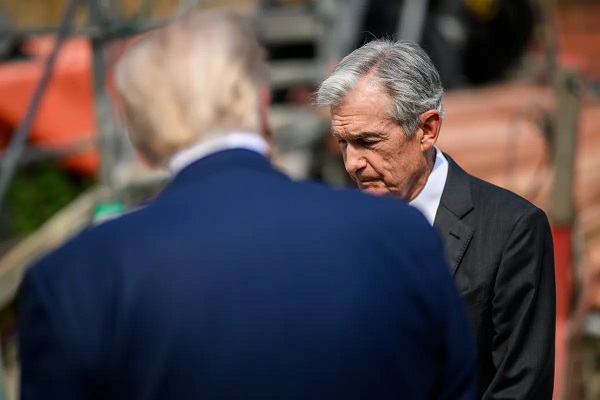

After a year of rising tension, the relationship between US President Donald Trump’s administration and the Federal Reserve seems to have reached a breaking point. In the coming months, something will have to give. And the rest of the world should pay attention: what happens in the United States may not stay there.
The feud began during Trump’s first presidency, shortly after he appointed Jerome Powell to be Fed Chair in 2017. But it has escalated sharply since Trump’s return to the White House, with the president mixing criticism of the Fed’s interest-rate policy with personal attacks against Powell. Now, the conflict seems to have entered a scorched-earth phase.
First, the Department of Justice served the Fed with subpoenas, raising the specter of an unprecedented criminal indictment of a sitting Fed chair. The response from Powell, who had so far avoided publicly addressing Trump’s attacks, was equally extraordinary. In a video message, he framed the DOJ investigation as a transparent attempt to subvert the central bank’s independence. “This is about whether the Fed will be able to continue to set interest rates based on evidence and economic conditions,” he stated, or whether “monetary policy will be directed by political pressure or intimidation.”
The spotlight into which the Fed has now been thrust is as intense as it is uncomfortable. Domestically, a bipartisan group of former policymakers – including former Fed Chairs Ben Bernanke, Alan Greenspan, and Janet Yellen – were quick to sound the alarm, releasing a statement arguing that such “prosecutorial attacks” have “no place” in a country “whose greatest strength is the rule of law.” An attack on central-bank independence, they warned, is an attack on a pillar of economic well-being.
Beyond the US, a group of leading central-bank governors – including the heads of the Bank of Canada, the Bank of England, and the European Central Bank – also put out a joint statement affirming that they “stand in full solidarity” with the Fed and Powell. It was a remarkable move, which defied the long-standing norm about non-interference with the domestic affairs of other countries. In the case of New Zealand, this triggered a rebuke by the government, with the foreign minister urging the central-bank governor to “stay in her lane.”
Some US legislators have signaled that they will block the approval of any new nominees to the Fed board – including a successor to Powell, whose term as chair ends in May – until the current hostilities are resolved. This gridlock threatens to disrupt the central bank’s operations. It also risks creating a “fortress Fed,” where officials may feel compelled to run policy in a manner that explicitly resists political pressure, potentially oversteering in the opposite direction.
When Powell’s successor does take over, many fear that “political flexibility” will take precedence over a technocratic commitment to price stability. This conjures a grim future of unanchored inflation expectations, macroeconomic instability, and heightened financial volatility. It brings to mind a phrase often heard during my years at the International Monetary Fund: “Macroeconomic stability isn’t everything, but without it, you have very little.”
International spillovers would be likely. The US has an outsize impact on the global economy because it issues the world’s dominant reserve currency and hosts its deepest financial markets; it also has important demonstration effects. The risks are particularly acute when it comes to central-bank independence, which, despite being crucial to economic well-being, is inherently fragile, owing to the “democratic deficit” associated with granting significant powers to unelected officials.
Fortunately, internal and external checks and balances exist to prevent worse outcomes in the US (which helps explain why markets have remained relatively calm). For starters, there is the structure of the policy-setting Federal Open Market Committee. While the chair is undoubtedly “first among equals,” FOMC members vote as individuals. This limits the extent to which the chair could bend the collective will toward political ends.
Moreover, the scars from the Great Inflation of the 1970s, which gave rise to the “misery index” (the sum of unemployment and inflation), run deep. Reining in inflation and re-anchoring inflationary expectations was an extremely painful process, which remains seared into the collective memory of Americans, not least central bankers.
It helps that markets today can be both responsive and impactful, as the United Kingdom found out during Liz Truss’s volatile 49 days as prime minister in 2022. Governments and central banks must reckon with “bond-market vigilantes,” who can effectively walk away from what they perceive as reckless policy.
Even if the feud between the Trump administration and the Fed does not turn out to be catastrophic, the challenge is to transform it into something constructive. Politicians, economists, and market participants should take this opportunity to reaffirm the critical importance of a Fed that is not only independent, but also pursues operational reforms, is held accountable for its performance, and embraces a more strategic policy approach.
The first step, however, must be to offer an “off-ramp” for both Trump and Powell. Given the bargaining chips that each holds, de-escalation appears entirely feasible.