.png)

Greenland’s Lesson for India: US Trade Deals Don’t Guarantee Protection
In a volatile global order, restraint, diversification and sovereign decision-making matter more than promises that can be withdrawn overnight.

Ajay Srivastava, founder of Global Trade Research Initiative, is an ex-Indian Trade Service officer with expertise in WTO and FTA negotiations.
January 18, 2026 at 6:00 AM IST
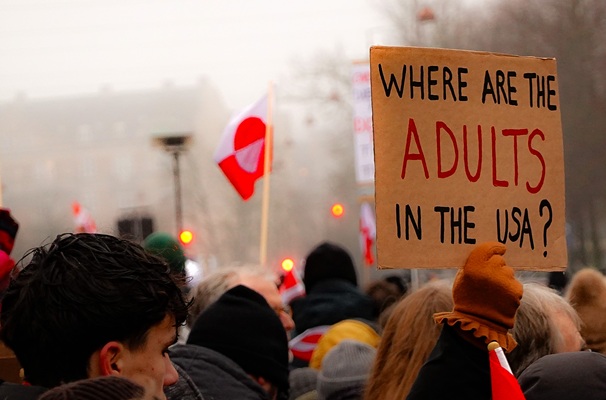
On January 17, 2026, President Donald Trump announced a 10% tariff on imports from Denmark, Norway, Sweden, France, Germany, the United Kingdom, the Netherlands and Finland, explicitly tying the tariffs to Greenland after these countries backed Denmark’s refusal to allow any US capture of Greenland.
The US tariff will take effect on February 1 and rise to 25% on June 1 and will continue until the US secures what Trump called the “complete and total purchase of Greenland,”.
The Greenland episode, immediately after the US capturing Venezuelan Oil fields and effecting regime change, reinforces a pattern in which Washington uses tariffs and sanctions as instruments of economic coercion to seize other country resources violating all international norms.
For Europe, the message is unmistakable: even recent trade deal offer no protection from new US tariffs.
The Greenland episode has accelerated a broader reassessment of dependence on Washington.
- Canada, a member of the Five Eyes intelligence alliance—America’s closest security partnership—was earlier hit with 35% U.S. tariffs, told the USMCA was “irrelevant,” and subjected to annexation rhetoric as America’s “51st state.” Ottawa responded by diversifying ties, signing eight agreements with China and seeing Beijing replace Washington as the largest buyer of Canadian crude.
- In Europe, trust has eroded sharply, with surveys showing 76% of Germans now view the US as unreliable, the lowest level on record.
- Australia has reset relations with China after trade retaliation hit wine, barley and coal exports, while Britain’s new government is planning a China visit. The pattern is clear: countries are hedging against U.S. policy volatility, not relying on trade agreements for protection.
For India, the implications are immediate. Under sustained US pressure, New Delhi has already taken costly steps—withdrawing from a BRICS naval exercise involving Russia, China, Iran and South Africa; stepping back from the Chabahar Port after decades of investment; and halting oil purchases from Iran and Venezuela while sharply cutting imports from Russia. Yet despite these concessions, US pressure on India remains relentless in trade negotiations and public forums.
The Greenland episode offers a clear lesson to India: trade deals with the US are not a shield against coercion. Tariffs and sanctions can be reimposed regardless of agreements. India should therefore avoid making unilateral concessions to US—on energy sourcing, regional projects, technology platforms, or strategic alignments—in the expectation that a trade deal will buy stability.
Iran offers a clear warning. While Starlink was active in Iran, videos of protests against the regime spread widely; once authorities jammed the satellites and tightened controls, the information flow reversed. Satellite networks bypass national controls, leaving governments struggling. As India considers allowing Starlink, it should factor in these strategic risks.
With limited room to pivot toward China due to border tensions, a $115-billion trade deficit, and Beijing’s support for Pakistan, India’s safest course is principled neutrality: diversify partners, ring-fence sovereign decision-making, insist on reciprocity, and retain leverage across energy, technology, and regional connectivity.
The core takeaway is restraint—do not trade strategic autonomy for promises that recent history shows can be withdrawn overnight.
More From BasisPoint