.png)

Gurumurthy, ex-central banker and a Wharton alum, managed the rupee and forex reserves, government debt and played a key role in drafting India's Financial Stability Reports.
June 28, 2026 at 12:47 PM IST
South Korea has long been an unlikely trendsetter. It exported K-pop before the world knew it wanted synchronised choreography. It made K-dramas a global addiction, transformed kimchi, bibimbap, and Korean barbecue into international cuisine, and persuaded millions that a ten-step skincare routine was perfectly rational.
Its latest export may be even more revealing: dopamine.
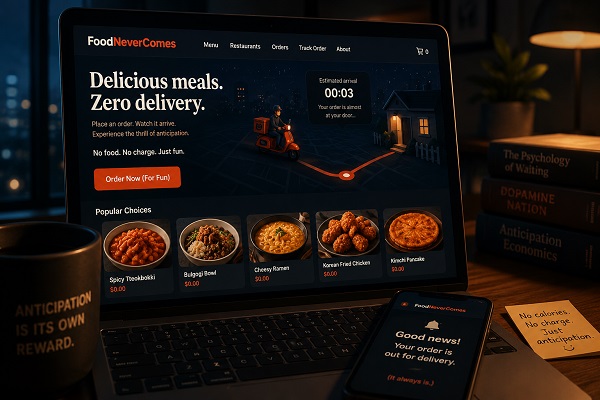
Among the newest digital curiosities is FoodNeverComes.com, a website where users browse menus, customise meals, place an order and even watch an imaginary delivery rider inch towards their home, only for the food never to arrive. No money changes hands, no calories are consumed, and the reward lies entirely in anticipation.
The craving is acknowledged, indulged and then quietly dissolved.
At first glance, this appears to be another symptom of humanity’s descent into digital absurdity. We progressed from eating food to photographing it, from photographing it to watching strangers eat it online, and now to ordering food that never exists. But perhaps the joke is on us.
Modern cravings are increasingly psychological rather than physical.
Midnight food deliveries, impulse purchases and endless online browsing often have less to do with hunger or necessity than with anxiety, boredom or loneliness. The act of choosing, waiting and expecting provides its own neurological reward. If a simulated purchase satisfies that urge without adding inches to the waistline or holes to the wallet, perhaps it is less madness than therapy.
This raises an uncomfortable question. Have we become consumers of products, or consumers of anticipation? The answer may extend far beyond food.
Financial markets have been practising dopamine economics for years. Every central bank policy announcement is preceded by weeks of speculation, followed by armies of economists parsing every adjective, comma and pause in the governor’s statement. One analyst discovers a hawkish nuance, another uncovers a dovish undertone, while television panels manufacture certainty out of ambiguity. Markets rise, fall and recover before anything in the real economy has actually changed.
Like FoodNeverComes.com, the excitement lies less in the policy itself than in the anticipation and interpretation. Sometimes the announcement changes little; the dopamine certainly does not.
The same phenomenon increasingly shapes geopolitics. One wonders whether Korea’s next innovation should be WarNeverHappens.com.
When Anticipation Goes to War
It sounds ridiculous, yet modern video games already provide much of this experience. Perhaps political leaders and armchair warriors merely require a more sophisticated version.
Viewed together, these phenomena reveal something profound about contemporary society. The object itself matters less than the anticipation surrounding it. The meal, the purchase, the monetary policy, even the war: all are increasingly secondary. What we truly consume is expectation.
That should worry us. Markets begin reacting to interpretations instead of fundamentals. Consumers chase emotional satisfaction rather than utility. Purists may object that satisfying one’s inner self is a kind of utility, but political discourse rewards outrage over outcomes, and the economy itself risks becoming one vast marketplace of simulated experiences and manufactured anticipation.
South Korea’s dopamine websites may therefore be more than clever digital novelties. They are diagnostic tools, exposing the psychology of an age in which expectations have become commodities.
The irony is delicious. Economists have spent decades studying inflation, productivity and consumption. Behavioural scientists have studied incentives and biases. Yet perhaps the defining economic resource of the twenty-first century is neither money nor data, but anticipation.
And if the next great export is not a product but a carefully engineered feeling of expectation, then FoodNeverComes may be remembered not as an internet curiosity but as an unexpectedly accurate metaphor for modern life. We no longer consume things; we consume dopamine.
More From BasisPoint