.png)

Phynix is a seasoned journalist who revels in playful, unconventional narration, blending quirky storytelling with measured, precise editing. Her work embodies a dual mastery of creative flair and steadfast rigor.
June 22, 2026 at 3:48 AM IST
Dear Insighter,
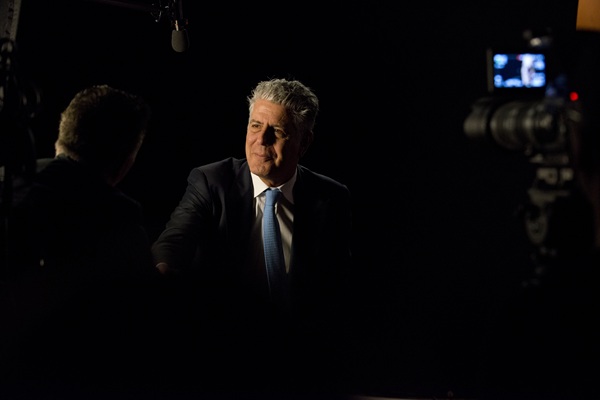
There's a line in Kitchen Confidential where Anthony Bourdain admits he became a cook because he wanted "adventure, good story, and a vicarious thrill". Not skill. Not technique. He never claimed to be the best chef in the room. In fact, he often described himself as fairly ordinary at the craft itself. But his real gift was something rarer, that of paying attention.
Just a man who had spent twenty-eight years in professional kitchens, who had graduated from the Culinary Institute of America, who had run the kitchen at Brasserie Les Halles in Manhattan for years—and who knew exactly where he stood. He was, as he put it, the chef you bring in after the chef you hired turned out to be “a psychopath, or a mean, megalomaniacal drunk.”
I’ve been reading Kitchen Confidential and watching Parts Unknown in fragments, the way you consume something you don’t want to finish too quickly. And I keep coming back to the same question: what makes someone like Bourdain so magnetic? He wasn’t the best cook as per his own admission. He wasn’t the most polished television host. He had flaws large enough to drive a truck through—addiction, a taste for the edge, a darkness that eventually swallowed him. And yet, the world couldn’t get enough of him.
Long before algorithms decided what we should watch, Bourdain built a global audience simply by showing up. He walked into kitchens, sat at strangers' tables and asked questions. What are you eating? Why? What does it tell me about where I am?
Almost a decade ago, we found ourselves at Banh Mi 25 in Hanoi, one of Bourdain's favourite banh mi spots. We expected the sort of place whose fame had inflated both expectations and prices. Instead, it was exactly what Bourdain loved. Fresh bread, herbs bursting with flavour, simple ingredients handled with care and a bill so small we checked it twice because we thought something had been left out.
No performance or pretense. No attempt to convince you that what you were eating was important. Just raw, fresh, humble food that somehow managed to feed more than hunger.
That was Bourdain's genius. He understood that the most interesting stories were rarely found in the fanciest dining rooms. They were found wherever curiosity led you. We could use a little of that mindset right now.
Take the Reserve Bank of India. As Kalyan Ram observes, the June MPC minutes read less like the proceedings of an inflation-targeting central bank and more like a committee determined to insure growth against future risks. Ram Singh openly argues that growth deserves policy support provided inflation risks remain manageable. Deputy Governor Poonam Gupta carefully lays out scenarios in which geopolitical shocks may hurt growth more than inflation, while Governor Sanjay Malhotra appears notably more sceptical of inflation forecasts than of growth projections.
Questions of openness and confidence also run through R. Gurumurthy's argument on rupee internationalisation. India wants the rupee to become a global currency, yet remains hesitant about allowing it to circulate freely beyond its borders. As Gurumurthy notes, no currency has achieved international relevance while remaining confined to its home market.
That tension between aspiration and reality appears throughout this week's monetary discussions. Former Deputy Governor Michael Debabrata Patra traces how monetary frameworks evolve, often resisting change until existing models stop delivering results. Sameer Narang reminds us that today's rupee depreciation, while persistent, remains mild compared with previous episodes, particularly the 2013 currency shock. Markets may feel uneasy, but history suggests perspective is warranted.
Jayanth R. Varma offers a deeper diagnosis. India's challenge, he argues, is not simply currency management but decades of current account distortions created by capital inflows, remittances and services exports. The result resembles a form of Dutch disease, where success in some sectors gradually weakens competitiveness elsewhere.
Meanwhile, V. Thiagarajan examines the RBI's FCNR swap window, highlighting how today's Basel III environment differs substantially from 2013. Policymakers may seek similar outcomes, but the constraints facing banks have changed considerably.
K. Srinivasa Rao highlights the widening gap between credit growth and deposit growth, forcing banks to rely increasingly on wholesale funding instruments such as certificates of deposit. The challenge is no longer merely growth but ensuring that growth remains sustainably funded.
Venkatakrishnan Srinivasan observes that corporate India has become opportunistic rather than defensive. Companies are taking advantage of lower yields to lock in funding before conditions change. They are borrowing not because they must, but because they can.
Gaura Sen Gupta points to another structural shift as India prepares to replace the Wholesale Price Index with a Producer Price Index. Bringing services into inflation measurement may appear technical, but it reflects a larger effort to align economic statistics with the realities of a modern economy.
Vivek Kaul offers an uncomfortable observation. India's retail investing boom, fuelled by SIP inflows, may also be facilitating exits by foreign investors and promoters at elevated valuations. The equity story remains strong, but Kaul reminds us that capital flows have two sides. Every buyer needs a seller.
That challenge lies at the heart of Anupam Sonal's examination of Basel III. The regulations have undoubtedly made individual institutions safer. Yet as banking becomes increasingly dependent on technology, cloud infrastructure and interconnected platforms, new vulnerabilities emerge outside traditional regulatory frameworks.
Governance remains equally important. Gurumurthy's another piece questions whether formal separation of chairman and chief executive roles is meaningful if boards lack the independence and courage to challenge management when necessary.
Krishnadevan V takes aim at another governance spectacle: the long awaited NSE IPO. After years of secondary market transactions and unrestricted ISIN transfers, public ownership already exists on a substantial scale. The listing increasingly resembles the final act of a drama whose key developments occurred long ago.
Abheek Barua looks overseas for lessons, analysing Indonesia's Danantara sovereign fund and its efforts to unlock greater value from state assets. The message resonates in India, where vast public sector holdings often remain underutilised.
Closer to home, Sujit Kumar identifies encouraging signs in India's state bond market. Investors are beginning to distinguish between stronger and weaker fiscal positions, rewarding discipline and penalising excess borrowing. Market pricing, however imperfect, is starting to matter.
If there is one sector where reality is catching up with narrative, it is industry.
Chandrika Soyantar charts the evolution of India's cement sector from a scale-driven business to one increasingly shaped by logistics, energy efficiency and carbon considerations. The industry's next winners may not be the largest producers but the smartest operators.
Rakesh Khar delivers a similar message about India's startup ecosystem. The country now boasts more than 130 unicorns, but the next decade will be defined less by valuations and more by profitability, resilience and cash generation. Building enduring businesses is harder than attracting funding.
Krishnadevan V's analysis of Sarvam AI captures the dilemma facing India's artificial intelligence ambitions. The company's $234 million funding round is impressive by domestic standards but modest compared with global AI leaders. The question is whether India can compensate for capital scarcity through efficiency, ingenuity and focus.
His second piece explores another evolving industry: diagnostics. Companies such as Dr Lal PathLabs and Metropolis are moving beyond illness and increasingly targeting wellness, prevention and long term customer engagement. The industry's future customer may be someone who isn't sick at all.
Sharmila Kantha examines India's push towards district level GDP statistics, an effort that promises to reveal economic realities hidden by state and national averages. Growth often looks very different when viewed up close.
Khar also captures a more constructive phase of Indian federalism. With chief ministers engaging more actively with the Centre and states participating more fully in national policy discussions, cooperation appears to be replacing confrontation in some important areas.
G. Chandrashekhar provides a reminder that economics still begins with weather. The delayed and uneven monsoon poses risks for kharif output and food inflation. Even the most sophisticated models remain vulnerable to rainfall patterns.
Amitrajeet Batabyal revisits the Green Revolution and finds surprising evidence that both very small and very large farms often outperform those caught in the middle. Sagari Gupta closes the industrial policy discussion by asking an important question about India's PLI programmes: how do firms exit? Entry conditions are well defined. Graduation remains far less clear. Successful industrial policy should eventually make itself unnecessary.
Across the Pacific, another institution is rediscovering the value of uncertainty. The BasisPoint Groupthink team analyses Kevin Warsh's early tenure as Federal Reserve Chair, arguing that his most significant contribution may be restoring genuine two way risk to monetary policy expectations. V. Thiagarajan expands on that theme, examining efforts to reduce reliance on dot plots, forward guidance and oversized balance sheets. The shift signals a return towards judgement rather than mechanical signalling.
The geopolitical landscape is evolving just as quickly.
Rajesh Ramachandran argues that the emerging US-Iran understanding reshapes regional dynamics in West Asia, alters Israel's position and creates new opportunities for India. Equally significant is his warning that India's foreign policy choices should be guided by strategic interests rather than domestic political narratives.
It is an argument Bourdain would likely have appreciated. Throughout his travels, he resisted simplistic categories. Countries were never merely allies or adversaries. They were places filled with people trying to live ordinary lives.
Markets, investors, policymakers all want certainty. Yet almost every article in this week's edition argues for something else.
Bourdain understood that the best meal might come from a tiny stall you almost walked past. The best conversation might happen with someone whose language you barely speak. The most important lesson might arrive from a place you never planned to visit.
Until next week, stay curious, and never trust anyone who claims to have all the answers.
Also Read:
Not Every Oil Shock or Sharp Currency Move is 1991 by BasisPoint Groupthink: The real risk isn't an imminent crisis—it's the slow erosion of resilience if we keep mistaking analogies for analysis.
How Tariff Policies Are Undermining Value-Added Manufacturing by Ajay Srivastava: India's aluminium tariffs protect the few at the expense of the many, raising costs for everyone from EV makers to construction firms.
When Vedanta Meets Wall Street's Trillion-Dollar Valuations by R. Gurumurthy: If spreadsheets can't explain Nvidia's valuation, perhaps ancient Indian philosophy can—price isn't value, and never was.
Telegram Ban: No Neat Answer To A NEET Failure by Srinath Sridharan: Blaming the messenger platform for examination leaks is like blaming the telephone for bad news—it misses the point entirely.
When Strategic Partnership Becomes Strategic Dependence by Anand Venkatanarayanan: India's room for manoeuvre may be narrower than it assumes, trapped between Washington's transactional instincts and Beijing's rising influence.
When the Strongest Move Is Not to Move by Sparsh Chhabra: In a world addicted to action, the hardest thing a central banker can do is nothing at all.
Trump's Iran Deal: This Is What Cutting Losses Looks Like by BasisPoint Groupthink: The agreement isn't victory or surrender—it's Washington admitting that even the most powerful empire sometimes needs to know when to fold.
Netanyahu Wanted This War; He's Getting Trump's Peace by Bobby Ghosh: The Israeli prime minister wanted to remake the Middle East; instead, he's watching his career get remade without him.
Sarci-Sense: The Bucket Problem Nobody Talks About by Srinath Sridharan: The humble bucket in India's bathrooms reveals more about our attitudes toward dignity and maintenance than any policy document ever could.
A Bit(e) of Nostalgia by Kalyani Srinath: Chocolate in 1980s India wasn't just food—it was a story, a journey, and a currency of love that money couldn't buy.
Portugal Were Held by a Failure of Service, Not Their Captain by Aarav Aher: Portugal's draw wasn't Ronaldo's failure—it was a failure of service, and the real story is being buried under the weight of his famous name.
The Fed Has Been Honest and Stupid by Todd G. Buchholz: The Fed's blunders aren't conspiracies—they're the inevitable result of outdated maps, lagging indicators, and politicians who keep lighting fires.
The US-Iran Agreement Is a First Step by Mohamed A. El-Erian: The markets have calmed, but the real test is whether a memorandum can survive the political and economic earthquakes still to come.
More From BasisPoint