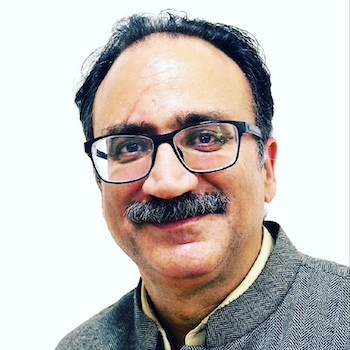
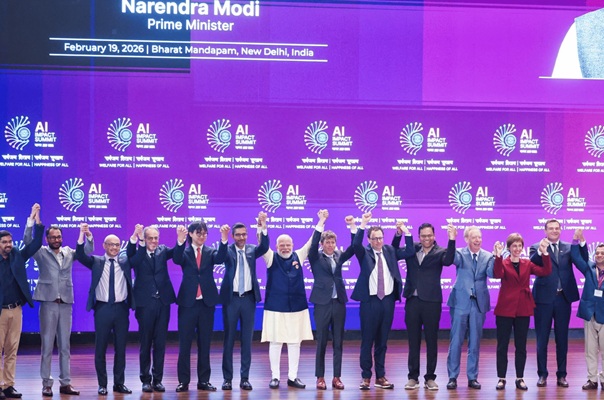
"I had seen him in films and on television, but meeting him in person, I was deeply impressed by the Tamil Nadu Chief Minister when he said, if I'm quoting him right, that Tamil Nadu wants to grow to a $1.5 trillion economy by 2035,” said Ashok Lahiri, recently appointed Vice Chairman of Niti Aayog, at the end of the 11th Governing Council meeting chaired by Prime Minister Narendra Modi.
This is a significant endorsement from India's top policy think tank, highlighting Tamil Nadu's ambitious aspirations under C Joseph Vijay's leadership.
Vijay has just come to rule the industrialised state, and is setting a new political template. His presence at the Niti Aayog meeting shows he means business, and is willing to transact with the Centre, as is evident from his one-on-one interaction with the Prime Minister the same day. This marks a departure from the recent stand-off witnessed betweeen the earlier DMK government and the centre.
Incidentally, for the first time in years, every Chief Minister attended the recent Niti Aayog meeting. This signals a new phase in the competitive federal play. A pivot from public conflict for political grandstanding to hard-nosed economic bargaining between the Centre and the states at one level, and among states themselves. The return to institutional dialogue augurs well for the India growth story while reinforcing Niti Aayog’s role in not playing favourites on political lines.
During the last few years, meetings of the Governing Council—a forum intended to foster the spirit of Team India—faced severe headwinds as several opposition Chief Ministers stayed away, accusing the Centre of favouring NDA-ruled states in policy decisions, fiscal transfers, and the allocation of major projects.
The presence of opposition leaders like Karnataka's D K Shivakumar, Kerala's V D Satheesan, Tamil Nadu's Vijay, and Telangana's Revanth Reddy shows that opposition-ruled states have understood that boycotting the apex policy body might not draw economic returns, thoughit might help make some political noise. The new look Niti Aayog would have imagined that the absence of top opposition leaders only dimmed its overall authority. The spate of one-on-one meetings with the Prime Minister has set a positive context, but both have to walk the talk.
India needs strong states, irrespective of the colour of the ruling alliance, and a strong centre. Viksit Bharat demands that the double-engine model function as a development framework, not merely as a BJP electoral narrative. Luckily, we have political consensus on building a developed India when it turns 100 as an independent nation.
The road map may differ, but the end goal is universal. The Centre has to inspire confidence across states and union territories that is equally committed to their growth and not biased either way. The reconstituted Niti Aayog has ignited hope, but it is a fractious play given intense competition among states – within the NDA fold as well as in the non-NDA fold.
Southern Spice
The May 4, 2026, electoral verdict triggered a unique South India flavour to the federal story. Barring Tamil Nadu, where it supports the government, the Congress is ruling three of the most economically competitive states – Karnataka, Telangana and Kerala.
With Congress in charge of three of India’s economic heavyweights, the next test is whether investment follows competitiveness and execution, or whether the party's traditional high-command instincts end up shaping where capital is encouraged to go. The Centre can either merely play a facilitator or adjudicate on merit.
Traditionally, Karnataka, Telangana and Kerala have been at one another's throats when it comes to drawing global projects in new-age domains like semiconductors and AI. Tamil Nadu has traditionally been a safe bet for global investors and will pose a significant challenge to the southern, largely Congress, block. Competitive federalism has thus an unusual southern flavour with a political twist.
The five southern states—Tamil Nadu, Karnataka, Telangana, Kerala, and Andhra Pradesh—contribute 30% to India's national GDP. Because they carry the financial weight of the country while often expressing concerns over low returns from the central tax pool, their internal race for investments has turned hyper-competitive.
Remember how in 2024, three southern states rolled out the red carpet to Foxconn, with Karnataka, Tamil Nadu and Andhra claiming the project to be theirs. The friction reached a peak when Foxconn's top leadership, including Chairman Young Liu, engaged in simultaneous high-level correspondence and MoUs with both Telangana and Karnataka within a matter of days. Today, the global major has listed investments in each of these three states, outlining the importance of the southern block.
A broader southern political narrative led by Congress could inevitably trigger a new phase of economic bargaining. That, in turn, may strengthen India's federal framework. At another level, expecting politics to be completely subservient would be a fallacy, especially with Andhra Pradesh being under the BJP-led National Democratic Alliance.
Within the southern Congress fold, it might yet be a fierce competition for getting the world’s best to the state that best deserves it. Auto, financial services, and infra projects in the brick-and-mortar domain are observing a southern skew. Tamil Nadu has aggressively positioned itself as the "EV capital of India," successfully anchoring major plants like VinFast, Ola Electric, and Hyundai.
To counter this, Karnataka rolled out hyper-customised incentives in its aerospace and semiconductor policies to ensure Bengaluru remains the tech epicentre, while Telangana has countered with dedicated industrial parks and lightning-fast single-window clearances around Hyderabad's "Future City." Amravati is being positioned as the most developed state capital in the country.
In the tech space, it is an all-out war for supremacy. Historically, Bengaluru held a near-monopoly on global tech hubs between Hyderabad and Chennai. The two compete with the pitch of discounted land, regular power supply, and customised skilling programmes. Kerala, playing to its strengths, pitches fiercely in the niche new-age sectors—specifically AI, Life Sciences, and Space-Tech—drawing on its high Human Development Index to attract clean, knowledge-driven global investments.
NDA Inc Federal Battle
The royal investment battle has an interesting feature in the west, another developed bucket, with Maharashtra and Gujarat being the top contenders. Within the NDA block, there is a growing whisper that Gujarat gets favoured for prize projects, including the Olympic games pitch.
Maruti Suzuki's expansion from its traditional Haryana base to a new project in Gujarat is one example of this trend in the auto sector. In newer industries such as data centres, semiconductors and display fabrication, states are competing nationwide to attract investments. The contest to become India's gateway to global finance has increasingly become a battle royale between Gujarat's GIFT City and Maharashtra, the country's traditional financial powerhouse.
The proliferation of global investor summits—held not just by the usual pro-business states but even by historically sceptical ones such as West Bengal—reflects the growing pressure on states to compete for capital. The sales pitch is familiar: cheaper power, land at concessional rates, and generous tax breaks, all packaged under the banner of ease of doing business.
Let competition do its job. The best should make it to Team India, while the rest are pushed to raise their game. Lahiri and Niti Aayog have little room for sentiment: economic merit must decide the final XI.
.png)