.png)

When a Private Bank Is Almost Entirely State-Owned
A bank owned almost entirely by Bank of Baroda still carries the tag of a private sector bank. Nainital Bank reveals a regulatory paradox.

T. Bijoy Idicheriah is a senior central banking journalist and communications strategist with extensive experience analysing monetary policy, financial regulation and banking governance. He previously served as a consultant to the Reserve Bank of India.
March 13, 2026 at 3:10 AM IST
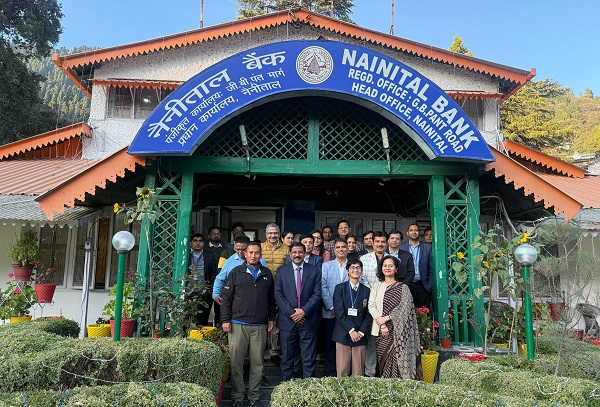
India’s banking system contains a few institutional curiosities, but few are as striking as The Nainital Bank. The institution continues to be classified as an old-generation private-sector bank, even though it is almost entirely owned by a public-sector bank.
Bank of Baroda held 98.62% of The Nainital Bank as of Dec 31, 2025, and is designated as its promoter. Bank of Baroda itself is majority-owned by the Government of India. The Nainital Bank’s balance sheet on its website notes that the Government of India's shareholding is 98.62%.
Yet the RBI categorises the institution as an old-generation private-sector bank, a label typically applied to banks that existed before the liberalisation era, when new private-sector banking licences were introduced in the 1990s.
This divergence between ownership and classification has persisted for decades.
The story goes back to 1922, when Indian leaders, including freedom fighter and later Bharat Ratna Govind Vallabh Pant, established The Nainital Bank to meet the banking needs of Indians in what was then known as the United Provinces.
The turning point came in 1973 when the RBI asked Bank of Baroda to take over the management of the bank. Over time, Bank of Baroda’s shareholding steadily increased until it became the dominant shareholder. Today, it treats Nainital Bank as a domestic subsidiary.
The regulatory label, however, remained unchanged.
There have been intermittent attempts to alter the ownership structure. Bank of Baroda has at various points explored the possibility of listing the bank or bringing in a strategic investor, partly in response to regulatory nudging.
The most recent effort came in December 2022, when Bank of Baroda invited expressions of interest from potential investors. A banking licence remains highly prized, and reports at the time suggested that several prominent investors showed interest, including Premji Invest, Mobikwik and broking firm Zerodha.
The effort did not culminate in a transaction.
In November 2025, the Bank of Baroda instead infused fresh capital into Nainital Bank to upgrade technology and operational processes. The capital infusion further increased Bank of Baroda’s shareholding.
Attempts to change the bank’s ownership structure have also encountered resistance. During the 2022–23 process, the Nainital Bank Officers’ Association approached the Delhi High Court seeking to halt any stake sale. Although the court declined to interfere, Bank of Baroda’s counsel told the court that the RBI had asked the bank either to merge Nainital Bank with itself or divest its stake.
Regulatory unease with the arrangement has surfaced before. The Committee to Review Governance of Boards of Banks in India, chaired by P J Nayak and submitted to the RBI in 2014, specifically cited Nainital Bank as one of the institutions that “defy ownership logic”.
More than a decade later, that observation still holds.
India’s banking sector has undergone significant consolidation in recent years. Several public sector banks have been merged, and the government has repeatedly indicated its willingness to rationalise ownership structures across the banking system.
Against that backdrop, Nainital Bank’s hybrid status stands out.
The issue is not merely one of classification.
Institutional ambiguity can affect governance expectations, strategic direction and regulatory oversight. Nainital Bank’s growth has also remained modest compared with several other old- and new-generation private banks, despite its more than century-long history.
At some point, the status quo may become increasingly difficult to justify.
If the intention is for Nainital Bank to operate as a genuine private-sector institution, Bank of Baroda may have to proceed with divestment and identify investors who meet the Reserve Bank of India’s fit-and-proper criteria.
If, on the other hand, the bank is effectively to remain within the public sector ecosystem, then merging it with Bank of Baroda or restructuring ownership more transparently may be the more logical course.
Until such a decision is taken, the Nainital Bank will remain one of the more unusual institutions in Indian banking, a bank whose regulatory classification and ownership structure point in different directions.
Ultimately, it will fall to the RBI to decide how long that contradiction can continue.
*This article begins a new series, Unusual Banks, which explores institutions in India’s banking system that do not fit neatly into conventional categories.
More From BasisPoint