.png)


For over two decades, the United States has regarded India as a “natural partner” — a rising power whose geography, military capabilities, and democratic credentials made it indispensable to America’s strategy in the Indo-Pacific. Five successive US administrations, Republican and Democratic alike, invested heavily in strengthening that partnership, treating India not just as a market, but as a long-term strategic bet.
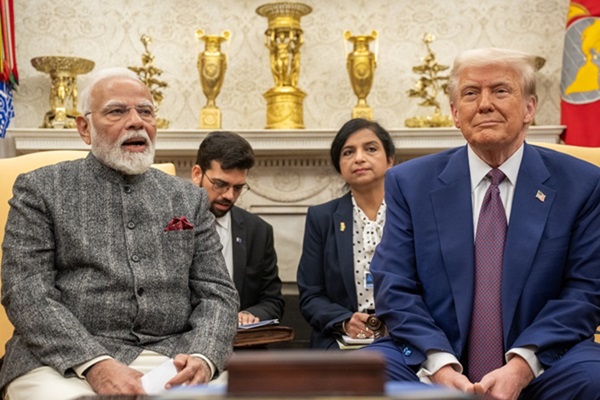
But the goodwill that the US built up with India over that period has been rapidly eroded since Donald Trump’s return to the presidency last year. Trump’s second presidency has brought repeated public insults and a bruising trade war, with the US using tariffs as tools of geopolitical coercion. The interim trade deal announced on February 2 may have halted the economic confrontation, but trust — the essential currency of any strategic partnership — is unlikely to be restored any time soon.
By reducing the effective US tariff burden on Indian goods from 50% to 18%, the newly-announced deal will deliver short-term relief for India. But it comes with plenty of strings attached, including the requirement that India move toward near-zero tariffs on US industrial products and a wide range of agricultural goods. India’s decision to open its sensitive agricultural sector – the country’s largest employer – to a flood of imports from the US is already sparking a domestic backlash.
But that is not all. India has also agreed to purchase a whopping $500 billion worth of American goods over the next five years, and to replace discounted Russian oil with US energy at market prices, which also implies additional transport costs. Meanwhile, the US offered no binding commitments to India. This lopsided bargain looks nothing like a stable, reciprocal, rules-based trade partnership, and underscores how far US trade policy has drifted from World Trade Organization norms. It is probably best understood as a tactical de-escalation, not a strategic reconciliation.
The way the deal was announced reinforces this interpretation. Typically, bilateral agreements or joint statements are announced simultaneously in both capitals to signal equal partnership. The free-trade agreement India recently concluded with the European Union, which created a trade corridor encompassing roughly 25% of global GDP and one-third of world trade, was touted by both sides as the “mother of all deals.”
The US-India agreement, by contrast, was announced first by Trump, who portrayed it on his social-media platform as a favor to Prime Minister Narendra Modi, whose “request” for an agreement Trump had granted “out of friendship and respect.” Days later, the White House released a “joint statement” outlining the terms of the agreement at 5:00 a.m. Indian Standard Time.
The Trump administration then added injury to insult, announcing a presidential executive order authorizing reimposition of punitive tariffs if the US deems India to have violated its commitment to halt all direct and indirect imports of Russian oil. By framing Indian energy imports as a US national-security issue, the administration has turned economic engagement into a compliance test. The message to India is unmistakable: autonomy will be tolerated only within US-approved limits.
India’s leaders have framed the agreement as a win, noting that India now faces lower tariffs than China or Vietnam. But this is a low bar for a relationship that successive US administrations described as “defining.” And they are probably well aware that Trump could still pull the rug out from under them. The arrangement’s details have not yet been finalized, and Trump has a long history of changing his mind, scrapping deals, and layering on new demands.
Whatever happens next, India will not quickly forget Trump’s past betrayals. Nor will it overlook his slights, such as branding India, whose GDP growth outpaces that of all other major economies, as a “dead economy” last July.
In a sense, Trump might have done India a favor. By exposing the raw transactionalism at the core of his foreign policy, he has left no doubt that, under his leadership, the US is not a reliable strategic partner. As a result, India’s government is committed to diversifying the country’s economic relationships away from the US, as underscored by its FTAs with the EU and the United Kingdom – an effort that will likely continue, regardless of the new trade agreement with the US.
Markets are similarly unlikely to put too much faith in the US. News of the trade deal did trigger a stock-market rally in India, but the gains are likely to be short-lived.
Strategic partnerships are sustained not by tariffs and threats, but by predictability, mutual respect, and restraint – qualities that have been conspicuously absent from Trump’s presidency. The US should beware. Whatever short-term concessions Trump secures through bullying and coercion will be dwarfed by the long-term costs of destabilizing a partnership that, as previous administrations recognized, is vital to American interests in the Indo-Pacific and beyond.