.png)

Risk aversion returns as Middle East tensions cloud markets despite strike pause
Here’s your quick read to start the day: a chatty, no-fuss look at overnight moves, the big story, what’s on the docket, and the tickers you need to watch.
Richard is an independent financial journalist who tracks financial markets and macroeconomic developments
March 27, 2026 at 1:50 AM IST
GLOBAL MOOD: Extreme Risk-Off
Drivers: Iran rejects US peace terms, Brent surges back to $108, Fed prices out 2026 cuts
Asia-Pacific markets moved firmly risk-off Friday after a sharp Wall Street selloff overnight, with investors unsettled by contradictory signals on a possible US-Iran truce.
President Donald Trump’s decision to delay strikes on Iran’s energy infrastructure briefly raised hopes of diplomacy, but Tehran’s denial of direct talks and rejection of US proposals kept uncertainty high. Rising oil prices above $108 and fresh warnings from Federal Reserve officials that the West Asia conflict could worsen inflation further dampened sentiment, triggering a broad shift away from risk assets across global markets.
TODAY’S WATCHLIST
- India April-September Borrowing Calendar
THE BIG STORY
Federal Reserve Governor Lisa Cook added to the growing chorus of Fed officials sounding the alarm on inflation, saying the West Asia war has shifted the balance of risks "more toward inflation" at the central bank's dual mandate. Cook described the labour market as "in balance, but precariously so", a carefully chosen phrase that suggests the Fed sees the jobs market as one shock away from deterioration. Her comments reinforce the Fed's increasingly difficult position: inflation risks are rising from energy prices while employment risks are building quietly beneath the surface. With the 2-year yield surging nearly 60 basis points in a single session and markets pricing out all Fed cuts for 2026, Cook's remarks confirm that the central bank's next move is now genuinely uncertain and the 10-day Iran pause, if it holds, may be the only near-term catalyst capable of changing that calculus.
Data Spotlight
Natural gas storage saw a 54 bcf withdrawal in the week ended March 20th, well above the 44 bcf expected draw and sharply higher than the five-year average decline of 21 bcf, reflecting elevated energy demand amid the West Asia conflict. Total stockpiles fell to 1.829 trillion cubic feet, sitting 5.2% above year-ago levels.
Kansas City Fed manufacturing activity edged up to 11 in March from 10 in February, with broad-based gains across durable and non-durable production and employment rebounding to 7 from -6, though new export orders slipped into negative territory at -4.
Takeaway:
WHAT HAPPENED OVERNIGHT
- US stocks post biggest single-day loss since January as Iran war escalation fears return
- The Nasdaq tumbled 2.38%, confirming a correction, while the S&P 500 fell 1.74% and the Dow dropped 1.01%, the worst single-day declines since January 20th.
- Nvidia led Dow losses, falling over 4%, as the AI bellwether bore the brunt of the risk-off rotation.
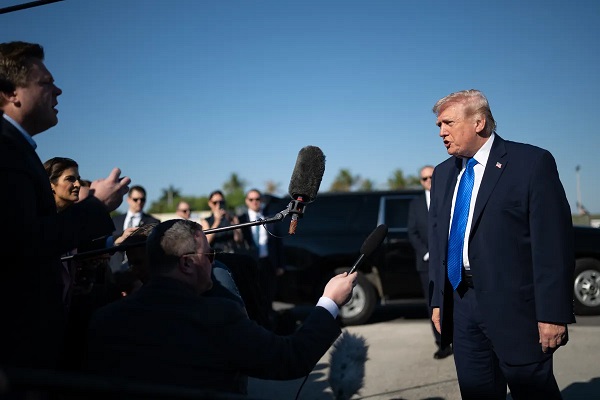
- Trump warned Iran to make a deal "or face a continued onslaught" and raised the prospect of taking control of Iranian oil, a dramatic escalation of US war aims that rattled markets.
- A senior Iranian official called the US peace proposal "one-sided and unfair" while insisting diplomacy had not ended and keeping the ceasefire window technically open but barely.
- Oil surging back above $108 directly reignited inflation fears, hitting rate-sensitive and consumer-facing sectors hardest.
- The Nasdaq tumbled 2.38%, confirming a correction, while the S&P 500 fell 1.74% and the Dow dropped 1.01%, the worst single-day declines since January 20th.
- US Treasury hits July high of 4.39% as ceasefire hopes collapse, inflation fears reassert
- The 10-year yield rose to 4.39%, the highest since July as mounting doubts over a near-term conflict resolution drove fresh inflation repricing.
- The 2-year yield surged nearly 60 basis points to 3.96%, a dramatic move that signals markets are aggressively pricing out any near-term Fed easing.
- Trump refusing to commit to a deal while Tehran shows little willingness to compromise removed the last vestiges of ceasefire optimism from bond markets.
- Surging energy prices are reinforcing expectations that the Fed will keep rates steady throughout 2026, a higher-for-longer repricing that is rapidly becoming consensus.
- Initial jobless claims edged up to 210,000 while continuing claims fell to a nearly two-year low, a stable but softening labour market that gives the Fed little cover to cut.
- The yield curve is now pricing a world where inflation wins the Fed's mandate battle over employment, a stance that carries significant recession risk if energy prices remain elevated.
- The 10-year yield rose to 4.39%, the highest since July as mounting doubts over a near-term conflict resolution drove fresh inflation repricing.
- US Dollar rose for third straight session as war doubts, inflation fears persist
- The US dollar index edged up to 99.9 for a third consecutive session of gains as ceasefire optimism continued to fade.
- Trump refusing to commit to a deal while Tehran shows little willingness to compromise reinforced the safe-haven bid for the greenback.
- Surging energy prices are strengthening expectations that the Fed will keep rates steady throughout 2026, directly supporting the dollar's yield appeal.
- The greenback was mostly higher against the euro and the Australian dollar, reflecting broad-based safe-haven demand rather than US-specific strength.
- The US dollar index edged up to 99.9 for a third consecutive session of gains as ceasefire optimism continued to fade.
- Crude oil surges 5.7% as ceasefire hopes fade and Brent reclaims $108
- Brent crude jumped $5.79 or 5.7% to $108.01/barrel while WTI gained $4.16 or 4.6% to $94.48/barrel as diplomatic optimism rapidly unwound.
- Hopes for a swift end to the war faded as the five-day negotiation window failed to produce a concrete ceasefire framework.
- Trading volume for the front-month Brent contract hit its lowest level since February 27, the day before US-Israeli strikes began suggesting thin liquidity amplified the price move.
- The low-volume surge is a warning sign that markets remain highly susceptible to headline-driven swings in either direction with little fundamental anchoring.
- With the Islamabad talks timeline still uncertain and Iran maintaining public denial of negotiations, the ceasefire premium has been largely priced back out of crude markets.
- Brent crude jumped $5.79 or 5.7% to $108.01/barrel while WTI gained $4.16 or 4.6% to $94.48/barrel as diplomatic optimism rapidly unwound.
Day’s Ledger*
Economic Data
- India Bank Credit-Deposit Data
- India FX Reserves Data
- India April-September Borrowing Callender
Corporate Actions
- Midland Polymers board to consider fund raising
- Piramal Finance board to consider fund raising
- Sundaram Finance board to consider fund raising
- Sundaram Clayton board to consider interim dividend
Policy
- US Fed Cook Speech
- US Fed Barr Speech
Tickers to Watch
- Fino Payments Bank chief Rishi Gupta granted bail in GST case
- Sunita Maheshwari reappointed independent director at HDFC Bank
- UltraTech settles dispute with Jaiprakash over Dalla Super unit and mines
- Infosys nears a leadership transition as AI rapidly rewires industry
- Thyssenkrupp, Jindal Steel sale talks falter on pension and energy costs
- Piramal Finance receives order allowing a tax loss of ₹10,110 crore
Must Read
- US proposal not enough for success, but talks still possible: Iran official
- European Parliament approves US trade deal but adds safeguard clauses
- OECD projects India's GDP to grow at 7.6% in FY26, 6.1% in FY27
- Oil rises as investors reassess West Asia ceasefire prospects
- CPI alignment and need for flexibility back 4% inflation target retention
- India’s tech spending expected to grow 13.4% in 2026; among highest in APAC: Report
- Trump says oil and stock market reaction to Iran conflict not as severe as he expected
See you tomorrow with another edition of The Morning Edge.
Have a great trading day
𝐖𝐨𝐫𝐥𝐝 𝐁𝐚𝐧𝐤’𝐬 𝐑𝐞𝐜𝐚𝐧𝐭𝐚𝐭𝐢𝐨𝐧 𝐨𝐟 𝐚 𝐃𝐨𝐠𝐦𝐚
The World Bank appears to be rethinking one of its longest-held positions. After decades of cautioning against state-led industrial policy, its recent work acknowledges that targeted intervention has historically shaped growth, innovation, and scale—from East Asia to the United States.
TK Arun writes, If industrial policy is no longer an exception but a pattern, what does that say about past prescriptions? Was the resistance ideological rather than empirical? And what should emerging economies take away from this late recantation?
(*Compiled from various media sources)
More From BasisPoint