.png)

Gurumurthy, ex-central banker and a Wharton alum, managed the rupee and forex reserves, government debt and played a key role in drafting India's Financial Stability Reports.
July 18, 2026 at 5:39 AM IST
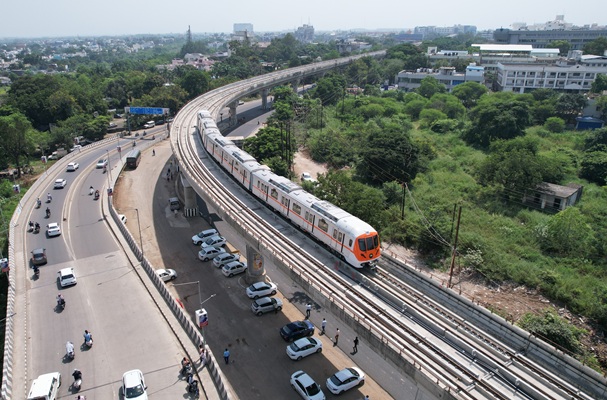
The news sounded almost surreal. The Madhya Pradesh Metro Rail Corporation recently announced that metro coaches and stations in Bhopal and Indore could be hired for birthday parties, pre-wedding shoots, weddings, fitness sessions, film shoots and cultural events. The reason was obvious. The newly-launched metro systems were struggling with low ridership, and the authorities hoped that "Celebration on Wheels" would generate non-fare revenue while introducing people to the metro. Reports said that the Bhopal Metro was carrying fewer than 200 passengers a day.
One could dismiss this as an innovative revenue model. One could even smile at the novelty.
But one shouldn't.
When a metro station has to become an event venue to attract people, the problem is not the metro. The problem is the city.
Or, more precisely, the problem is that India has become remarkably good at infrastructure planning while remaining surprisingly poor at urban planning.
The two are not the same.
Infrastructure planning asks, "Where can we build another metro?" Urban planning asks a far more fundamental question: "How should people live and move?"
That difference explains why India can simultaneously build world-class metro systems and remain home to some of the world's most frustrating urban commutes.
Every new metro line is celebrated as proof of development. Politicians inaugurate stations, newspapers publish photographs of gleaming trains and official presentations proudly count kilometres of track laid.
Yet, outside the station, the traffic jam remains exactly where it was.
Because a metro is merely one component of a city while a city is an ecosystem.

Urban planning is not about inserting a railway through an already congested landscape. It is about designing neighbourhoods where homes, workplaces, schools, markets, parks and transport are conceived as one integrated system. It is about ensuring that the first and last kilometre of every journey is as effortless as the journey itself.
In other words, urban planning is about relationships while infrastructure planning is about projects. And India has confused one for the other.
Every agency performs its own task. The metro corporation builds stations. The highways department constructs flyovers. The municipal corporation widens roads. Another department lays underground utilities and digs them up again six months later.
Each project is completed but the city never is.
The commuter experiences this fragmentation every day. A comfortable twenty-minute metro ride is often preceded by another thirty minutes navigating broken footpaths, unsafe crossings, missing feeder buses, illegal parking and chaotic traffic. The metro itself is efficient. Everything surrounding it is not.
Connectivity ends where the station begins. No marketing campaign can solve that.
Contrast this with Japan.
A railway station is not merely a transport facility. It is the heart around which an entire neighbourhood evolves. Housing, offices, schools, shopping streets, parks and public spaces naturally converge around transit. Walking is not treated as an inconvenience but as the first mode of transport.
Singapore follows the same philosophy. Long before an MRT line is built, planners decide where people will live, where buses will connect, where cycling paths will run, where commercial centres will emerge and how pedestrians will move. Housing policy, transport policy and land-use policy are inseparable.
The infrastructure is impressive. More importantly the planning behind it is almost invisible. That invisibility is precisely why it succeeds.
India celebrates the opposite.
We celebrate visible assets rather than invisible systems. We count kilometres of metro lines, expressways and flyovers as though they were measures of urban excellence. They are engineering statistics.
Even India's much-publicised greenfield townships often reveal the same mindset. Their brochures showcase wide roads, metro corridors, business districts and gleaming residential towers. But these are still collections of projects rather than coherent cities.
Residential towers rise before neighbourhood shops. Office districts emerge before schools. Bus routes arrive years later. Footpaths become parking lots. Metro stations eventually open, but residents still require cars or motorcycles simply to reach them.
Jane Jacobs (The Death and Life of Great American Cities) warned that cities are living organisms, not engineering diagrams. Christopher Alexander (A City Is Not a Tree) argued that successful cities are complex networks of overlapping human relationships rather than neatly segregated zones. Great cities emerge when planners understand how people actually live, not merely how infrastructure can be constructed.
India, however, continues to plan backwards.
Each new project attempts to repair the shortcomings of the previous one.
That is not urban planning. It is infrastructure planning chasing yesterday's mistakes.
Perhaps that is why the image of a metro hosting weddings and birthday parties should not amuse us. It should unsettle us.
A metro should never have to invent reasons for people to visit it. People should use it because life naturally flows through it.
The finest cities are not those that build the most infrastructure. They are those where infrastructure quietly disappears into the rhythm of everyday life because every element has been planned as part of a larger whole.
More From BasisPoint