.png)


Dhananjay Sinha, CEO and Co-Head of Institutional Equities at Systematix Group, has over 25 years of experience in macroeconomics, strategy, and equity research. A prolific writer, Dhananjay is known for his data-driven views on markets, sectors, and cycles.
December 16, 2025 at 10:20 AM IST
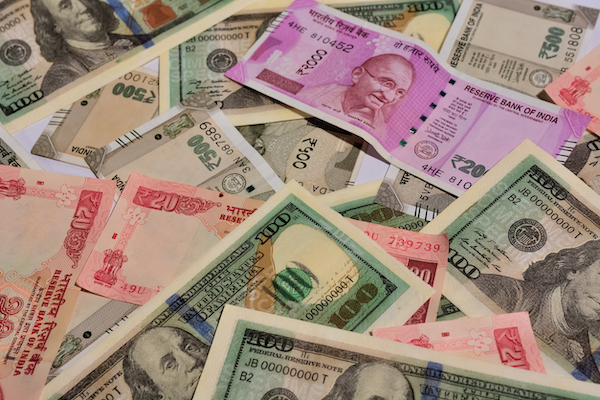
India’s economic narrative is caught in a contradiction. Headline growth remains among the fastest globally, yet the rupee continues to weaken in a seemingly orderly but persistent fashion. As of mid-December, the currency trades near 91.20 to the dollar, down about 7% this year. That move is not an aberration. It caps more than a decade of managed depreciation during which the rupee has depreciated close to 90% from levels around 48 in 2012, despite repeated and often heavy intervention by the Reserve Bank of India.
Currencies of fast-growing economies are expected to strengthen over time as productivity gains, capital inflows and expanding tradable sectors support appreciation. India’s experience has been the opposite. The divergence between growth and currency performance is no longer cyclical noise. It reflects deeper structural constraints that intervention has masked but not resolved. The arithmetic increasingly points towards a faster depreciation path, with the rupee gravitating towards 100 over the next year or two.
India formally operates a managed float, but in practice, the exchange rate has often resembled a tightly guided corridor. Since 2012, the RBI has more than doubled its foreign currency assets to roughly $560 billion, largely to smooth volatility and prevent disorderly capital outflows. Intervention intensity has steadily risen. In 2024-25, gross foreign exchange turnover crossed $760 billion, well above the level of reserves themselves. The first half of the current year saw net dollar sales exceed $44 billion, even as reserves stayed broadly flat.
For years, this strategy delivered a slow and predictable depreciation of around 4% annually. That pace is now becoming harder to sustain. Reserve coverage has stagnated near nine months of imports, while balance sheet risks have grown as reserves are increasingly deployed in longer-duration assets. Each additional dollar of defence now carries a higher opportunity cost.
The deeper puzzle is why a fast-growing economy needs such defence at all. The answer lies in the composition of growth. Since the global financial crisis, global trade has slowed sharply as protectionism has risen and supply chains have been fragmented. India’s industrial base has struggled to adapt. Manufacturing’s share of gross value added has declined steadily, merchandise exports have lost global share, and industrial production growth has halved compared with the pre-2012 period. The rupee’s long depreciation has closely tracked this erosion.
Export sensitivity to global demand has amplified the problem. Studies show that a modest slowdown in global trade leads to an outsized fall in India’s real exports, with spillovers into domestic activity. Services exports and remittances provide cushioning, but they cannot indefinitely offset weakness in goods trade, especially when domestic demand remains import-intensive.
A weaker currency has also failed to generate durable competitiveness. The real effective exchange rate has corrected sharply this year, undoing years of overvaluation. Yet India’s manufacturing structure relies heavily on imported inputs. Roughly a third of raw materials are imported, while only a small fraction of output is exported. More than half of merchandise exports come from sectors with high import dependence. In this setting, depreciation raises costs faster than volumes, diluting any export benefit and increasing inflation risks.
External balances reflect this fragility. The current account deficit has widened again despite soft domestic demand, driven by a ballooning merchandise trade gap. Past periods of apparent external improvement were less a sign of competitiveness and more a by-product of weak investment and consumption. Any cyclical stimulus quickly reopens the deficit.
Capital flows offer little relief. Net inflows as a share of GDP have collapsed over the past decade. Foreign direct investment has slowed, portfolio flows remain volatile, and equity valuations leave India looking expensive relative to peers. The cushion that once financed deficits with ease has thinned.
Against this backdrop, the rupee’s recent slide appears less like a policy choice and more like an overdue adjustment. Maintaining the earlier pace of depreciation would require ever larger interventions at rising cost. A shift towards a 6 to 7% annual depreciation looks increasingly likely, placing 100 within reach over the next 12 to 24 months.
The market implications are uncomfortable. Bond yields are biased higher as rate cuts pause, and liquidity tightens. Equity returns are likely to be uneven, with export-oriented sectors benefiting at the margin while domestic, rate-sensitive and import-dependent sectors face pressure. History suggests that sharp depreciation phases rarely spare the broader market.
The path to 100 signals the end of easy-managed stability. Without a revival in private investment, genuine productivity gains and structural reform, currency weakness will remain a symptom rather than a solution. Notwithstanding, India’s growth resilience, its currency trajectory, is telling a more sobering story.
More From BasisPoint