.png)

Kalyani Srinath, a food curator at www.sizzlingtastebuds.com, is a curious learner and a keen observer of life.
January 10, 2026 at 8:09 AM IST
It began as an unremarkable dinner-table conversation, the sort that plays out nightly in countless Indian homes, where the aroma of aloo gobi mingles with the television news murmuring from a corner. The city’s municipal elections had finally been announced after a long hiatus—rumours of delays, corruption and millions quietly pocketed hanging in the air like monsoon dust. Between mouthfuls of dal and rice, we turned to our elder child, a bright-eyed 22-year-old edging into adulthood. “Kanna, have you applied for your voter ID yet?”
Her answer was a simple “No.” Followed by an even simpler, “Not interested.”
The words hovered, lighter than the papads crumbling on her plate, yet they landed like a muted thunderclap in my mom-heart. I should have let it pass. But curiosity, as it often does, bubbled up—frothy as morning filter coffee. I began sounding out others her age. Offline, casually, over stolen exchanges at traffic signals and park benches. Online too. This wasn’t new. Major newspapers had been flagging the same drift. The verdict was uniform: a collective shrug, a weary “Why bother?”
That shrug demanded deeper thought. These weren’t disengaged innocents. They were lawyers drafting briefs in glass towers, engineers coding ambition into startups, artists sketching futures on café napkins. Were they truly shying away from the franchise? Had education and economic stability turned the polling booth into an anachronism? Or was it the pull of elsewhere—metros, migrations, foreign shores—dulling the meaning of a local vote?
Picture this: a typical college canteen in the heart of a sweltering summer, where youth politics once crackled like Diwali fireworks. It's inevitable in India, that heady mix of grassroots fervour, where debates over chai cups ignite into rallies, and friendships forge leaders amid the tangle of caste loyalties and family legacies. Back in the day, these tables buzzed with placards and chants, nepotism be damned—everyone had a cause, a banner, a megaphone. Fast-forward a decade (or two), and the same tables are lined with laptops, LinkedIn tabs and GRE prep apps. Campaign posters have given way to coding bootcamps. Something has shifted.
Performative Politics
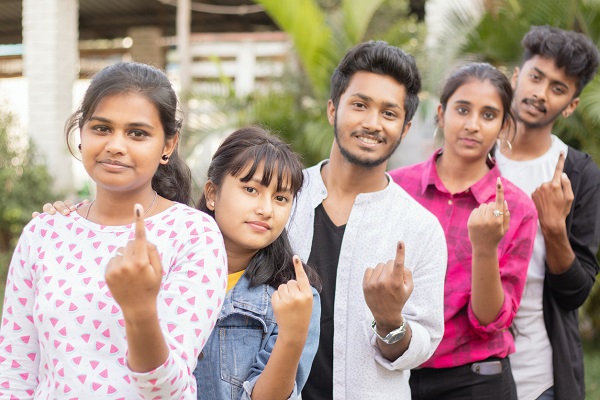
Today's youth swim in a sea of celebrity sway and citizen spotlights, where Instagram floods with inked-index-finger flexes. Does that propel them to polls? Spot a film star at a local booth, queuing like the common folk for a quick photo-op or triumphant selfie? Or is it mere social media sorcery—post-vote café crawls, ten inked hands clustered for that viral grid, hearts exploding before the high fades? It tantalises, this glamour glow: influencers beaming "I Voted!" from air-conditioned booths, racking likes faster than street-side vadas vanish. Yet, does the flash ignite real fire, or fizzle into fleeting filters? For many, it's performative polish—inked for the 'gram, not the grit. The hype hooks the scrollers, but rarely hooks the habit; glamour glitters, yet votes? They ghost.
This isn’t laziness. It is distance. Parents scrimped to fund engineering and law degrees, instalments paid from years of savings. Those children now move through globalised offices and campuses, their horizons expanding faster than a pressure cooker's whistle. Voting feels like anchoring a kite already airborne. "Why mar the city when I might not even live here next year?" quips Aarav, a law student with a startup side-hustle. Stability breeds selectivity—they pick battles worth their bandwidth.
Scratch deeper, and apathy reveals itself as disillusionment. This is a generation raised on immediacy—food in 20 minutes, payments in seconds. Elections feel slow, cumbersome: paperwork, queues under tin roofs, EVMs shadowed by conspiracy.
"We grew up watching the circus," shares Meera, a med student interning at a chaotic public hospital. "Promises of clean streets and jobs, then the same old sludge. Our college unions were fun—youth politics with its caste tango and family heirlooms—but real stakes? It chews you up."
And yet, these same young citizens volunteer at shelters, crowdfund disaster relief, march for climate causes and sign digital petitions by the thousands. They haven’t abandoned civic action; they’ve rerouted it. Yet, the system seems rigged to sideline them. Voter cards arrive late, if at all—lost in postal limbo or bureaucratic black holes. Polling stations sprout in inconvenient corners, far from urban nests. And for the diaspora-dreamers? Absentee voting is a myth, a punchline in group chats.
Education isn’t the culprit. They know the numbers. They understand that in tight races, one vote can tip the scales. Lawyers cite Supreme Court lore on franchise as fundamental right; engineers crunch turnout stats showing youth lagging at 40% while elders hit 70%. They know it's crucial. But knowledge without fire fizzles. As one chartered accountant put it, “When the menu only offers burnt rotis, you go looking for sushi.”
What makes them shy away, then? A cocktail of factors, frothy and potent: the grind of survival in a land where dreams demand 24/7 vigilance; the trauma of witnessed graft—from builder bribes to utility scams; the siren call of global mobility, where loyalty lies with LinkedIn networks over local levers. Youth politics' old alchemy—caste cauldrons and nepotistic nexuses—repels more than it recruits, tasting sour against meritocracy's
Young India isn’t rejecting democracy. It is renegotiating it. From dinner tables to digital spaces, the message is clear: participation, but on their terms. And in that quiet rebellion lies both a warning and a possibility.
More From BasisPoint