.png)

June 18, 2026 at 1:30 AM IST
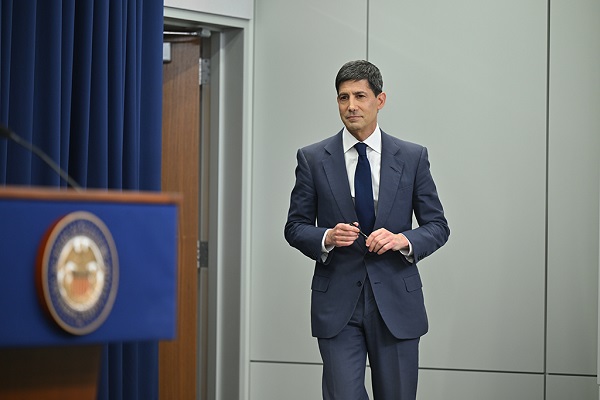
The Federal Reserve held interest rates steady on Wednesday but signalled a hawkish shift at its first policy meeting under Chair Kevin Warsh, with policymakers lifting their projected rate path, sharply marking up inflation forecasts, and dropping the kind of forward guidance that had framed recent policy statements.
The Federal Open Market Committee voted 12-0 to maintain the federal funds target range at 3.50-3.75%, saying the decision supported the Fed’s dual mandate and reaffirming its policy of maintaining ample reserves in the banking system.
The statement said economic activity is expanding at a solid pace despite elevated uncertainty linked partly to the conflict in the West Asia, while productivity growth and capital investment remain strong and job gains have kept pace with the workforce.
The Committee’s inflation language was firm. It said inflation remains elevated relative to the Fed’s 2% goal, in part because of supply shocks that have driven price increases in sectors including energy, and ended with a blunt pledge: “The Committee will deliver price stability.”
The bigger surprise came in the Fed’s quarterly projections. The June Summary of Economic Projections showed the median fed funds rate rising to 3.8% at end-2026, up from 3.4% in March, with medians of 3.6% in 2027, 3.4% in 2028 and 3.1% in the longer run. The new rate path effectively moved the Committee away from the earlier easing bias and toward the possibility of a quarter-point hike later this year.
The dot plot showed a divided but hawkishly tilted FOMC.
Nine of the 18 submitting participants projected a 2026 rate above the current midpoint, eight projected no change, and one projected a cut. The distribution included one dot at 4.375%, five at 4.125%, three at 3.875%, eight at 3.625% and one at 3.375%.
Warsh did not submit his own rate-path projection, leaving 18 submissions rather than the full 19-member set. Reuters reported that the omission was consistent with Warsh’s broader review of Fed communications and his scepticism toward the dot plot as a policy-signalling tool.
The macro forecasts gave the hawkish signal more force. Officials raised their 2026 median PCE inflation forecast to 3.6%, from 2.7% in March, and lifted the core PCE forecast to 3.3%, also from 2.7%. Core inflation was projected to remain above target through 2028, at 2.5% in 2027 and 2.1% in 2028.
The growth and labour projections did not show enough weakness to offset the inflation concern. The Fed cut its 2026 GDP growth median to 2.2%, from 2.4% in March, but lowered its unemployment-rate forecast to 4.3%, from 4.4%. That combination — weaker growth, stickier inflation and no meaningful labour-market deterioration — left the SEP looking more stagflationary than recessionary, and more hawkish than the unchanged rate decision alone suggested.
Taken together, the statement and projections marked a change in tone at the start of the Warsh era. The Fed did not raise rates, but it removed easing guidance, emphasised inflation credibility, allowed the dots to show meaningful hike risk, and left markets to infer that the next live debate may be patience versus tightening rather than patience versus cuts.
Markets treated the package as a hawkish surprise. Treasury yields jumped, and the dollar firmed, with the markets focused on the higher dots, the inflation revisions and the communications reset under Warsh.
More From BasisPoint